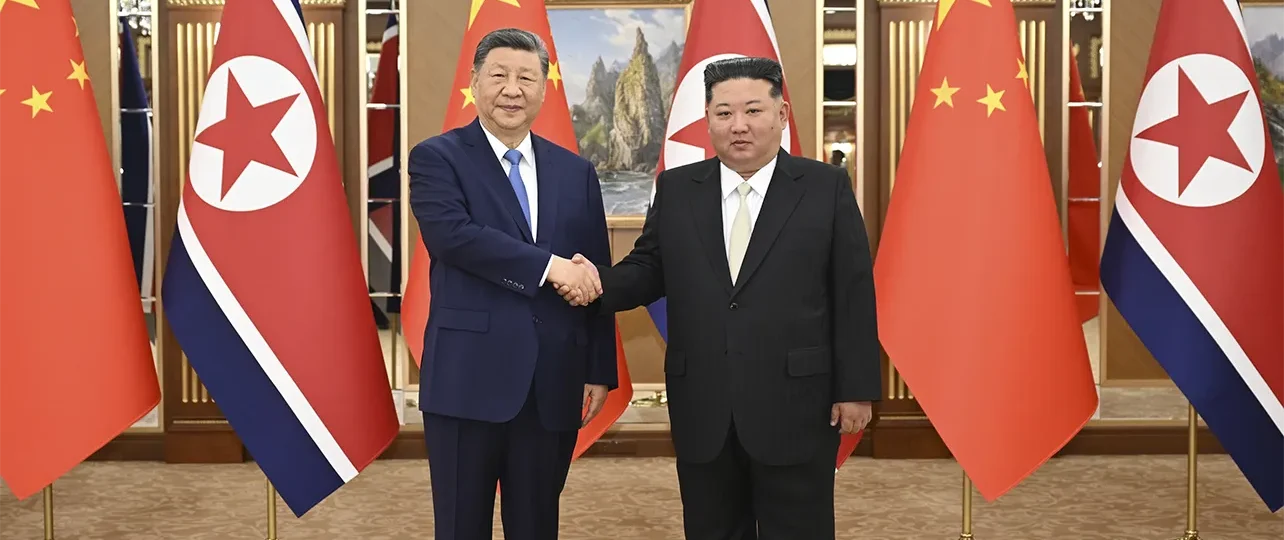

CHINA’S latest embrace of North Korea is less a reset than a calculated warning to the region: Beijing still wants to shape Pyongyang’s future, but it is no longer making denuclearisation the price of engagement. Xi Jinping’s rare visit to Kim Jong Un signals that China is prioritizing strategic control, border stability and geopolitical leverage over open confrontation with a nuclear-armed ally.
The optics matter. Xi’s pledge to deepen cooperation in trade, agriculture, technology and other areas reinforces a relationship built on practical interests, not ideology. But the more striking fact is what Beijing did not say: there was no public push on North Korea’s nuclear program, despite Kim’s continued expansion of his arsenal and his repeated insistence that the country’s nuclear status is non-negotiable.
That silence is politically loaded. It suggests China is adapting to a new reality in which pressure has limited value, North Korea is more confident than ever, and Russia’s support has given Kim more room to resist outside demands. For Beijing, the priority now appears to be preventing Pyongyang from slipping fully into Moscow’s orbit while keeping the peninsula stable enough to protect Chinese interests.
Kim, meanwhile, enters this moment stronger than at any point in years. He can use Xi’s visit as proof that North Korea is not isolated, even as it expands its weapons program and hardens its defiance. That gives him both propaganda value and diplomatic cover, especially if Beijing is willing to treat him as a partner without confronting the issue that most alarms the wider region.
The wider message is stark: the old strategy of isolating North Korea into surrender has failed, and China is now managing the consequences rather than trying to reverse them. For South Korea, Japan and the United States, that means a more complicated security landscape, one in which Beijing remains a central player but not a force for denuclearization.