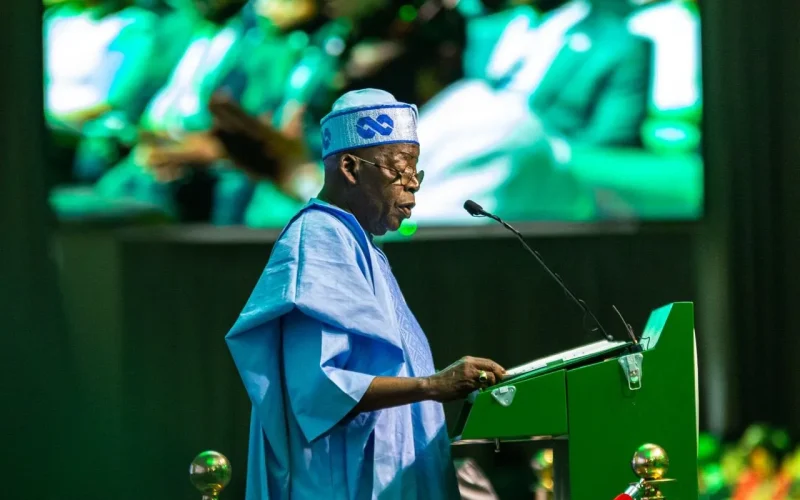
NIGERIA’s President Bola Ahmed Tinubu issued one of the most pointed security warnings of his administration, telling Nigeria’s armed criminal networks — from kidnappers and bandits to those who finance terror — that the time to surrender is running out.
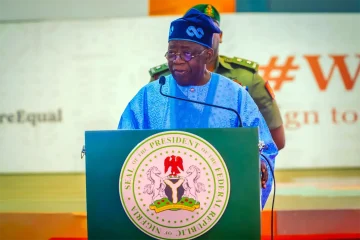
Speaking during the Democracy Day address at the Eagle Square in Abuja, where Nigeria marked 27 consecutive years of unbroken civilian rule, Tinubu delivered an unambiguous ultimatum that drew audible attention in the hall and will reverberate across conflict-affected communities from the North-West to the North-East.
“To bandits, kidnappers, and sponsors of terror: Surrender or face the full force of the Nigerian State. These windows of surrender will not remain open forever. No mercy will be shown to those who trade in the blood of Nigerians.”
The warning came at a moment of acute public anxiety. Tinubu acknowledged that the national mood on Democracy Day was “dampened” by the recent abduction of children in Oyo and Borno states, signalling that the administration is acutely aware of the political cost of persistent insecurity.
The President pointed to what he described as measurable progress in the military campaign against armed groups, citing an 81 percent decline in terror-related deaths since 2015 and the neutralisation of more than 13,000 fighters in the past year alone. In Arege, Borno State, he said, security forces had degraded a command centre belonging to the Islamic State West Africa Province (ISWAP).
At the same time, Tinubu defended the continued use of rehabilitation and reintegration as instruments of counterterrorism strategy. More than 124,000 fighters and their dependents have surrendered through Operation Safe Corridor since 2023, he said — a figure the administration presents as evidence that the carrot-and-stick approach is yielding results.
But Thursday’s address suggested the administration is preparing to tighten those terms. The president’s language — “no mercy” and “these windows will not remain open forever” — marks a rhetorical escalation from previous messaging, and security analysts are likely to read it as a signal that operational tempo against holdouts may intensify.
To back the threat with resources, Tinubu announced that the 2026 national budget commits N5.41 trillion to defence and security, described as the largest allocation in Nigeria’s history. He also cited a recent government declaration of a security emergency and the approval of recruitment drives for more than 50,000 new police officers and thousands of military conscripts.
The Democracy Day address is traditionally the highest-profile platform for presidential communication in Nigeria, and Tinubu’s security framing occupied a central portion of a wide-ranging speech that also touched on economic reforms, electricity policy, and local government autonomy.
The dual message — warning armed groups while reassuring citizens that the state is gaining the upper hand — reflects the political tightrope the administration walks as it attempts to demonstrate governance competence ahead of governorship elections in Ekiti and Osun states, which the president called on security agencies and the Independent National Electoral Commission (INEC) to ensure are peaceful and credible.
Nigeria has battled insurgency in its North-East since 2009, when Boko Haram launched its armed campaign. The conflict has since fractured into multiple armed factions, including ISWAP, while the North-West and North-Central regions have faced separate but overlapping waves of banditry, kidnapping, and communal violence. The cumulative humanitarian toll runs into millions of displaced persons and tens of thousands of deaths.
Thursday’s address offered no new specific timelines or operational details. But in the tradition of Nigerian security discourse, the president’s explicit invocation of state force — paired with the closure of surrender windows — is widely understood as a formal signal to military commanders and intelligence services that the gloves are coming off.