
IT WAS THEATRE. Carefully scripted, meticulously timed, and breathtakingly brazen — a political magic trick performed on a nation that had waited years for a national airline to call its own.
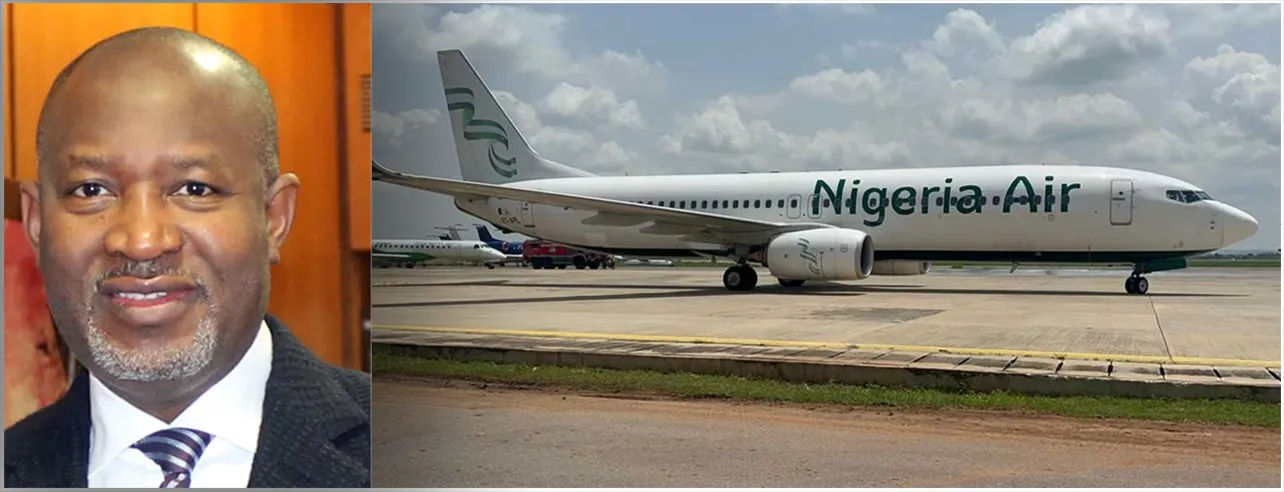
Courtroom testimony delivered in Abuja on Wednesday has laid bare what prosecutors describe as an extraordinary act of official deception: that the aircraft which rolled onto the tarmac of the Nnamdi Azikiwe International Airport on 27 May 2023 — painted in the proud colours of Nigeria Air — was never Nigerian at all. It belonged to Ethiopian Airlines. It had been chartered for three days. And the moment the cameras stopped clicking, it flew back to Addis Ababa.
“The aircraft will stay in ABV airport for static display of Nigeria Air livery until May 28, 2023. The chartered flight will be operated by the Ethiopian Airline crew in Ethiopian Airline uniform.”
Contract document, read in court
THE WITNESS SPEAKS
The revelation came from Christopher Odofin, an Economic and Financial Crimes Commission (EFCC) investigator testifying as the 12th prosecution witness (PW12) in the trial of former Minister of Aviation and Aerospace Development, Hadi Abubakar Sirika, before Justice S.C. Oriji of the Federal Capital Territory High Court, Abuja.
Odofin read directly from a contract agreement with Ethiopian Airlines that laid out the arrangement with clinical precision. The aircraft would depart Addis Ababa on the evening of 26 May 2023, to arrive in Abuja by early morning on the 27th. It would sit on the tarmac for “static display” of the Nigeria Air livery until the 28th. And on the morning of 29 May 2023 — the very day power transferred from President Muhammadu Buhari to his successor — it would quietly slip away back to Ethiopia.
What was supposed to look like the dawn of a new era in Nigerian aviation was, if the prosecution is to be believed, little more than a 72-hour photo opportunity — funded, allegedly, by public money.
“The Federal Government of Nigeria and Nigeria Air may put together local models who will be in Nigeria Air uniforms to pose for ceremonial pictures.”
Contract document tendered as evidence
MODELS, UNIFORMS AND A MANUFACTURED MOMENT
Among the most damning details read into the court record was a clause indicating that local models wearing Nigeria Air uniforms could be flown to Addis Ababa and brought back aboard the Ethiopian aircraft, specifically “to pose for ceremonial pictures.”
It was, in effect, a casting call for a fiction. The Buhari government had spent years promising Nigerians a revived national carrier. Here, allegedly, was the delivery: hired actors, borrowed livery, and a plane that would disappear before the ink dried on the new administration’s first executive orders.
The witness testified that the display was “deliberately planned to coincide with the end of the first defendant’s tenure as Nigeria’s Minister of Aviation and Aerospace Development on May 29, 2023” — and to pass the aircraft off as evidence that the promise of Nigeria Air had been fulfilled.
A DEAL SIGNED FIVE DAYS BEFORE HANDOVER
Investigators established that Ethiopian Airlines entered into the charter arrangement just five days before the Buhari government’s expiration — on 24 May 2023. The EFCC received confirmation directly from Ethiopian Airlines in a letter dated 12 June 2023, responding to the Commission’s formal request for information.
That letter confirmed what the tarmac display had concealed: that the agreement was for a short-term charter, explicitly for static display purposes, covering a window of not more than three days. The Nigeria Air logo was removed from the aircraft before it departed Abuja.
There was no airline. There were no routes. There were no passengers. There was only an illusion, allegedly constructed at public expense, to burnish a minister’s legacy in the dying hours of an administration.
THE CONTRACT TRAIL
The prosecution also surfaced fresh details about the financial trail behind Nigeria Air’s ill-fated creation. The contract to establish the carrier was awarded to Tianaero Nigeria Limited — a company owned by Gabriel Tilmann, described in court as a close associate and personal friend of the former minister.
An initial contract awarded on 4 April 2022 was valued at over ₦299 million. By 17 October 2022, that contract had been extended — allegedly on the personal instructions and directives of Sirika himself, based on his relationship with Tilmann’s company — to exceed ₦599 million.
Investigators recovered a voice note allegedly sent by Sirika from Spain, directing the permanent secretary to ensure the contract went to Tianaero Nigeria Limited.
According to testimony, investigators also recovered a voice note, now marked as Exhibit 37 and contained on a compact disc, which was allegedly sent by Sirika while he was in Spain. In the recording, he is said to have directed the permanent secretary to ensure that the contract was awarded to Tianaero. The prosecution has applied to play the recording in open court at the next hearing on 17 June 2026.
FOUR DEFENDANTS, SIX COUNTS
Sirika is before the court on an amended six-count charge brought by the EFCC, alleging abuse of office and misappropriation of public funds totalling over ₦2 billion. Standing trial alongside him are his daughter, Fatima Hadi Sirika; his son-in-law, Hamma Jalal Sule; and Al Buraq Global Investment Limited.
All documents tendered by the prosecution on Wednesday — duly signed, authorised, and accompanied by certificates of identification — were admitted without objection from any of the four defence teams. The absence of objection is legally significant: it removes a key avenue for later challenge.
The case has wound through a series of legal skirmishes, including a failed bid by the defence to have the prosecution discontinued and an earlier ruling by Justice Oriji that struck out confessional statements from two co-defendants on procedural grounds. Despite those setbacks, Wednesday’s hearing delivered what prosecutors clearly regard as a centrepiece of their case.
CONTEXT: A NATION’S AVIATION DREAM DEFERRED
Nigeria Air was one of the signature promises of the Buhari administration — a successor to Nigeria Airways, the once-proud carrier that collapsed in 2003 under the weight of mismanagement and debt. For eight years, successive announcements, unveiled liveries, and investment roadshows kept the dream alive in the public imagination.
The May 2023 tarmac display at Abuja’s Nnamdi Azikiwe International Airport generated enormous media coverage and was widely reported as the launch of the new carrier. Many Nigerians celebrated. The incoming Tinubu administration later confirmed that no airline had actually been established — there were no aircraft, no Air Operator Certificate, no operational infrastructure.
Wednesday’s testimony, if proven, provides the most detailed account yet of what prosecutors allege lay behind that celebrated “launch”: a charter agreement, a set of borrowed uniforms, and a borrowed plane, all arranged in the final days of a government counting its remaining hours in power.