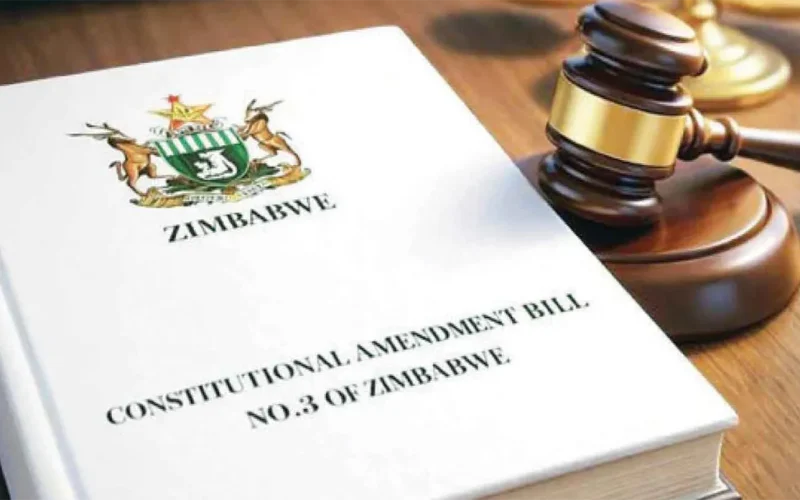
ZIMBABWE’S National Assembly has voted to shred the constitutional limits on President Emmerson Mnangagwa’s time in office, passing the Constitution of Zimbabwe Amendment (No. 3) Bill — known as CAB3 — by a margin that left no room for doubt about who controls parliament: ZANU-PF.
The result was emphatic. Two hundred and sixteen legislators voted in favour; only 42 voted against – comfortably clearing the two-thirds majority of 187 required under the constitution. Parliamentary Speaker Jacob Mudenda announced the figures to a chamber where police had tightened security ahead of the vote, a measure that itself spoke to the combustible atmosphere surrounding what observers call the most consequential constitutional amendment Zimbabwe has attempted since the adoption of the 2013 constitution.
The bill now moves to the Senate. Given ZANU-PF’s commanding influence over traditional leaders who populate the upper house, passage is widely considered a formality. Once enacted, CAB3 will extend presidential, parliamentary and local-authority terms from five years to seven, postponing the 2028 general elections to 2030 and keeping the 83-year-old Mnangagwa in office two years beyond the constitutional limit he once swore to honour.
There is more. Buried beneath the headline term extension is a provision that abolishes the direct popular election of the president — replacing universal suffrage at the executive level with a system in which parliament elects the head of state. Critics call it a second coup hiding inside the first.
A PRESIDENT WHO PROMISED TO BE A CONSTITUTIONALIST
The irony runs deep. At his 2018 inauguration, Mnangagwa described himself as a constitutionalist and pledged to serve no more than the two five-year terms permitted by the 2013 constitution — the document millions of Zimbabweans endorsed in a national referendum. Those commitments now read as a preface to their own negation.
CAB3’s path from idea to vote has been a study in how a dominant party can stage-manage a constitutional overhaul while gesturing at democratic process. The bill was gazetted on 16 February 2026, triggering a mandatory 90-day public consultation period. Public hearings opened on 30 March in venues critics said were deliberately undersized, with allegations that participants had been bused in to manufacture the appearance of popular support. A record 182 MPs ultimately participated in the National Assembly debate — more than the two previous constitutional amendment rounds combined — yet Justice Minister Ziyambi Ziyambi, who has fronted the bill throughout, was forced to concede ground on the Zimbabwe Gender Commission clause and provisions on traditional chiefs after cross-party resistance exposed those provisions as political liabilities.
The concessions were tactical, not principled. The core of the bill — the term extension and the abolition of direct presidential elections — remained intact and passed on Thursday without modification.
COURTS SWEPT ASIDE ON THE EVE OF THE VOTE
The last judicial firewall fell the day before the National Assembly voted. On Wednesday, a seven-member Constitutional Court bench led by Chief Justice Elizabeth Gwaunza unanimously struck off the roll a challenge brought by six liberation war veterans — among them Reuben Zulu, Godfrey Gurira and Shoorai Nyamangodo — who had sought to block Mnangagwa from advancing a bill they argued would directly benefit him in violation of constitutional conflict-of-interest provisions.
The Constitutional Court ruled the application fatally defective and declined to determine its merits. Constitutional law professor Lovemore Madhuku, who prepared the war veterans’ case, said the court found the constitutional obligations relied upon were insufficiently specific for it to exercise its original jurisdiction. The veterans’ legal team announced they would immediately refile in the High Court.
A separate challenge by former Binga North MP Prince Dubeko Sibanda, which sought to halt the parliamentary proceedings on the grounds that the provisions extending the terms of incumbents were constitutionally incompetent, was also dismissed as unripe for determination — meaning the court declined to act until the parliamentary process ran its course. That course completed on Thursday.
MDC leader Douglas Mwonzora, himself a constitutional lawyer, insisted that CAB3 remains challengeable even after parliamentary approval. He pointed to a prior Constitutional Court ruling that had required a referendum for any extension of a presidential term, arguing it would be difficult for the same court to now rule differently when the argument is placed squarely before it in a post-enactment challenge. “I am yet to see how else a Constitutional Court can rule if we present it with an argument that there are people who have been voting for president over the years,” Mwonzora said. “They have no interest in being in Parliament, but they are now being told that you can no longer vote for president. Has their right to vote not been affected?”
‘A SELF-SAVING PROGRAMME’
Opposition voices have been unsparing. Job Sikhala, chair of the National Democratic Working Group, characterised CAB3 as a mechanism designed to protect the loot and cover rights abuses — the language of a man who has watched Zimbabwean politics at close quarters for two decades. Jameson Timba, convener of the Defend the Constitution Platform, called the cabinet’s February endorsement politically destabilising and announced his coalition would engage legal counsel while appealing to the Southern African Development Community, the African Union and the United Nations to intervene.
Human Rights Watch documented an intensified crackdown against opponents of the bill through the first quarter of 2026. The Committee to Protect Journalists condemned harassment of media workers covering the public hearings in April, citing intimidation by ruling-party supporters. The Bulawayo pressure group Ibhetshu LikaZulu called on workers, students, churches, civil society and traditional leaders to resist the extension through every democratic means available.
Police tightened security around the Mount Hampden parliament buildings on the day of the vote — a detail that underlined how far removed Thursday’s proceedings were from the image of confident democratic renewal that ZANU-PF has tried to project under what it calls Zimbabwe’s Second Republic.
THE 2030 AGENDA AND THE CONTINENTAL PATTERN
CAB3 did not emerge from nowhere. ZANU-PF formally adopted what it calls the 2030 Agenda at its annual conference in Bulawayo in 2024, building a party architecture around Mnangagwa’s continued incumbency. Cabinet endorsed the draft bill in February 2026. The ruling was then presented as a governance modernisation measure — an attempt to reduce what the government termed election-related toxicity and create an enabling environment for development.
Constitutional scholars have not been persuaded. D. Tinashé Hofisi of the University of Virginia’s Karsh Institute of Democracy described CAB3’s cumulative effect as a fundamental reordering of the constitutional system, concentrating presidential authority while weakening mechanisms for popular accountability. He argued that the bill exemplifies executive consolidation through constitutional disruption — and that Mnangagwa may prove even more authoritarian than Robert Mugabe, under whose 33-year reign ZANU-PF originally consolidated its grip.
Zimbabwe’s manoeuvre is part of a continental pattern. Research shows that since 2020, term-limit evasion has been twice as frequent in sub-Saharan Africa as in any other region globally. Uganda, Rwanda, Cameroon, Guinea, Ivory Coast and Togo have all seen leaders amend their way to extended incumbency. What distinguishes the Zimbabwean case is the additional provision scrapping direct presidential elections — a step that goes beyond what most of its regional predecessors attempted.
GOVERNMENT DISMISSES FOREIGN CONCERN
Information ministry permanent secretary Nick Mangwana — recently reappointed to his position by Mnangagwa — has been the government’s most visible defender of CAB3, dismissing international criticism as interference in Zimbabwe’s sovereign affairs. When United States Congressman Gregory Meeks warned Mnangagwa against constitutional overreach in October 2025, Mangwana’s ministry responded that it is the will of Zimbabweans that shapes the nation’s future.
Critics have noted the circularity of that argument: the bill under debate would remove from ordinary Zimbabweans the most direct mechanism through which they could express that will — the direct vote for president.
WHAT COMES NEXT
The Senate is expected to ratify CAB3 before the end of June 2026. ZANU-PF holds significant influence there through appointed senators and traditional leaders who historically vote in line with the ruling party caucus. Analysts estimate the party needs no more than three Senate defections to be at risk — a scenario considered implausible given the patronage network that sustains the bill’s supporters.
Once enacted, Mnangagwa would sign the amendment into law and the 2028 election cycle would formally be deferred to 2030. Opposition and civil society organisations have indicated they will pursue post-enactment court challenges, with legal teams already preparing applications framed around voting rights rather than the procedural grounds on which earlier challenges faltered.
Whether Zimbabwe’s judiciary will provide a meaningful check at that stage remains the pivotal question. Thursday’s Constitutional Court ruling, declining to adjudicate on the merits of the war veterans’ challenge the day before the National Assembly vote, did not inspire confidence in those who believe the courts represent the country’s last democratic safeguard.
Zimbabwe has been ruled by ZANU-PF since independence in 1980 — 45 years during which the party has steadily tightened its grip on every institution of state. With CAB3, the ruling party has moved to place the succession question beyond the reach of the electorate for at least another four years. The question that remains open is whether the courts, civil society, the regional body SADC, or the international community can do what the opposition could not: stop it.