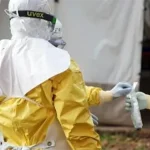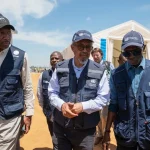
THE accelerating spread of the Bundibugyo Ebola virus in eastern Democratic Republic of the Congo is now a direct threat to more than 2 million forcibly displaced people, UNHCR warns, with the risk of cross-border transmission mounting across an interconnected region where fighting continues alongside the outbreak.
“UNHCR is deeply concerned by the accelerating spread of Bundibugyo Ebola virus disease in the eastern Democratic Republic of the Congo and the growing risks it poses to displaced communities across the region,” said Dr. Allen Maina, UNHCR’s Head of Public Health, at a press briefing today at Geneva’s Palais des Nations. “For refugees and internally displaced people already facing trauma and insecurity and a lack of adequate humanitarian assistance, the outbreak is fueling fear and misinformation, eroding trust in response teams and delaying access to life‑saving care.”
As of 17 June, the DRC had reported 896 confirmed Ebola cases and 232 deaths across 31 health zones. Uganda confirmed 19 cases and two deaths; none were refugees, yet Dr. Maina stressed that the danger for displaced populations remains severe. “More than 2 million forcibly displaced people, including over 320,000 refugees, live in areas at risk in the DRC, where fighting continues alongside the spread of Ebola disease,” he said. “Fears are growing about population movements into and out of affected areas, and their potential impact on transmission, reinforcing the need to align public health with protection interventions.”
The crisis is already triggering dangerous flashpoints. On 7 June, around 2,250 people fled Mbau, near Beni – one of the outbreak’s epicentres – after armed-group movements sparked panic, arriving in Oicha, North Kivu, an Ebola-affected zone already hosting more than 14,300 displaced people. Days earlier, distrust over Ebola deaths at the Kpangba site in Ituri Province led some internally displaced people to temporarily block response teams from accessing the site.
“This distrust can directly hinder life‑saving interventions,” Dr. Maina said. “As the outbreak continues to expand in areas where conflict and disease intersect, working with community leaders is critical to building trust, countering misinformation and ensuring that public health measures are aligned with population movements.”
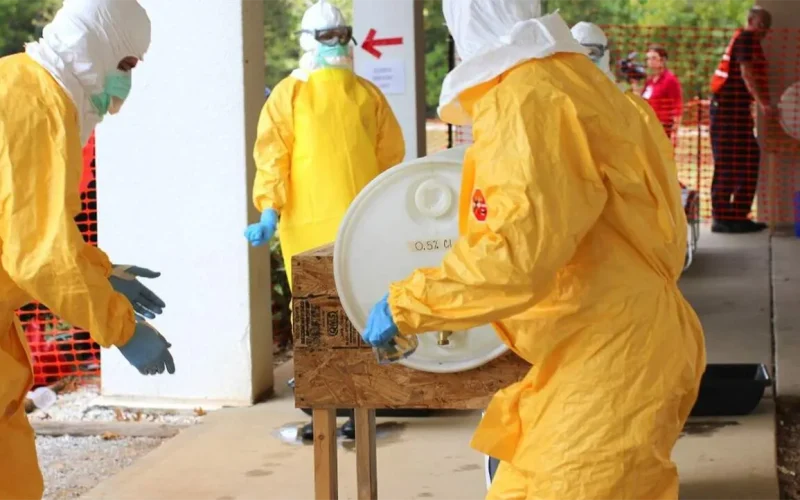
UNHCR is backing government-led response plans in high-risk areas like Bunia, having trained more than 100 community leaders on Ebola prevention in the past week so they can relay messages in local languages. In Ituri, along the South Sudan border, trained refugees are installing chlorinated handwashing stations in refugee-hosting villages.
“The risk is regional,” Dr. Maina emphasized. “Eastern DRC sits in an interconnected region where trade, family ties and refugee movements link Uganda, Rwanda, Burundi, Tanzania and South Sudan. UNHCR is reinforcing preparedness in those countries… to strengthen surveillance, screening, infection prevention, communication and water, sanitation and hygiene support in refugee‑hosting areas and border corridors.”
He warned that border closures are counterproductive. “UNHCR believes that border closures are ineffective at preventing the spread of the epidemic, as they can drive people towards unofficial crossing points, where health screening and surveillance are more difficult,” he said. “Public health measures should preserve access to asylum for people in need of international protection, with appropriate screening, triage, isolation and referral systems.”
UNHCR is seeking $14 million for Ebola preparedness and response from July to November to support displaced people and host communities in the DRC and Uganda, and to bolster preparedness in Burundi, Rwanda and South Sudan.
“Given the rapid increase in cases, the response must scale up accordingly and remain firmly anchored in national leadership,” Dr. Maina said. “It must not come at the expense of other essential services like primary health care, gender-based violence services and education.”