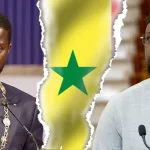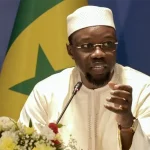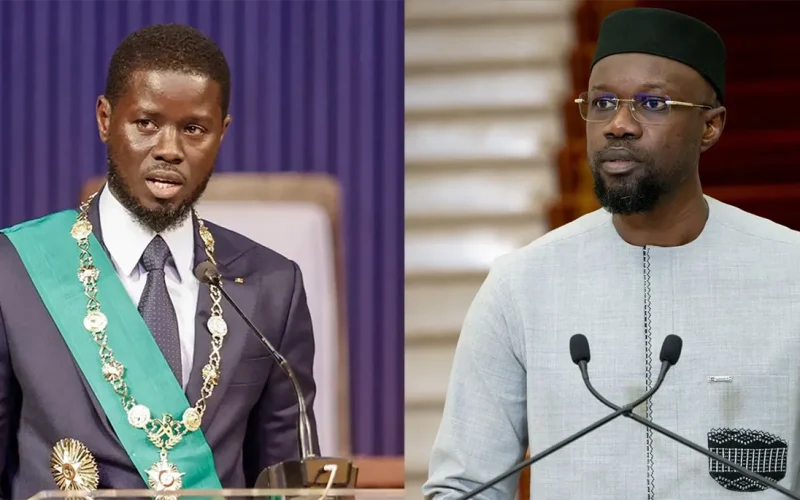
Senegal’s political honeymoon is over, and what replaces it will be remembered as one of the most consequential power struggles in the country’s history. On Monday, the National Assembly — an institution now thoroughly remade in the image of Ousmane Sonko, its newly installed Speaker — passed sweeping constitutional reforms that strip the presidency of authority and hand it, piece by piece, to parliament and the office of the prime minister. President Bassirou Diomaye Faye’s response was immediate and unambiguous: he would not simply accept the law. He would put it to the people in a referendum.
It is a small thing to describe and an enormous thing to understand. Beneath the procedural language of constitutional courts, parliamentary inquiry powers and dissolution rules lies a much older and more brutal story: two men who once stood shoulder to shoulder against an entrenched political establishment are now locked in a fight neither can afford to lose, and only one is likely to walk away with the presidency intact.
The Move on the Board
The bill adopted on Monday is no minor tinkering with the machinery of state. It requires the executive to keep parliament informed of agreements over the exploitation of natural resources, expands the powers of parliamentary inquiry committees, and replaces the existing Constitutional Council with a new nine-member Constitutional Court. It bars a sitting head of state from simultaneously leading a political party, restricts what an outgoing executive can do in the gap between an election and the official proclamation of results, and tightens the rules under which a president may dissolve the National Assembly altogether.
Each provision, read in isolation, can be defended on the grounds of institutional balance. Read together, the message is unmistakable: this is a law designed to ensure that whoever next sits in the presidential palace at Avenue Léopold Sédar Senghor does so with substantially less room to manoeuvre than Faye currently enjoys — and substantially less room than Sonko himself will tolerate being denied, should the chess match now under way end the way many in Dakar already expect it to.
Pastef, Sonko’s party, controls 130 of the Assembly’s 165 seats — a margin so commanding that the opposition’s boycott of the vote was symbolic rather than consequential. The bill passed by the qualified majority Sonko needed, and he wasted no time framing the outcome as final. “I will ask the president of the republic to promulgate this law, plain and simple,” he told the chamber, arguing that under existing constitutional precedent, a text adopted by three-fifths of deputies present requires no further validation. It was a direct challenge to Faye’s authority to do anything but sign.
Faye’s Countermove
Faye did not blink, but neither did he concede the legal argument. Through his justice minister, Moussa Sarr, the presidency announced it would bypass simple promulgation altogether and instead submit the law to a national referendum — a manoeuvre that, if it holds up to constitutional scrutiny, returns the question to the electorate rather than leaving it settled by a parliamentary vote Sonko’s party was always going to win comfortably.
It is, in its own way, as bold a move as the bill itself. A referendum allows Faye to reframe a parliamentary defeat as an unresolved national question, to appeal over the head of an Assembly he no longer controls directly to a public that elected him president in his own right in 2024. It buys time. It creates a new battlefield — one fought in town halls and on campaign platforms rather than in committee rooms where Pastef’s numbers are simply too large to contest. And it forces Sonko to do something he has so far been able to avoid: campaign against the constitutional architecture of restraint that his own movement built its legitimacy upon.
Whether Faye actually possesses the constitutional authority to substitute a referendum for promulgation is now itself a live dispute, and one that will likely end up before the very judicial bodies the new law proposes to restructure. Presidential coalition figure Aminata Touré put the underlying grievance plainly: parliament, she said, was “being used to weaken the president,” with the reforms aimed squarely at concentrating power in the hands of the Assembly’s leadership — which is to say, in Sonko’s hands.
A Partnership Built to Break
To understand why this fight is happening now, and why it is unlikely to end with a single referendum, one has to return to the peculiar arithmetic of the Faye-Sonko alliance. Sonko was the movement’s heart and its most formidable campaigner, generating a following among Senegal’s disaffected youth that no other politician in the country could match. But a defamation conviction barred him from standing in the 2024 presidential election himself, forcing Pastef to run his then little-known lieutenant, Faye, in his place. Faye won outright. Sonko became prime minister days later. The arrangement was always a fiction of equals: Faye held the formal power of the presidency, including the constitutional right to dismiss his prime minister by simple decree, while Sonko held the movement’s soul and its parliamentary muscle.
That fiction collapsed in May, when Faye sacked Sonko and dissolved the government after months of mounting tension, much of it rooted in a genuine policy disagreement over how to manage Senegal’s punishing public debt, which stands at roughly 132 percent of GDP. Faye has favoured re-engagement with the IMF; Sonko has pushed a more sovereigntist, domestically financed path, consistent with the anti-establishment economic nationalism that built Pastef’s base in the first place.
Sonko’s response to being fired was not retreat but escalation. Within days, he was reinstated to the Assembly and elected Speaker, a manoeuvre the opposition denounced as an “institutional coup” but which gave him exactly the platform he needed: control of the one institution capable of legislating around presidential authority rather than through it. Monday’s constitutional reform is the first major exercise of that platform, and it will not be the last.
The Game Ahead
What is unfolding in Dakar should be read by the rest of the continent as a case study in how power struggles play out inside young democracies whose institutions are simultaneously strong enough to be fought over and weak enough not to constrain the fight decisively. Neither Faye nor Sonko commands an outright knockout blow. Faye retains the formal powers of the presidency and, for now, the authority to call elections, dismiss governments and resist promulgation. Sonko retains a parliamentary supermajority, the loyalty of Pastef’s grassroots base, and the moral authority of having built the movement that put Faye in office in the first place.
The referendum, whenever it is held, will be the next real test of whose mandate carries more weight with ordinary Senegalese: the president’s, won at the ballot box in 2024, or the parliamentary majority’s, built on Sonko’s enduring popularity with the same electorate. A defeat for Faye at the referendum would be a body blow from which his presidency may not recover politically, even if he remains formally in office. A defeat for Sonko would blunt, but not end, his evident ambition to occupy the presidency itself at the earliest constitutional opportunity.
It is that ambition — widely assumed in Dakar’s political class, though never stated by Sonko in such blunt terms — that gives this contest its true stakes. Many analysts now expect this struggle to terminate, eventually, in Sonko’s own ascent to the presidency, whether through a future election once any disqualifications are resolved, through a negotiated transition, or through the kind of institutional erosion of Faye’s authority that Monday’s vote represents the opening chapter of. If that scenario plays out, it will mark a sensational and faintly tragic conclusion to a partnership that, barely two years ago, promised to remake Senegalese politics — a partnership that instead appears destined to be sacrificed at the altar of one man’s pursuit of the office that a criminal conviction once denied him.
For now, both men are playing for position rather than checkmate. But the opening move has been made, and it was Sonko who made it. The referendum is Faye’s answer. Neither man has shown any sign of being willing to lose.