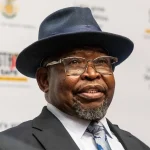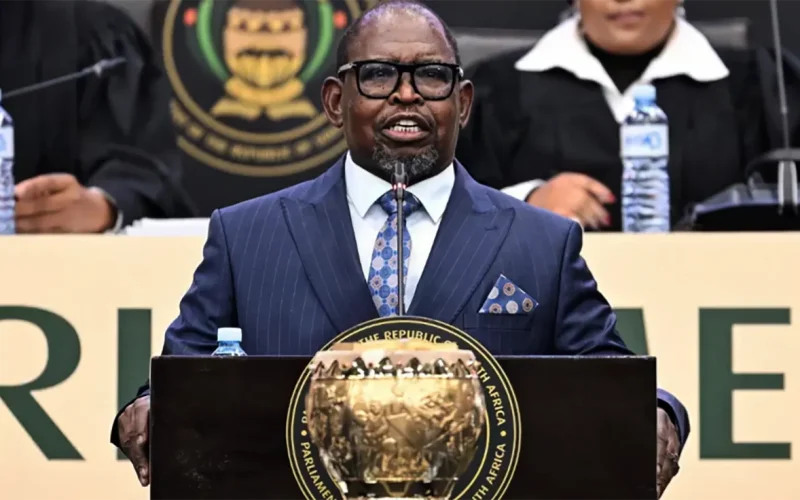
SOUTH Africa’s Finance Minister Enoch Godongwana tabled the country’s 2026 Budget before a packed National Assembly on Wednesday, declaring that the country has reached “an important turning point in the management of our public finances.” In a speech that balanced fiscal discipline with targeted relief, Godongwana announced significant new spending on peace and security, scrapped a proposed VAT increase, provided inflation-linked tax relief to households, and gave pensioners a small but welcome grant top-up.
R2 Billion for the Fight Against Crime
In one of the most eye-catching commitments of the Budget, the Minister allocated R2 billion specifically toward fighting organised crime, drawing directly on the Criminal Asset Recovery Account (CARA) fund.
Referencing President Ramaphosa’s State of the Nation Address, Godongwana said the defence force would stand alongside the police to tackle illegal mining and gangsterism. He told Parliament:
“We have allocated R1 billion to the police service, and another R1 billion to the SANDF, through the CARA fund for the fight against organised crime.”
This forms part of a broader peace and security package. Total spending on peace and security increases from R268.2 billion in 2025/26 to R291.2 billion by 2028/29. The Border Management Authority receives an additional R990 million over the medium term to fill 738 new positions, while R2.7 billion is added to defence to maintain the South African Air Force’s fighter capability.
The judiciary also received attention, with R687 million allocated to increase court capacity and an additional R883.8 million shifted to the Office of the Chief Justice to strengthen its independence from the Executive from 1 April.
Tax Bracket Relief: A Break for Hard-Pressed Households
In welcome news for millions of South African workers, the Minister confirmed that personal income tax brackets and rebates will be adjusted fully in line with inflation — effectively preventing bracket creep from eroding real take-home pay.
This follows the government’s decision to withdraw a proposed R20 billion tax increase that had been provisionally included in the May 2025 Budget. The Minister explained:
“The improving fiscal position allows us enough room to withdraw the proposed tax increases, without putting fiscal sustainability or economic activity at risk.”
Godongwana also announced two savings incentives aimed at building a culture of long-term financial security:
• The tax-free annual investment limit for Tax-Free Savings Accounts increases from R36 000 to R46 000 per year.
• The limit on retirement fund deductions rises from R350 000 to R430 000, enabling South Africans to shelter more income from tax each year.
Small business owners also received targeted relief. The VAT registration threshold doubles from R1 million to R2.3 million — a measure the Minister directly attributed to public submissions, quoting Gauteng entrepreneur Renette Oosthuizen, who had written in to call for exactly this change. The capital gains tax exemption on the sale of a small business for older persons rises from R1.8 million to R2.7 million, now applicable to businesses valued up to R15 million.
No VAT Increase — But Sin Taxes Rise
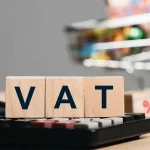
In what will be widely welcomed by consumers already under cost-of-living pressure, the 2026 Budget contains no increase in Value Added Tax. The standard VAT rate remains unchanged.
However, the Minister made clear that taxes on tobacco, alcohol and fuel would rise in line with inflation. Godongwana was direct:
“Increases to certain taxes are unavoidable.”
For smokers and drinkers, the increases are as follows:
• A 20-pack of cigarettes rises from R22.81 to R23.58.
• A 340ml can of beer or cider increases by 8 cents.
• A 750ml bottle of wine goes up by 15 cents.
• A 750ml bottle of spirits will increase by R3.20.
Fuel levies also increase, with the general fuel levy rising by 9 cents per litre for petrol and 8 cents for diesel, and the Road Accident Fund levy going up by 7 cents per litre.
A Little More for Pensioners and Grant Recipients
South Africa’s 26.5 million social grant recipients will see modest increases from April 2026. The Minister announced:
“The old age grant, disability grant and care dependency grant rise by R80 in April 2026, to R2 400.”
The war veterans grant also increases by R80 to R2 420. The foster care grant rises by R40 to R1 290 in April, with a further R10 increase in October. The child support grant and grant-in-aid grant go up from R20 to R580.
Total spending on social grants for 2026/27 reaches R292.8 billion. The Social Relief of Distress grant continues in its current form for the year ahead.
The Bigger Picture: Debt Stabilised, Credibility Restored
Underpinning the entire Budget is a message of hard-won fiscal stability. For the first time in 17 years, South Africa’s gross debt stabilises as a share of GDP — at 78.9 per cent in 2025/26 — before falling to 77.3 per cent in 2026/27 and 76.5 per cent by 2028/29.
Total government spending in 2026/27 amounts to R2.67 trillion, with the social wage — comprising education, health and social protection — accounting for more than 60 per cent of non-interest spending.
Closing his address, Godongwana struck a tone of cautious optimism:
“A budget and a fiscal strategy that advances inclusive growth and the sustainability of public finances is a crucial part of achieving this greater freedom. It moves us closer to fulfilling our constitutional promise to do all that it takes for our people to live with dignity and prosperity.”