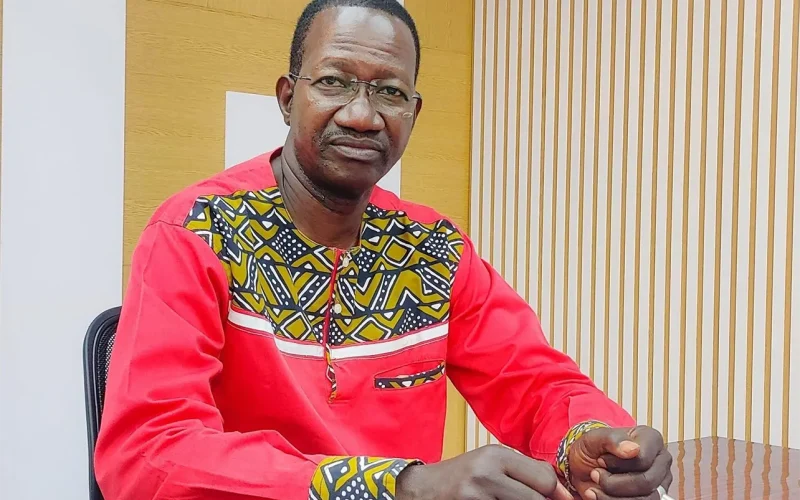
THE February 5 arrest of prominent Malian journalist Youssouf Sissoko marks the latest escalation in a systematic assault on press freedom across the Sahel, where military juntas are weaponising vaguely worded legislation to criminalise independent reporting and crush dissent.
Police detained Sissoko, editor-in-chief of the weekly newspaper L’Alternance, at his Bamako residence following publication of an article that scrutinised statements by Niger’s military ruler, Gen. Abdourahamane Tiani. The piece challenged Tiani’s unsubstantiated allegations – made after a late-January Islamic State attack on Niamey’s international airport – that France, Côte d’Ivoire, and Benin were complicit in the assault.
Charged with spreading false information and insulting a foreign head of state under Mali’s 2019 cybercrime law, Sissoko now faces up to 10 years imprisonment. He remains in pretrial detention at Bamako’s central prison, with trial scheduled for March 9 before a specialised anti-cybercrime tribunal. The charges exemplify how broadly written statutes – ostensibly designed for national security – have become instruments of political repression.
The Architecture of Repression
Mali’s cybercrime law has drawn sustained criticism for its deliberate ambiguity. Articles 20 and 21 criminalise digital “threats” and “insults” without defining these terms, granting authorities sweeping discretionary power to prosecute journalists, activists, and ordinary citizens. This legislative vagueness is not accidental – it is a feature that enables arbitrary enforcement against regime critics while maintaining a veneer of legality.
Since seizing power in a 2021 coup, Mali’s junta has systematically dismantled the country’s democratic infrastructure. The regime has suspended media outlets, dissolved civil society organisations, abolished multiparty politics, and pursued criminal prosecutions against critics. In January, the Ministry of Territorial Administration banned the circulation of Jeune Afrique, one of Africa’s most influential news outlets, further constricting the information environment.
The Malian Association of Private Print Media Publishers condemned Sissoko’s arrest on February 5, with Reporters Without Borders issuing a release demanding the following day. Yet international pressure has proven ineffective against juntas increasingly insulated from external accountability.
Regional Pattern of Press Suppression
Sissoko’s detention is not an isolated incident but part of a broader regional trend. Across the Sahel, military governments that came to power through coups – Mali in 2021, Burkina Faso in 2022, and Niger in 2023 – have adopted strikingly similar strategies to silence independent journalism and control information flows.
In Burkina Faso, the junta has suspended multiple international media organisations and detained journalists covering security deterioration and civilian casualties. Niger’s military rulers have similarly restricted press access and prosecuted reporters who question official narratives. The three nations formalised their alignment in September 2023 by establishing the Alliance of Sahel States, coordinating not only security operations but also information control strategies.
This coordinated repression reflects a shared authoritarian playbook: exploiting public frustration with security crises and governance failures to justify emergency measures, then entrenching power by eliminating accountability mechanisms. Independent journalism – which documents military failures, civilian suffering, and government corruption—represents an existential threat to these regimes’ carefully constructed narratives of nationalist salvation.
Shrinking Civic Space, Escalating Consequences
The collapse of media freedom is both a symptom and an accelerant of broader democratic backsliding across the Sahel. When journalists cannot report without fear of imprisonment, civilians cannot access information necessary to make informed decisions, hold authorities accountable, or participate meaningfully in civic life.
The stakes extend beyond press freedom. In conflict zones where armed groups operate, where humanitarian crises unfold, and where allegations of military abuses emerge, independent journalism serves as an essential witness. Its suppression creates information vacuums that enable atrocities to proceed unchecked and populations to suffer unseen.
Mali’s junta must immediately and unconditionally release Youssouf Sissoko and drop all charges. Regional bodies, including the Economic Community of West African States and the African Union, must move beyond rhetorical condemnation to impose meaningful consequences on regimes that systematically violate fundamental freedoms.
The international community cannot treat the Sahel’s media crackdown as a peripheral concern. Press freedom is not a luxury of stable democracies—it is a frontline defence against authoritarianism, a mechanism for documenting abuse, and a prerequisite for any eventual democratic restoration. Its systematic destruction across Mali, Burkina Faso, and Niger demands an urgent, coordinated response before the region’s information environment descends into complete darkness.