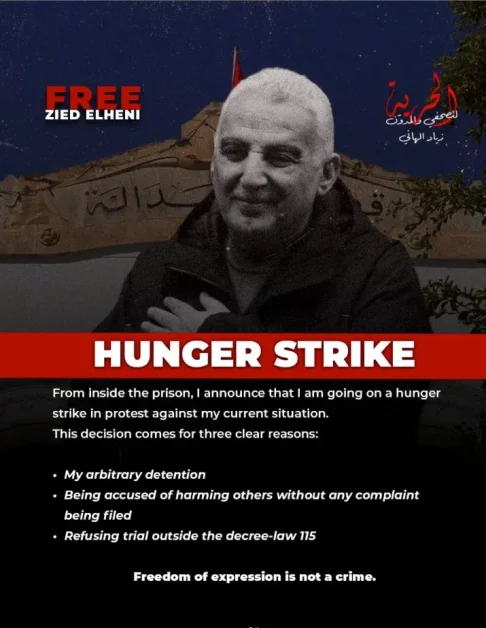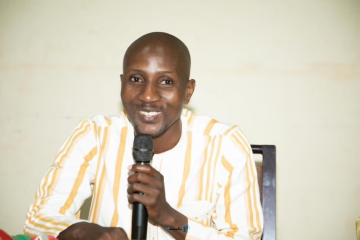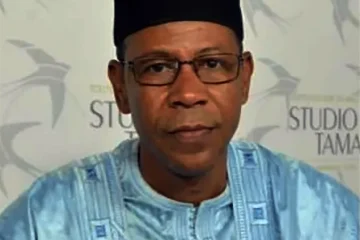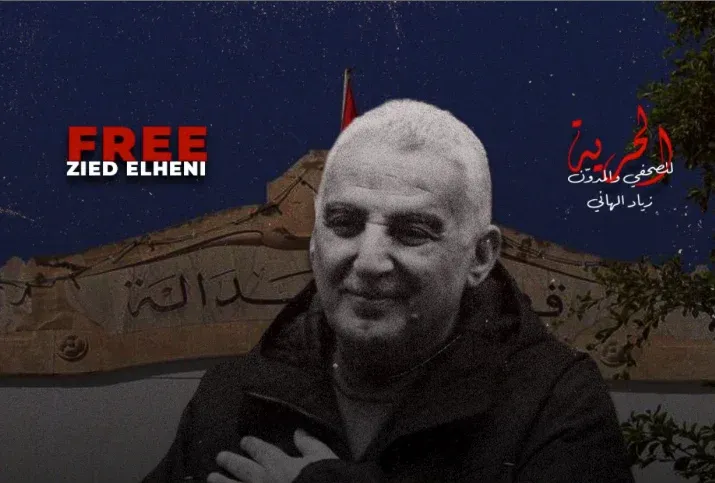
| “I went on a hunger strike from inside prison in protest against arbitrary detention, defamation without any formal complaint, and an unfair trial outside the protections of Decree 115.” — Zied El Heni, from prison |
Those are not the words of a broken man. They are the words of a journalist who has been locked in a cell in Tunis for five days – and who refuses, with every fibre of his being, to pretend that what is happening to him is just.
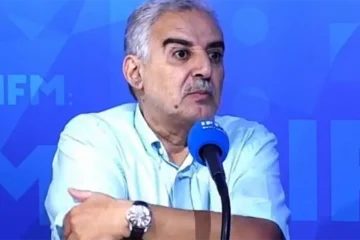
Zied El Heni — editor-in-chief of the independent outlet Tunisian Press, broadcaster, one of the most celebrated voices in North African journalism — was arrested on 24 April 2026 after responding to a summons from the Fifth Central Unit for Combating Information and Communication Technology Crime in the capital. What should have been a routine appearance became a detention. The charge: a Facebook post in which he criticised a judicial decision. Two days later, on 26 April, he began a hunger strike. As The African Mirror goes to press, he is on day five.
He has chosen not to be silent about why. From inside his cell, El Heni issued a clear and unambiguous statement of conscience – a declaration that names what is being done to him: arbitrary detention, defamation without formal complaint, and a trial conducted outside the protections that Tunisian law is supposed to guarantee journalists. He is not confused about his situation. He is not intimidated by it. He is fighting it.
A Family United in Resistance
| “We do not wish to be painted as worried or thinking about his health. We are proud of him, of what he is doing — we root for him and will continue the battle he has been fighting.” — Ithar El Heni, daughter |
The family of Zied El Heni has been equally forthright. Through his daughter Ithar, the El Heni family issued a message that stands in deliberate contrast to the image of a suffering household awaiting rescue. They want no part of that narrative.
“As a family, we would only like to deliver a message of support and resistance,” Ithar said. “We do not wish to be painted as worried or thinking about his health or anything — we are proud of him, of what he is doing, we root for him and will continue the battle he has been fighting. We believe in his right to freedom of speech, that he shouldn’t be in jail for speaking truth and for speaking about the injustice his colleague faced. Opinions shouldn’t be discussed in trial courts.”
That final line – opinions shouldn’t be discussed in trial courts – is not merely a personal view. It is a legal principle, a constitutional value, and a statement that Tunisia’s own Decree-Law 115 is meant to enshrine. The El Heni family are not waiting for their patriarch to be released on compassionate grounds. They are demanding justice, and they are doing it on his terms.
A Post. A Prosecution. A Precedent.
The charge against El Heni is rooted in a Facebook post in which he criticised a judicial decision – specifically, the sentencing of fellow journalist Ghassen Ben Khelifa to two years in prison in March 2026. For that act of professional solidarity and public commentary, El Heni is being investigated under Article 86 of Tunisia’s telecommunications code, a provision that carries a maximum penalty of two years in prison.
Press freedom advocates have repeatedly warned that Article 86 is dangerously elastic – a blunt instrument capable of catching almost any online expression in its wide net. By routing a journalism case through a cybercrime unit rather than through press law, Tunisian authorities are, critics say, deliberately circumventing Decree-Law 115, the legal instrument that guarantees journalists the right to be prosecuted only under the press code – not ordinary criminal statutes.
| “Detaining Zied El-Heni over a social media post critical of a judicial decision is a clear example of how Tunisian authorities are weaponising the law to silence journalists.” — Carlos Martínez de la Serna, CPJ Programme Director |
The Committee to Protect Journalists (CPJ) has been unequivocal. “Detaining Zied El-Heni over a social media post critical of a judicial decision is a clear example of how Tunisian authorities are weaponising the law to silence journalists,” said CPJ Programme Director Carlos Martínez de la Serna. “Authorities must immediately release El-Heni and stop using vague legal provisions to target the press.”
His trial, according to sources who spoke to the CPJ on condition of anonymity citing fear of reprisal, is scheduled to begin on 30 April – giving authorities barely a week between arrest and dock. His lawyers argue that the speed of the process is itself a statement: justice hurried is justice buried.
Africa Speaks — TAEF Demands His Release
The African Editors’ Forum (TAEF), the continent’s premier organisation for editors and media executives, has issued a direct and unambiguous call: release Zied El Heni immediately.
In a statement signed by TAEF President Churchill Otieno, the Forum condemned the application of the Cybercrime and Communication Technology Crimes framework against a journalist for a social media post as “a dangerous precedent for press freedom” not just in Tunisia, but across the African continent and its neighbouring regions.
TAEF called upon the full breadth of Africa’s media landscape – editors, reporters, broadcasters, publishers – as well as international human rights organisations, to stand in unified defence of El Heni. “TAEF urges the Tunisian authorities to respect the principles of free speech and the protections afforded to journalists,” Otieno’s statement read. “They must release Zied immediately.”
| “Repression has come to affect everyone. Journalism has become a crime, civil society work has become a crime, political opposition has been criminalised.” — Mohamed Yassine Jlassi, former SNJT President |
The Broader Pattern: Tunisia’s Shrinking Sky
El Heni’s arrest does not exist in a vacuum. It is the latest crescent in a darkening moon over Tunisian press freedom – a sky that was once, briefly and brilliantly, among the most open in the Arab world.
The 2011 uprising that dismantled the regime of Zine El Abidine Ben Ali gave birth to a rare and precious thing: a Tunisian press that breathed freely. For nearly a decade, journalists tested the limits of a new democracy and found them wide. Tunisia became the Arab Spring’s only apparent democratic success story – until, in July 2021, President Kais Saied dissolved the elected parliament and consolidated power by decree.
Since that moment, observers have watched the space for independent voices contract. Journalist Sonia Dahmani was sentenced to 18 months in prison in April 2026. Ghassen Ben Khelifa received two years. The Tunisian Human Rights League (LTDH), one of Africa’s oldest civil society organisations, has been suspended. The investigative outlet Inkyfada faces a court hearing on 11 May. The association that publishes it — Al Khatt — faces potential dissolution.
Mohamed Yassine Jlassi, a former president of the Tunisian journalists’ union SNJT, captured the atmosphere plainly during a protest in Tunis last week. “Repression has come to affect everyone,” he said. “Journalism has become a crime, civil society work has become a crime, political opposition has been criminalised. People now increasingly find themselves facing arbitrary prosecutions without the bare minimum guarantees of a fair trial.”
The national journalists’ union itself described El Heni’s detention as “arbitrary” — and warned that it represents “another step aimed at intimidating journalists.”
The Man Behind the Microphone
Zied El Heni did not arrive at this moment by accident. For years, he has been a fixture of Tunisian public life – on radio, on social media, in print – a journalist who understood that the purpose of a free press is not to celebrate power but to interrogate it. He has faced prosecution before, on charges that revolved around notions of “offending officials” and “insulting” the state. Each time, the charges reflected less about his conduct and more about the government’s tolerance for critique.
His willingness to stage a hunger strike — to place his own body on the line — says everything about the depth of his conviction. This is not a man performing dissent. This is a man who has made a life’s work of truth-telling and who now finds himself in a cell for the act of publishing an opinion.
As day five of his hunger strike began, his family’s message rang clear across the continent: they are not waiting. They are fighting. And they are proud.
- The Mirror’s Position
The African Mirror stands unreservedly with Zied El Heni and every journalist across this continent who faces imprisonment, harassment, or intimidation for doing their job. The criminalisation of a Facebook post is not a legal matter. It is a political act – and it demands a political response from every editor, every reporter, and every reader who believes that the press must remain free.
Tunisia’s authorities have a trial date set. The world has its own verdict already forming. The question is not whether Zied El Heni’s post crossed a legal line. The question is whether Tunisia still believes in the lines it drew for itself in 2011 – and whether, if those lines are gone, anyone in power will say so plainly.
Until he is released, The African Mirror will continue to report. Until he is free, his hunger strike is our hunger strike. And until Tunisia’s press is free, Africa’s press is not fully free.