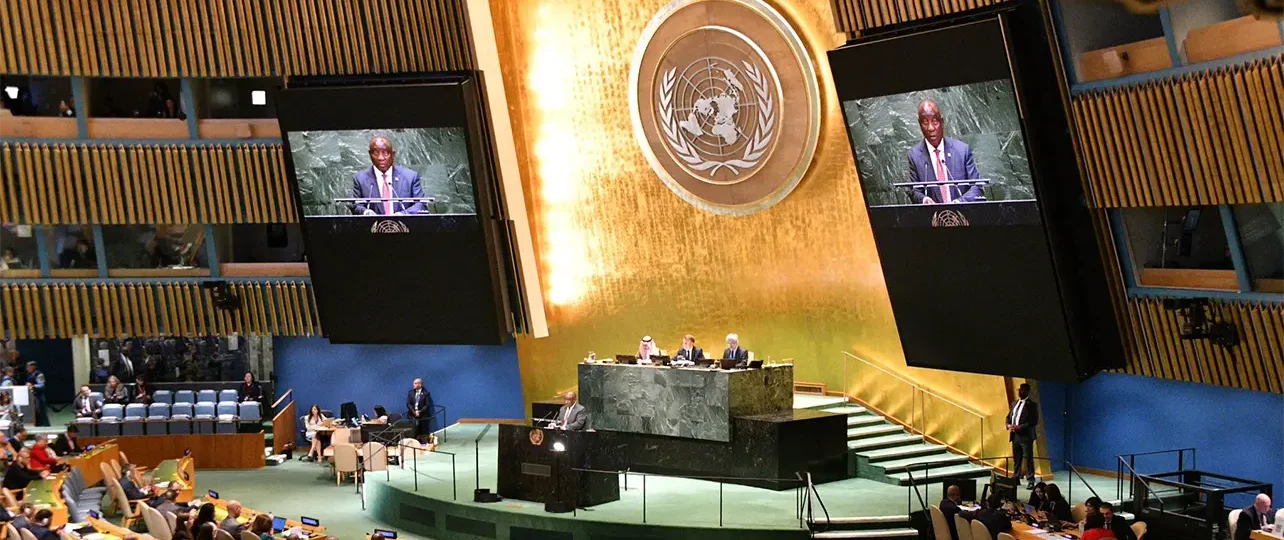

AFRICAN leaders took centre stage at the United Nations General Assembly on Monday as South African President Cyril Ramaphosa and Senegalese President Bassirou Diomaye Faye joined 14 other heads of state in delivering forceful calls for Palestinian statehood while condemning what they termed Israeli atrocities in Gaza, as the enclave faces its first confirmed famine.
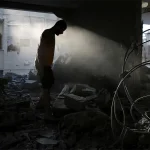
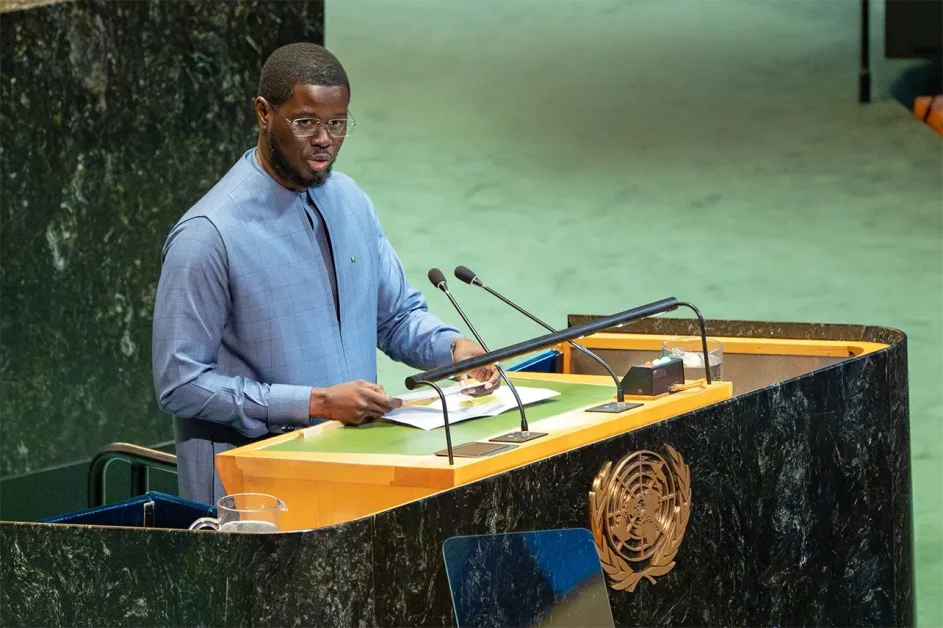
Senegalese President Faye delivered one of the most pointed addresses, describing the situation in Gaza as “a tragedy that resembles ethnic cleansing” and challenging the international community’s response. “We are witnessing an indescribable tragedy that resembles ethnic cleansing. Faced with such inhumanity, remaining silent and inactive is not an option; it would even be passive complicity,” Faye declared in his address to the 80th UN General Assembly.
Speaking at a high-level conference on the two-state solution during the UN’s 80th anniversary session, Ramaphosa declared that the global majority must “continue to pursue this ideal despite efforts by Israel to make the establishment of a Palestinian state practically impossible.”
“This is a matter of great significance, not only for the people of Palestine, not only for the people of Israel, but for all people who cherish the ideals of freedom and self-determination,” Ramaphosa told the assembly. “The world is appalled at the brutal acts of genocide and grave war crimes committed by Israel in Gaza, aimed at eradicating the Palestinians from that narrow strip of land.”
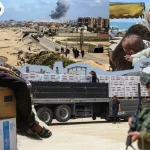
The South African leader’s remarks came as more than half a million people in Gaza are trapped in famine, marked by widespread starvation, destitution and preventable deaths, according to UN agencies, which confirmed the first official famine declaration for Gaza in August 2025.
African Unity on Palestinian Rights
The African leaders’ speeches highlighted continental solidarity with Palestinian rights. Faye, who came to power earlier this year after being released from prison just weeks before Senegal’s presidential election, used his platform to “highlight three priorities: the fight against poverty, the reform of global governance and the defence of the rights of the Palestinian people.”
The Senegalese president “unequivocally condemned Israeli bombings and the prolonged occupation of Palestinian territories” in what observers described as one of the strongest denunciations of Israeli actions heard at this year’s assembly.
France, Andorra, Belgium, Luxembourg, Malta, and Monaco join diplomatic push for Palestinian recognition, bringing fresh momentum to statehood efforts. Applause rang out in the UN General Assembly Hall on Friday as countries endorsed a declaration on the peaceful settlement of the question of Palestine and implementation of the two-State solution with Israel.
Ramaphosa outlined five key demands to restore prospects for a two-state solution: “global recognition of Palestine and its sovereignty and territorial integrity; an immediate ceasefire, an end to the genocide and the release of hostages by Hamas and political prisoners by Israel; full respect for international law; removal of obstacles to the two-state solution, including a halt to illegal settlements; and restoration of humanitarian aid and reconstruction in Gaza.”
The South African president emphasised his country’s position supporting “a contiguous Palestinian State existing peacefully and side by side with the State of Israel, along the 1967 borders, with East Jerusalem as its capital.”
Gaza Crisis Reaches Breaking Point
Ramaphosa highlighted the desperate humanitarian situation, noting that “UN reports stating that all areas of Gaza have reached acute starvation levels and that the residents are facing famine.” “The worst-case scenario of famine is currently playing out in Gaza,” UN-backed food security experts said, describing mounting evidence of widespread starvation.
UN experts noted that “half a million people in Gaza are starving” and questioned whether “State authorities become so numb to these numbers — so desensitised, once again, to the systematic breaches of our collective moral and legal obligations?”
The humanitarian crisis has been compounded by casualties among people trying to access food supplies, with 1,239 fatalities and more than 8,152 injuries since 27 May 2025, according to Gaza’s Ministry of Health.
Israeli Opposition and International Law
Israeli Prime Minister Benjamin Netanyahu rejected the international conference efforts, stating: “I have a clear message to those leaders who recognise a Palestinian state after the terrible massacre on October 7th, 2023: You are giving a huge reward to terrorism”
However, Ramaphosa stressed that “the viability of a two-state solution depends on full and universal respect for international law” and called for “immediate and full implementation of resolutions of the United Nations, as well as the Provisional Measures and Advisory Opinions of the International Court of Justice.”
Israel’s delegate rejected the UN declaration as a “carefully staged performance for headlines” while the General Assembly moved forward with endorsing the landmark declaration concerning Palestinian statehood.
Historical Context and Urgency
Ramaphosa reminded delegates that shortly after the UN’s creation, “the General Assembly adopted Resolution 181, which recommended the creation of two states, Israel and Palestine. Immediately following the adoption of this resolution, only the State of Israel was created, ushering the Palestinians into a decades-long wilderness of statelessness characterised by decades of occupation and now genocide.”
“This is a conflict that has raged for almost as long as the United Nations has existed,” he declared. “It will be a blight on our collective conscience if self-determination, sovereignty and human rights continue to be denied to the Palestinian people.”
The 16 world leaders’ united call comes as the United Nations marks its 80th anniversary, with diplomats facing one of the organisation’s most challenging periods in addressing global crises.
Abbas Addresses UN Virtually After US Visa Denial
Palestinian President Mahmoud Abbas addressed the UN General Assembly by pre-recorded video after the United States refused to issue visas for Palestine’s delegation, with the resolution allowing his virtual participation passing by a vote of 145-5, with six abstentions.
In his virtual address, Abbas is expected to have reiterated his longstanding position that “those who think that peace can prevail in the Middle East without the Palestinian people enjoying their full, legitimate and national rights would be mistaken.” Abbas has previously told the Assembly that “your support for the establishment of the State of Palestine and for its admission to the United Nations as a full member is the greatest contribution to peacemaking in the Holy Land.”
The General Assembly’s decision to allow Abbas to speak by video mirrored a similar exception made in 2022 for Ukrainian President Volodymyr Zelenskyy following Russia’s invasion. The resolution passed with the US and Israel among the five countries voting against the measure.