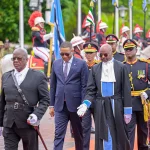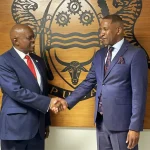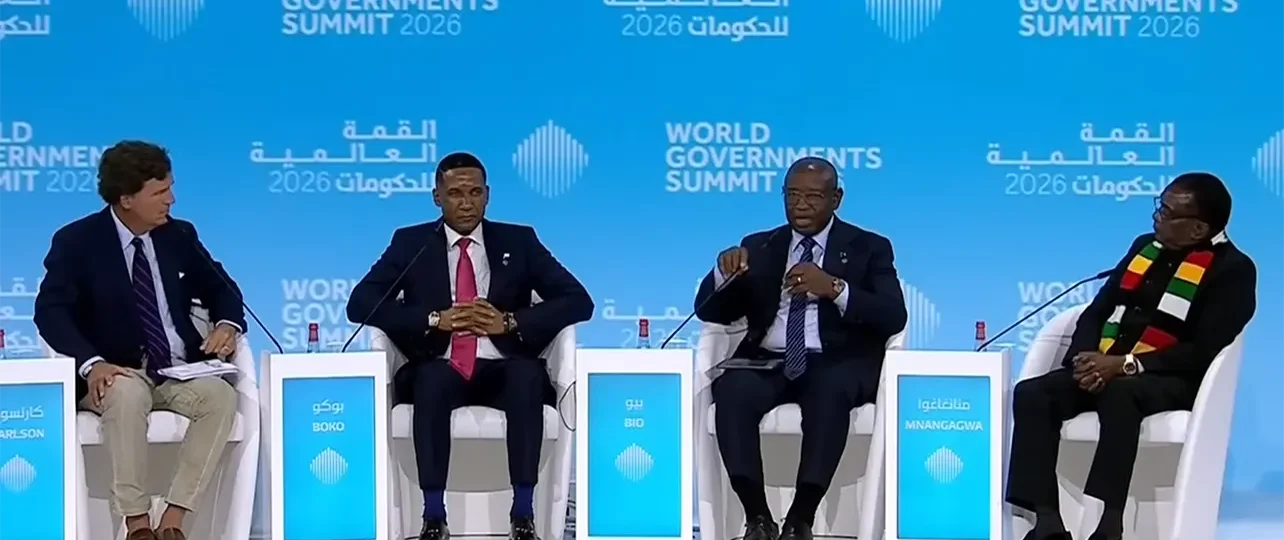

THREE African heads of state offered pointed critiques of Western engagement with their continent during a panel discussion at the World Government Summit 2026, while defending their nations’ increasing partnerships with China and questioning the West’s commitment to democratic governance.
Zimbabwe President Emmerson Mnangagwa, Sierra Leone President Julius Maada Bio, and Botswana President Duma Boko fielded questions from moderator Tucker Carlson on topics ranging from Chinese investment to brain drain and land reform.
China Versus the West
When pressed to compare Chinese and Western investment models in Africa, Mnangagwa declined to frame the relationship in binary terms. “We don’t need to please the West or please the East. We please ourselves,” the Zimbabwean leader said, emphasising his nation’s sovereignty in choosing economic partnerships.
Mnangagwa noted that while Zimbabwe initially relied on Western development assistance after independence, the country has diversified its partnerships over time. He cited historical context as the foundation for bilateral relationships, adding that Zimbabwe maintains positive relations with China “despite being a former British colony.”
The exchange highlighted growing sensitivity around Africa’s economic pivot toward China, with Mnangagwa resisting characterisations that the continent is simply trading one form of resource extraction for another.
Zimbabwe’s Land Reform Legacy
The discussion turned contentious when Carlson questioned Mnangagwa about Zimbabwe’s controversial land seizures from white farmers in the early 2000s under former president Robert Mugabe. The policy triggered Western sanctions and contributed to economic collapse.
Mnangagwa defended the seizures as reclaiming sovereignty. “Land did not belong to a race. It belonged to Zimbabweans,” he said, arguing that colonial powers had initially taken the land. “Those who wanted to have land at the same basis as the African people of Zimbabwe remained. But those who felt superior left.”
When asked about targeting people based on skin colour, Mnangagwa maintained that the land redistribution was not racially motivated but rather a correction of colonial-era dispossession.
Demographic Dividend
Both Sierra Leone’s Bio and Botswana’s Boko emphasised Africa’s youthful population as a strategic advantage. Africa has a median age of 19.3 years, compared to ageing populations in Europe and North America.
Bio outlined his administration’s investment in free primary and secondary education as a strategy to retain and develop human capital. “Without education, definitely you can’t make it,” he said, framing educational access as both an individual necessity and a national development imperative.
Boko struck an ambitious tone regarding Africa’s demographic future. “With such a population, Africa is poised to rule the world,” he said. When asked about plans for global leadership, he advocated for a “fairer, more equitable” system where “innovation serves humanity, not just a predatory elite.”
Democracy in Retreat
Bio acknowledged what he termed a “state of flux” in global governance, noting that Western nations that once promoted democracy appear less committed to the model. “Those who are leading the way or who have been teaching us to be democratic are no longer committed to that method of governance,” he said.
Despite observing democratic reversals globally and across Africa, Bio affirmed his commitment to liberal democracy and its associated freedoms. “Democracy is the best method of governance,” he maintained, even as he noted the concept receives diminishing attention in international discourse.
The panel underscored shifting dynamics in Africa’s relationship with traditional Western partners and emerging global powers, as well as African leaders’ increasing willingness to challenge Western assumptions about development, governance, and historical accountability.