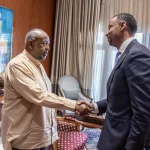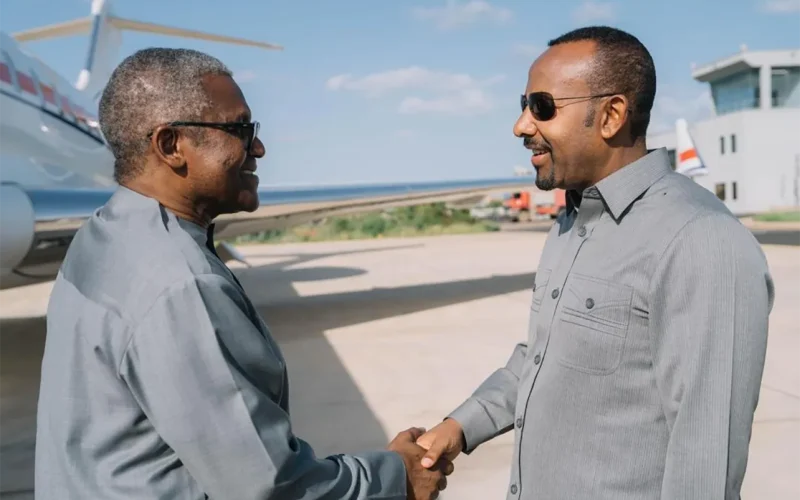
WHEN Africa’s richest man walks the red earth of a construction site in Ethiopia’s Somali region alongside a Nobel Peace Prize-winning prime minister, it is not a photo opportunity. It is a statement of civilisational intent.
Aliko Dangote’s visit to Gode recently, where he stood with Prime Minister Abiy Ahmed and surveyed the steel and ambition rising from the Ogaden Basin – carried a meaning that transcends the extraordinary numbers now attached to it. The Dangote Group announced on Sunday that its investment in the Gode Urea Fertilizer Plant has been expanded from an initial $2.5 billion to more than $4 billion, making this one of the largest single industrial investments in Africa’s history and, without question, the most consequential act yet in the continent’s long, tortured struggle for food sovereignty.
Africa is hungry not for want of land, water, or labour. It is hungry because it cannot feed its own farms.
The Structural Wound
The numbers are damning in their familiarity. Sub-Saharan Africa imports approximately 80 percent of the fertiliser it uses. The Gulf states, Iran, Russia, Ukraine, India, and China collectively supply the inputs that African smallholder farmers – who produce nearly 70 percent of the continent’s food – depend on to coax yields from some of the most fertile soil on earth. The continent holds nearly a quarter of the world’s arable land and yet pays more than $40 billion annually to import food, a figure that threatens to climb inexorably as Africa’s population moves toward two billion by mid-century.
This dependency is not an accident of geography. It is the residue of a colonial architecture that extracted raw materials from Africa while ensuring the continent remained a consumer rather than a producer of industrial goods. Fertiliser is simply the most visceral modern expression of that inheritance: African farmers paying foreign exchange to foreign suppliers so that African soil can yield African food.
The consequences of this arrangement become catastrophic when the world convulses. Between 2020 and 2024, COVID-19 and then Russia’s war in Ukraine strained global fertiliser supply chains to breaking point. African farmers absorbed those shocks the only way they could – by using less fertiliser, accepting lower yields, earning less, and tightening already threadbare household budgets. Then, in late February 2026, the conflict in Iran erupted and exposed the wound all over again, this time with clinical severity.
The Iran Shock and Its African Victims
Iran is the fourth-largest global exporter of urea, one of the cheapest suppliers in the world, and a critical source for Nigeria, Ghana, Togo, Kenya, Tanzania, and much of North Africa. Qatar – another major urea producer – shut down production in early March 2026 after Iranian missiles struck its gas infrastructure. Shipping through the Strait of Hormuz, the narrow waterway through which an estimated 36 percent of global seaborne urea once flowed, collapsed by 95 percent from the war’s outset.
The Food and Agriculture Organisation has since warned that even a 10 percent reduction in fertiliser availability could translate into up to 25 percent less maize, rice, and wheat grown in sub-Saharan Africa. The World Food Programme estimated that an additional 45 million people worldwide could face acute food insecurity if the conflict persists beyond mid-2026. Urea prices surged by 60 to 70 percent in the immediate aftermath of the crisis, with African importers — operating without the cushion of strategic reserves, currency strength, or alternative supply infrastructure – among the most exposed.
There is no internationally coordinated strategic reserve for fertiliser. When supply is disrupted, it stays disrupted.
Malawi imports 52 percent of its fertiliser from the Gulf. Burkina Faso and Senegal have been classified as high-risk due to their import dependency and inadequate logistics systems. West African states like Nigeria and Ghana have already begun emergency pre-purchasing from Russia to fill the gap for the third quarter of 2026 – trading one geopolitical dependency for another, this time with Moscow gaining diplomatic leverage across the continent as a dividend.
The International Fertiliser Association has warned that Gulf countries together account for 23 percent of global ammonia trade, 34 percent of global urea trade, and 18 percent of global ammoniated phosphate trade. For sub-Saharan Africa, which sits at the end of every supply chain and at the beginning of every shock, the structural exposure is not a policy failure. It is a civilisational emergency.
The Gode Intervention
Into this emergency walks the Gode Urea Fertilizer Plant – and behind it, a partnership between Africa’s largest industrial conglomerate and one of the continent’s most consequential states.
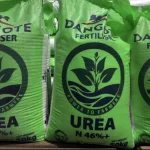
The original deal, signed on 28 August 2025 in Addis Ababa in the presence of Prime Minister Abiy Ahmed, committed $2.5 billion to building a urea fertiliser complex in Gode, in Ethiopia’s Somali Regional State. The plant would be connected by a 110-kilometre pipeline to the Calub and Hilala natural gas fields in the Ogaden Basin, giving it a feedstock advantage that most African industrial projects could only dream of. Ethiopian Investment Holdings (EIH) took a 40 percent equity stake; Dangote Group retained 60 percent. Production capacity was set at three million metric tonnes of urea annually – a figure that would make the Gode complex one of the largest single-site urea production facilities anywhere in the world.
Now, nine months later, Dangote has returned to the site – walking it with Abiy Ahmed as construction advances – and announced that the project’s scope has expanded dramatically. The total investment now exceeds $4 billion. New infrastructure includes a 120-megawatt power plant, a two-million-tonne NPK blending facility, a polypropylene packaging plant, and the 110-kilometre gas pipeline. Ethiopia, Dangote disclosed, has become the second-largest recipient of his group’s continental investment, absorbing nearly nine percent of the Group’s total African outlay projected to 2030.
In March 2026, Dangote Industries separately signed a $4.2 billion natural gas supply agreement with GCL Group, guaranteeing a 25-year energy supply for the fertiliser facility. This is not a speculative project. The gas is contracted. The site is active. The construction is advancing ahead of the original 40-month timeline, according to the Prime Minister.
What This Means for Ethiopia
For Ethiopia, the strategic logic is overwhelming. The country is Africa’s top fertiliser importer by volume – not a small distinction for a nation in which agriculture contributes more than a third of GDP. Annual fertiliser import costs have run to approximately $1 billion in foreign exchange, a haemorrhage into reserves that the government can ill afford. The Gode plant, once operational, would eliminate that expenditure entirely and, given the three-million-tonne annual capacity set against Ethiopia’s current domestic consumption of around 1.7 million tonnes, position the country as a regional exporter – supplying Kenya, Djibouti, Somalia, Sudan, and potentially markets further afield.
Finance Minister Ahmed Shide, speaking at the August 2025 signing ceremony, invoked the Grand Ethiopian Renaissance Dam as the closest analogue – an infrastructure project that transformed Ethiopia’s relationship with its own natural resources and with its neighbours simultaneously. The comparison is not a rhetorical excess. A fertiliser plant of this scale, anchored in domestic gas reserves and producing at world-competitive costs, would do for Ethiopia’s food security what the GERD has done for its energy sovereignty.
Prime Minister Abiy has framed the project with characteristic ambition, expressing optimism that revenues from Gode could eventually rival the foreign exchange contributions of Ethiopian Airlines – an institution that has become the continent’s most admired aviation enterprise precisely through disciplined state investment in strategic national infrastructure.
The “Africa for Africa” Blueprint
What makes the Gode project potentially more important than its Ethiopian context is the model it represents. The Dangote-EIH joint venture is not a foreign-financed extractive project. It is not a World Bank-conditioned loan attached to reform requirements. It is an African capital – the accumulated industrial wealth of Nigeria’s Aliko Dangote, already deployed at scale in Nigeria’s $20 billion Lagos refinery and fertiliser complex – partnering with an African state’s sovereign investment vehicle in an African country, to produce a critical agricultural input for African farmers.
Dangote has been explicit about the civilisational dimension of what he is doing. “Africa has the capacity to feed itself and even export to the rest of the world,” he told journalists in Gode last weekend. “Our fertiliser investments across the continent are designed to unlock that potential and secure a prosperous future for our people.” At the signing in August 2025, he described the deal not as commerce but as “an entrepreneurial vision for a self-sufficient Africa.”
The ownership structure – 60 percent private, 40 percent state – is a model that analysts have begun to identify as a potential template for other African governments seeking to solve systemic industrial challenges that neither government capacity nor private capital alone can address. It provides the state with strategic equity, national interest protection and political accountability, while leveraging the private sector’s capital, expertise and global networks. It is, in essence, a 21st-century expression of what pan-Africanist economists have long argued: that the state and the entrepreneur are not adversaries in the project of African development, but partners with distinct and complementary roles.
The Structural Challenge That Remains
It would be dishonest to present Gode as a solution without acknowledging the scale of the problem it addresses.
Africa’s fertiliser dependency is not only a production problem. It is a distribution problem, a subsidy problem, a soil science problem, a rural finance problem, and a logistics problem. Even if Gode produces three million tonnes of urea annually from 2029 onwards, those inputs will only reach African farmers if supply chains, rural markets and agronomic extension systems are rebuilt to carry them. The continent’s smallholder farmers – who operate on narrow margins, have limited access to credit, and often face steep price hikes even when supply is theoretically available – cannot benefit from industrial production that stops at the factory gate.
The African Union’s 2024 Africa Fertiliser and Soil Health Action Plan identified the need for an integrated approach combining efficient mineral and organic fertilisers, improved seeds, soil diagnostics, and targeted extension services. Researchers point to agroforestry, bio-fortified crops, aquaculture, and home gardens as complementary resilience strategies – not as substitutes for industrial inputs, but as essential buffers when global supply chains fail, as they have repeatedly and will again.
There is also the question of execution. The Gode project is on a 40-month construction timeline targeting early 2029 completion. The Iran shock is happening now. The farmers of Burkina Faso, Malawi, and Tanzania who face depleted fertiliser stocks this planting season will not wait until 2029 to know whether they can afford to feed their children. The urgency of the crisis exposes a structural truth: Africa’s food sovereignty project is not behind schedule. It never truly began.
A Verdict in Progress
The Dangote-Abiy partnership at Gode is not the end of Africa’s fertiliser dependency. It is the most credible beginning that dependency has yet been offered.
It is an African answer, financed by African capital, structured by an African state, built on African gas reserves, designed to produce a critical industrial input for African farmers, with the explicit ambition of making Africa a net exporter rather than a net importer of the inputs that feed it. In the context of a continent that has spent six decades absorbing lectures about food security from institutions that have never gone hungry, this is not a small thing.
It is, as Prime Minister Abiy Ahmed said, standing on the Gode site, “far more than infrastructure.” It is a strategic wager on the proposition that Africa’s agricultural potential – its land, its water, its people, its gas reserves, its capital – belongs to Africa, and that Africa is capable of deploying it for Africa’s benefit.
The Strait of Hormuz and the war in Iran have made that wager more urgent than the architects of the original August 2025 deal could have anticipated. History, as it so often does on this continent, has accelerated the timetable.
The excavators are running in Gode. The gas pipeline route is surveyed. The $4 billion is committed. Africa’s richest man and one of Africa’s most consequential leaders stood together on a dusty construction site in the Horn of Africa last weekend and made a bet on a continent that the world has too long bet against.
It is a bet, for once, worth watching.