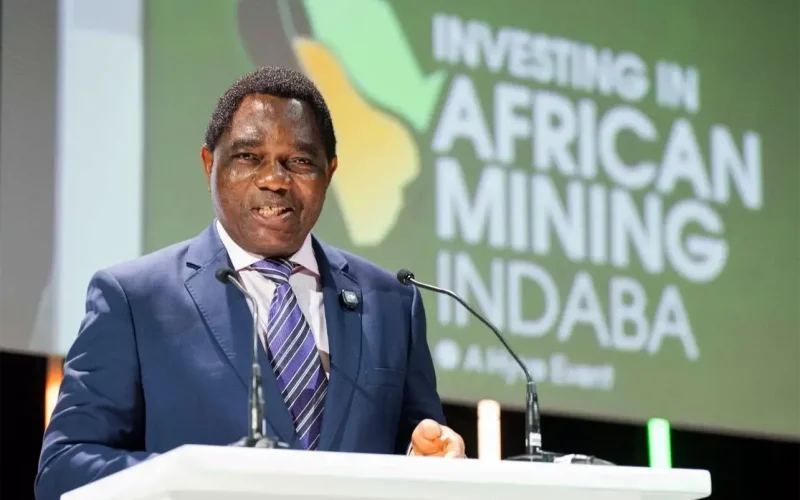
IN a forceful display of Pan-African unity at the 2026 Mining Indaba, leaders from across the continent issued an unambiguous message to global investors: the era of simply extracting Africa’s mineral wealth is over.
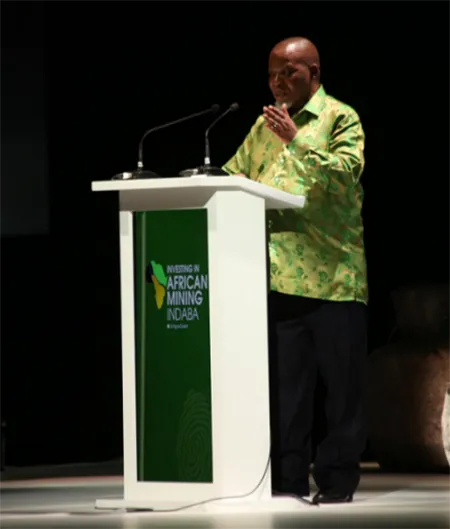
South African Minister of Mineral Resources Gwede Mantashe and Zambian President Hakainde Hichilema delivered addresses that marked a potential inflexion point in how resource-rich African nations engage with international capital — demanding partnerships over predatory deals, and value addition over raw material exports.
Speaking under this year’s theme “Stronger Together: Progress Through Partnerships,” both leaders framed African mineral resources as leverage in an increasingly multipolar world, not bargaining chips in a continental bidding war.
“We are witnessing heightened geopolitical tensions, driven largely by the competition of some developed economies seeking greater control over the natural resources of developing nations,” Mantashe told the gathering, describing the dynamic as “a serious threat to the sovereignty of resource-endowed countries.”
His remarks carried particular weight given the timing: global powers are scrambling to secure supplies of critical minerals essential for electric vehicles, renewable energy, and defence technologies – nearly all of which Africa possesses in abundance.
Hichilema reinforced the message with stark irony: “It is contradictory that while Africa is said to be the least developed, it is the most endowed with raw materials.” His solution? “Getting more organised so that we can be a worthy partner with other continents in the world.”
From Extraction to Industrialisation: The New Mandate
Both leaders moved beyond rhetoric to concrete policy shifts designed to capture more value from mining.
South Africa completed a comprehensive Critical Minerals Strategy in 2024, now being implemented with regulatory reforms aimed at attracting investment while ensuring “benefits of our mineral wealth are shared equitably with all South Africans,” according to Mantashe.
In a significant policy reversal, South Africa removed Black Economic Empowerment requirements at the prospecting stage – a move Mantashe defended not as abandoning transformation but as “pragmatic recognition that prospecting is a high-risk phase where no economic value has yet been proven.” The result: 358 prospecting rights and 32 mining rights granted in the 12 months preceding the Indaba.
Zambia took a different but complementary approach. President Hichilema announced that over $12 billion has flowed into Zambian mines since 2022, resurrecting operations dormant for decades. The Kalengwa mine, inactive for 47 years, is operational again. So is a Luanshya facility shuttered for 23 years.
“In 2024 alone, copper production went up by 12 percent,” Hichilema reported, projecting that Zambia will reach one million tonnes of copper production as the country positions itself at the center of the global energy transition.
Perhaps most significantly, both leaders insisted that value addition – processing minerals within Africa rather than shipping raw ore abroad – must become non-negotiable.
“Africa should not continue exporting raw materials as the main business. The mind frame must change,” Hichilema declared. “For us to grow, the mining sector sits at the centre of this, and value addition is a key component.”
Mantashe echoed this at the African Ministers’ Critical Minerals Roundtable, convened in partnership with the African Union: “Our partnership must move beyond extraction to industrialisation and value addition closer to the point of production.”
This represents a fundamental challenge to the traditional mining business model, where African nations provide raw materials while manufacturing value accrues elsewhere.
Yet both leaders acknowledged formidable obstacles. Mantashe noted industry struggles with “logistics and electricity,” referencing ongoing tariff relief negotiations for the ferrochrome sector. Hichilema cited “market volatility, infrastructure deficits, climate change” among challenges facing African mining.
Zambia is responding with institutional capacity-building – establishing a Minerals Regulation Commission to streamline approvals and conducting its first high-resolution geophysical survey in 50 years. “We are doing it at the national level, and the government is paying for that,” Hichilema emphasised, with aerial mineral surveys 55 percent complete and exploration data expected later this year.
South Africa is launching a Virtual Core Library through the Council for Geoscience, “a landmark national initiative that will transform how geological data is accessed, shared, and utilised.”
The Partnership Paradox
The addresses exposed an inherent tension: demanding sovereign control while courting foreign investment. Mantashe committed to “a regulatory framework that is more certain, more predictable, and more transparent – one that attracts investment” while simultaneously warning against external powers seeking “greater control” over African resources.
The balancing act was explicit in Zambia’s approach. “Resources create prosperity when unlocked through strategic partnerships,” Hichilema said, before adding: “We are not talking about exclusions but about getting more organised.”
Translation: African nations want investment capital and technical expertise, but on terms that build domestic industrial capacity rather than perpetuate dependency.
A Continental Awakening?
Whether this represents genuine transformation or aspirational rhetoric will depend on execution. Africa has issued such declarations before.
But several factors suggest this moment may be different: the global scramble for critical minerals gives resource holders unprecedented leverage; China’s Belt and Road investments have demonstrated alternatives to Western financing models; and a new generation of African leaders appears less willing to accept terms their predecessors tolerated.
Mantashe’s closing remarks on mine safety – 41 fatalities in 2025 versus 42 in 2024, “the lowest mine fatalities on record” – offered an unintentional metaphor. Progress measured in single digits after decades of advocacy.
The question facing the 2026 Mining Indaba: Will Africa’s push for value addition and partnership equity move at the same glacial pace, or has the continent finally found the collective leverage to accelerate change?
The answer will determine whether “Stronger Together” becomes reality or remains another conference slogan.