ON the morning of Saturday, 9 May 2026, Beauty Shoperai, 37, did what any wife and mother would do. She heard that her husband, Paul Masunda, had been struck and killed by a vehicle on the N1 highway near Bela-Bela in Limpopo. She ran — back across that highway, baby strapped to her back, a terrified teenager trailing behind her — to reach him. She never made it. The vehicle of Health Minister Dr Aaron Motsoaledi, driven by a member of the Protection Security Services (PSS), struck the family. Beauty Shoperai and her infant were killed. The teenager survived.
Three fatalities in minutes. Three SAPS members with questions to answer. Two culpable homicide dockets opened by IPID. And a nation, once again, asking a question it has been asking since at least 2008: why do the convoys of South Africa’s political elite operate as though the road belongs to them alone?
“Three fatalities in minutes. Three SAPS members with questions to answer. And a nation asking the same question it has been asking since 2008.”
A CHAIN OF CATASTROPHE
The Bela-Bela incident was not a single accident but a cascade of tragedy set in motion by two separate incidents on the same stretch of road within minutes of each other. According to SAPS national spokesperson Brigadier Athlenda Mathe, Paul Masunda had escorted his wife, children, and a 14-year-old family member to a bus stop before attempting to cross the N1. He was allegedly struck and killed by a vehicle driven by an off-duty police officer. His teenage child witnessed the collision and alerted Beauty Shoperai, who was on the other side of the road. She returned, baby on her back, directly into the path of Motsoaledi’s state vehicle.
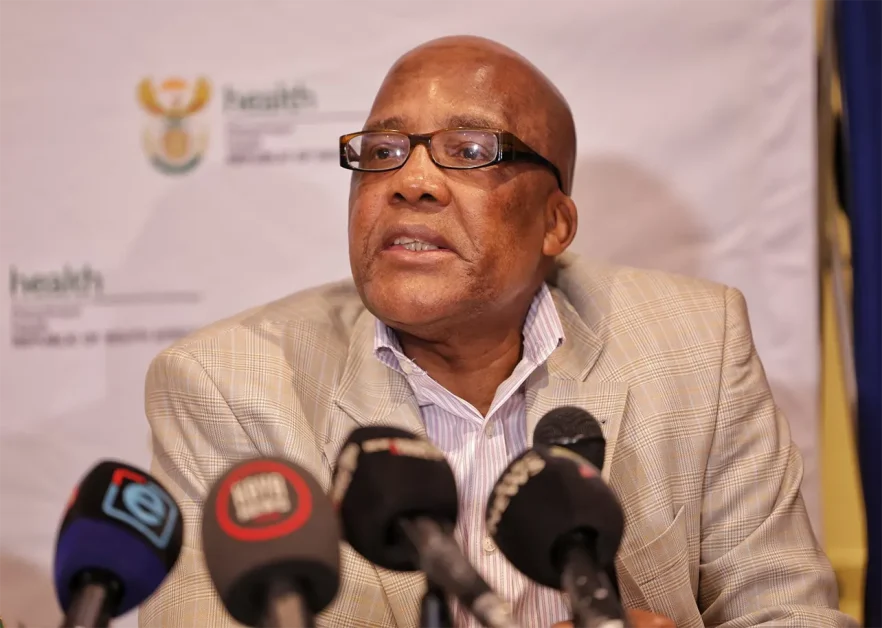
Minister Motsoaledi was on his way to Pretoria from Limpopo. His spokesperson, Sello Lediga, confirmed the direction of travel. SAPS confirmed the minister, his close protection officer, and the driver stopped immediately and remained at the scene until emergency services arrived — conduct described as “in line with standard protocol.” The IPID has assumed jurisdiction over both investigations because both drivers involved in the two separate incidents are SAPS members.
The bereaved family, Zimbabwean nationals, now face the additional burden of repatriating three bodies across an international border. Beauty Shoperai’s brother, Charles, described her as the pillar of the family. “She was the one who tried to save our family, just looking after her father,” he told Eyewitness News. The family is fundraising to bring their dead home.
THE BLUE LIGHT BRIGADE: A DECADES-LONG PATTERN
South Africa’s “blue light brigade” has been a source of public fury for the better part of two decades. The phrase refers to the high-speed, often aggressive convoys used to transport government ministers, deputy presidents, premiers, MECs, and senior officials. The exemptions that enable their conduct are embedded in the National Road Traffic Act (NRTA): Sections 58(3) and 60 permit SAPS members executing duties to exceed speed limits and disregard traffic signals — but only “with due regard to other road users’ safety.” That caveat has, in practice, frequently counted for little.
The documented record is damning. In February 2009, a pedestrian was struck and killed by a vehicle in then-ANC president Jacob Zuma’s cavalcade near Ulundi in KwaZulu-Natal. The convoy was en route to an ANC manifesto rally in Nongoma. A culpable homicide case was opened; no arrests followed. In November 2011, Thomas Ferreira, 18, was struck by the official vehicle of Gauteng MEC Humphrey Mmemezi — injuries that would leave him permanently brain-damaged. In March 2015, a young man was killed in a crash involving the blue light convoy of then-State Security Minister David Mahlobo near Witbank. In June 2018, two people died in a convoy-related crash in the Free State, with excessive speed alleged.
Beyond fatalities, the record includes gunshots fired at vehicles deemed too close to a presidential motorcade, assaults on motorists who did not clear the road fast enough, and the confiscation of camera equipment from journalists who tried to document the behaviour. The pattern is systemic, not incidental.
“The exemptions that enable convoy conduct are embedded in law. That legal caveat — ‘with due regard to other road users’ safety’ — has, in practice, frequently counted for little.”
MASHATILE AND THE CURRENCY OF IMPUNITY
The most persistent recent flashpoint has been the convoy of Deputy President Paul Mashatile. Residents along Allandale Drive in Midrand — where Mashatile lives — have described a pattern they say has become routine: the convoy blocking oncoming lanes during morning rush hour, driving against traffic, forcing motorists onto pavements, running intersections. Ward 132 councillor Annette Deppe has received footage from multiple residents and publicly demanded an investigation, describing the conduct as “reckless and unlawful” and corrosive to public trust.
In April 2025, Deppe posted footage showing vehicles identified as Mashatile’s convoy travelling on the wrong side of the N9 provincial road in Midrand, a police vehicle leading the procession past a motorist forced off the road. She challenged the necessity of a six-vehicle blue light escort on a provincial road during a traffic jam. Mashatile’s office declined to comment on security arrangements.
The Mashatile convoy’s record extends further. Eight members of his VIP Protection Unit face criminal charges in the Randburg Magistrate’s Court after video footage appeared to show them assaulting the occupants of a Polo Vivo on the N1 highway in Johannesburg in July 2023. The case is on trial. The defence has argued the civilian driver was a threat to the convoy; the complainants describe being boxed in by SUVs, a firearm pointed at them from a vehicle window.
These incidents have not prompted fundamental reform. They have prompted statements. The cycle repeats.
LAW VERSUS PRACTICE: THE ACCOUNTABILITY GAP
The legal architecture governing ministerial convoys is not absent — it is selectively enforced. NRTA Regulation 176 permits the use of blue lights and sirens by SAPS members on duty. Regulation 308(1)(h) requires other road users to yield immediately. But the operational caveats — that speed and disregard for signals must be exercised with due care for other road users — are the provisions most consistently ignored.
National Police Commissioner General Fannie Masemola has acknowledged that blue lights do not confer a blanket licence to disregard public safety, and that speeding by convoys requires careful consideration of surrounding conditions. Yet the institutional mechanisms for enforcing this are demonstrably weak. Suspensions may follow egregious incidents. Charges are opened slowly and resolved even more slowly. The 2023 Mashatile assault case took until 2024 to come to trial. The 2009 Ulundi killing produced no arrests.
Constitutional law expert Pierre de Vos has previously observed that the 2008 amendments to Sections 58 and 60 of the NRTA were drafted with significant latitude, not requiring a genuine emergency before a VIP driver could legally disregard the rules of the road. The practical effect is a near-blanket authorisation, softened by caveats that are rarely invoked against those who violate them.
Unisa researchers and road safety bodies, including the Automobile Association of South Africa, have repeatedly warned that current legislation shields convoy officers too broadly, and have called for legislative amendments that set hard speed ceilings and require genuine documented justification for emergency-mode convoy travel. Those calls have not produced legislative action.
“The institutional mechanisms for enforcement are demonstrably weak. Suspensions may follow. Charges open slowly, resolve slower. The cycle repeats.”
THE PUBLIC RECKONING
South Africans have never been entirely passive in the face of the blue light brigade. Motorists have filmed convoys and posted the footage online — often to viral condemnation. Residents have complained to ward councillors. Opposition parties have demanded investigations and tabled legislative proposals. In the Western Cape, the DA-led provincial government passed a resolution removing blue lights from the vehicles of provincial ministers. The City of Tshwane, under DA governance, announced its officials wait in traffic like ordinary citizens.
But at the national level, where the most powerful convoys operate, the debate has remained precisely that — a debate. The Motsoaledi crash has not produced a policy announcement. It has produced condolences from SAPS, confirmation that IPID is investigating, and expressions of regret from the minister’s office. The structural question — whether high-speed ministerial convoys should be permitted to travel at the speeds they do, on the roads they do, in the manner they do — remains unanswered.
That question now has new weight. Beauty Shoperai was not a statistic before May 9. She was a woman who had come to South Africa, whose husband was dead, whose baby was on her back, and who ran across a highway because she was a mother. She is a statistic now. So is her infant. So is her husband. So, in a different register, is the teenager who watched all of it happen and survived.
WHAT REFORM WOULD REQUIRE
Meaningful reform of South Africa’s VIP convoy culture would require several simultaneous interventions. First, legislative amendment to Sections 58 and 60 of the NRTA to impose mandatory speed ceilings — even for SAPS convoys — and require documented justification for emergency-mode travel logged before departure. Second, independent oversight of convoy conduct, removing it from the internal SAPS accountability chain that has demonstrably failed to produce consequences. Third, mandatory dashcam and GPS tracking of all convoy vehicles, with data accessible to IPID in real time. Fourth, criminal accountability that moves at a pace proportional to the severity of harm caused.
None of this is beyond South Africa’s institutional capacity. All of it is beyond South Africa’s current political will.
The question after Bela-Bela is not whether the law needs changing. It is whether a Zimbabwean family’s grief will be sufficient to change it, when the grief of South African families killed in similar circumstances over 17 years was not.
“The question after Bela-Bela is not whether the law needs changing. It is whether a Zimbabwean family’s grief will be sufficient to change it, when the grief of South African families over 17 years was not.”