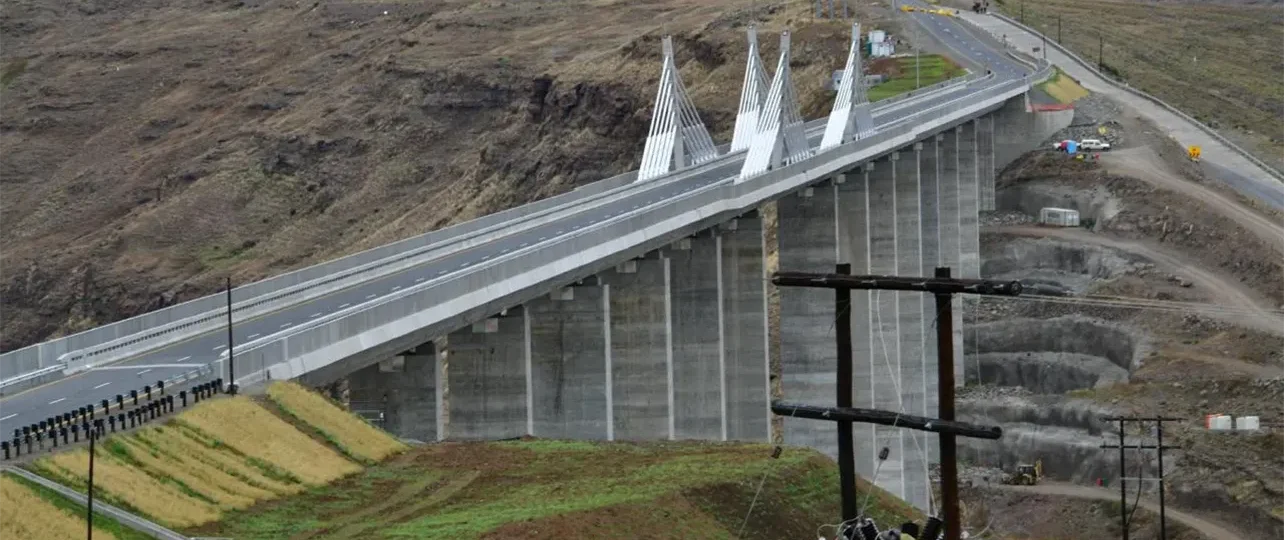

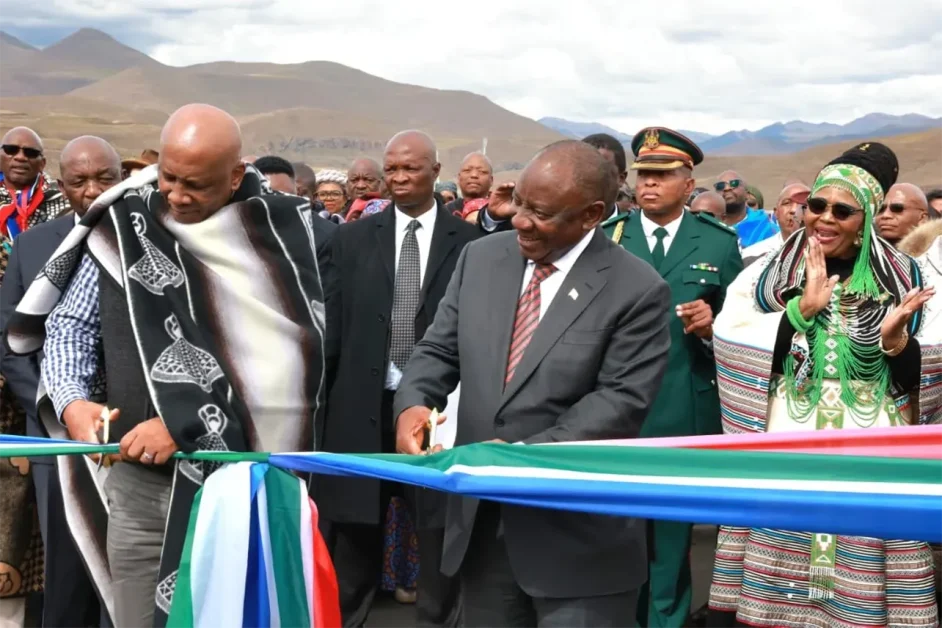
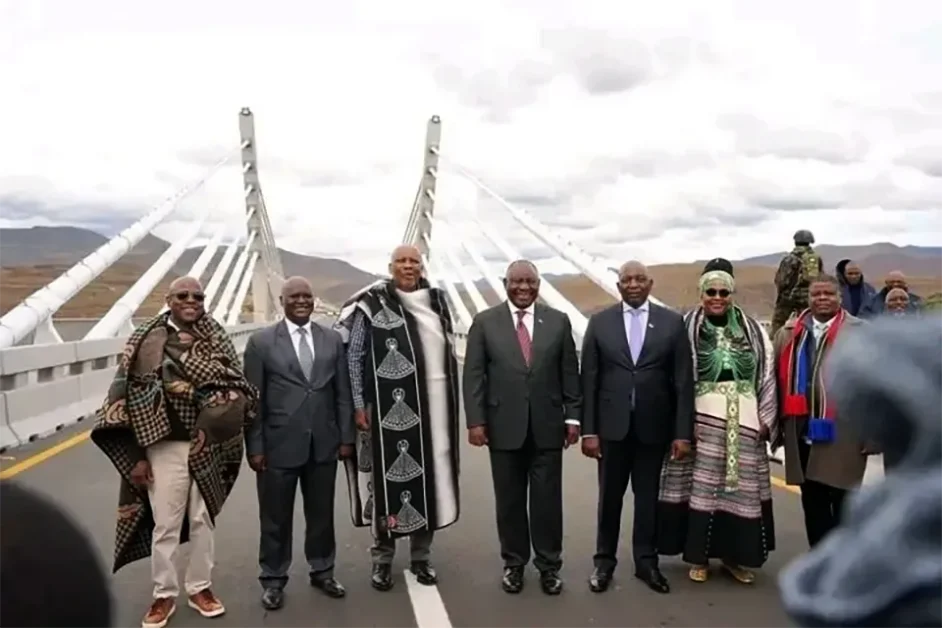
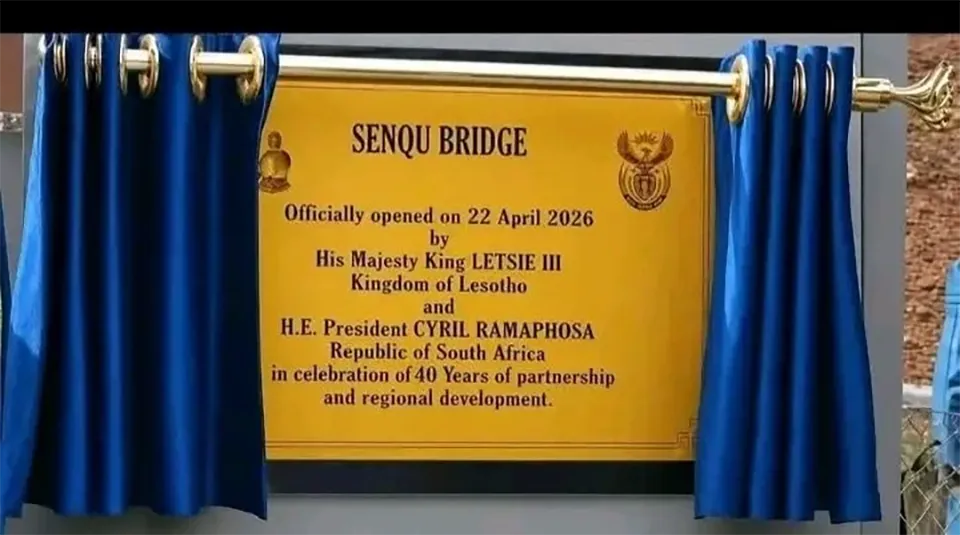
THE wind that sweeps down from the high Maluti Mountains carries the cold indifference of altitude. But on the morning of Wednesday, 22 April 2026, it carried something else: the unmistakable warmth of a milestone arrived at. In the remote district of Mokhotlong, in Lesotho, at more than 2,500 metres above sea level, South African President Cyril Ramaphosa crossed the border to stand shoulder to shoulder with His Majesty King Letsie III and Prime Minister Samuel Matekane for the official opening of the iconic Senqu Bridge – and its formal handover to the people of Lesotho.
At 825 metres long and between 90 and 100 metres above the valley floor, the Senqu Bridge is the longest and highest bridge ever constructed in the Kingdom of Lesotho. It is also the first extradosed cable-stayed bridge built in the country – a design so sophisticated it rivals comparable structures anywhere in the world. Constructed at a cost of R2.4 billion, the bridge was built not merely to span a river, but to preserve connectivity as the rising waters of the forthcoming Polihali Dam threaten to swallow existing roads and cut mountain communities off from schools, hospitals, and markets forever.
“South Africa is the spark that Africa needs. Today, we had a glimpse of what Southern African countries can achieve together.”
King Letsie III of Lesotho
King Letsie III’s words at the ceremony were unambiguous in their pan-African resonance. The monarch, whose Mountain Kingdom has for decades been simultaneously one of Africa’s most economically dependent and most geographically striking nations, framed the bridge not as a bilateral transaction but as a continental statement of possibility. His tribute to South Africa as “the spark” the continent needs echoes the long-standing philosophical architecture of the African Renaissance – an idea born in the Thabo Mbeki era that saw Pretoria’s industrial and technological capacity as the locomotive of broader continental development.
President Ramaphosa’s address was equally pointed. He reminded his hosts that the Lesotho Highlands Water Project remains “the largest investment South Africa has ever made outside its borders” – and that the waters of Lesotho’s highlands are not merely an environmental resource but a strategic lifeline for a water-scarce South Africa. His remarks were gracious but candid: a partnership rooted in mutual need, formalised through shared investment, and deepened through genuine solidarity.
“This project is more than infrastructure. It is more than steel and concrete. It is a symbol of a deep and enduring partnership.”
President Cyril Ramaphosa
What the Bridge Actually Does
To understand the significance of the Senqu Bridge, one must understand the engineering and political geography that makes it necessary. The Lesotho Highlands Water Project Phase II – a colossal bi-national undertaking valued at R53 billion – will, upon completion, increase the water supply capacity available to South Africa from 780 million to 1.27 billion cubic metres per year. At its heart is the Polihali Dam, currently under construction in the same Mokhotlong district.
When the Polihali Dam is complete, the reservoir it creates will permanently submerge existing valley roads. The communities of Mokhotlong – some of the most remote and vulnerable in all of Lesotho – would be severed from the rest of the country without a high-altitude crossing. The Senqu Bridge is precisely that crossing: engineered not for convenience but for survival. The Lesotho Highlands Development Authority formally handed the bridge over to the Government of Lesotho during the ceremony, making clear that this R2.4 billion asset now sits on African soil under African ownership and African sovereign control.
The project has also created tangible economic dividends. More than 1,200 people were employed during construction, the vast majority of them Basotho nationals. Local engineers, technicians, and professionals from both countries were embedded in the project. A Young Professionals Programme, now institutionalised as part of the broader LHWP framework, is seeding the next generation of African infrastructure expertise – a deliberate investment in human capital that will compound long after the concrete has cured.
The African Renaissance: A Dream Deferred, Not Abandoned
The Senqu Bridge did not emerge from a vacuum. Its intellectual lineage traces directly to the African Renaissance Programme conceived under President Mbeki, which envisioned South Africa – by virtue of being the most technologically advanced economy on the continent – as the natural springboard for infrastructure development across SADC and beyond. Under that vision, South Africa was to catalyse high-speed rail corridors connecting Johannesburg to Harare, Windhoek, Luanda, and Maputo; to build world-class freeways that would unlock cross-border economic corridors; and to position the region as a unified manufacturing and logistics platform capable of competing globally.
That vision was profoundly disrupted. The Zuma years – consumed by state capture, the systematic looting of Transnet, Eskom, and the development finance institutions – effectively mothballed South Africa’s capacity to lead continental infrastructure investment. The fiscal damage to Transnet alone set back rail development by a decade or more. The African Renaissance Programme did not die, but it was placed in a medically induced coma by political choices whose consequences the region still lives with.
The Senqu Bridge is not, by itself, the full realisation of that dream. Critics are not wrong to observe that after more than three decades of democratic governance, a single bridge – however magnificent – should prompt as much reflection as celebration. The absence of a high-speed rail corridor from Johannesburg to Harare is not a detail. It is a measure of lost time and squandered capital. The Senqu Bridge is evidence of what is possible; the absence of the railway is a reminder of what was lost./pu
“Guided by the spirit of Pan Africanism, South-South cooperation and solidarity, we are forging ahead to realise the vision of an economically integrated Africa.”
President Ramaphosa
What Ramaphosa’s R30 Million Signal Means
Beyond the bridge itself, President Ramaphosa used the occasion to announce that South Africa would provide R30 million in humanitarian assistance to Lesotho through the African Renaissance Fund – specifically to strengthen the Kingdom’s national response to HIV and tuberculosis in the context of what he described as “dwindling levels of international humanitarian assistance.”
The timing and framing of that announcement is significant. It arrives as the United States, historically the largest single donor to HIV/AIDS programming on the African continent, has dramatically retreated from its global health commitments under the current administration. PEPFAR – the President’s Emergency Plan for AIDS Relief – faces severe cuts that are already being felt in clinics and treatment programmes across sub-Saharan Africa. Lesotho, with one of the highest HIV prevalence rates in the world, is acutely exposed to that withdrawal. Ramaphosa’s R30 million is modest in absolute terms; in symbolic and geopolitical terms, it is a South-South response to a North-South abandonment.
It also reinforces a broader repositioning. South Africa currently holds the interim chair of SADC and is set to assume the full chairmanship later this year. Ramaphosa has signalled clearly that Pretoria intends to use that platform to accelerate trade, investment, and integration across the region — and to deepen what he calls “people-to-people links” that transcend the formal diplomatic architecture. The Bi-National Commission between South Africa and Lesotho, whose second session was held in Maseru in April 2025, has already generated six bilateral agreements covering water, energy, defence, skills development, and social development. A third session will accelerate those commitments.
The Extradosed Design: Engineering as Statement
The choice of extradosed cable-stayed design for the Senqu Bridge is itself worth examining. Extradosed bridges occupy a technical space between conventional prestressed concrete box-girder bridges and cable-stayed structures – delivering greater stiffness, better aerodynamic performance in high-altitude wind conditions, and a shallower pylon profile that suits the dramatic visual landscape of the Maluti Mountains. That Lesotho now owns one of the most technically advanced bridges in all of Southern Africa is not an accidental outcome; it reflects deliberate engineering ambition on the part of both the Lesotho Highlands Development Authority and the joint-venture contractors and design team who delivered the project.
Built to endure at altitude, the bridge is engineered for generations. It will outlast the political careers of every official who attended Wednesday’s ceremony. It will outlast current trade arrangements, currency fluctuations, and the episodic diplomatic tensions that inevitably arise between neighbours. It will carry goods, students, patients, and mourners across the Senqu valley long after every current political calculation has been rendered obsolete by history.
The Bigger Picture: Agenda 2063 and the Infrastructure Imperative
Ramaphosa invoked the African Union’s Agenda 2063 explicitly at the ceremony, framing the Senqu Bridge as a concrete expression of the continental vision for an economically integrated Africa. That framing is deliberate and defensible. Agenda 2063 identifies infrastructure as the foundational enabler of integration: without roads, bridges, rail corridors, energy interconnectors, and fibre networks, the African Continental Free Trade Area remains largely theoretical. The LHWP Phase II, of which the Senqu Bridge is a component, represents exactly the kind of hard infrastructure investment that transforms political aspiration into lived economic reality.
The completion of the Polihali Dam and Tunnel — now within sight, according to Ramaphosa — will increase water security for millions of residents in Gauteng and generate hydropower energy independence for Lesotho. It is, in miniature, the logic of the entire continental integration project: each country contributing what it has in abundance to a pooled regional economy that delivers more than any single nation could generate alone.
The African Mirror has consistently argued that the infrastructure deficit is not merely a technical problem awaiting engineers. It is a political problem awaiting leaders — and a governance problem awaiting institutions capable of delivering complex, multi-stakeholder projects across sovereign borders without the corruption, procurement manipulation, and political interference that have historically derailed comparable ambitions. The Senqu Bridge, delivered substantially on time and with a commitment that no affected community would be left worse off, is a demonstration that such delivery is achievable. It is not a given. It is earned.
Five Things the Senqu Bridge Tells Us
First, sovereign ownership matters. The formal handover of the bridge to the Government of Lesotho is not a ceremonial formality. It establishes a precedent that infrastructure financed through bi-national water agreements becomes an asset of the host nation, not a permanent extension of donor leverage. This is the architecture of partnership, not patronage.
Second, the Young Professionals Programme embedded in the LHWP is quietly one of the most important components of the entire project. Infrastructure that does not also build institutional and human capital is infrastructure that will eventually require external dependency for its maintenance. Lesotho’s ability to own its engineering future depends not just on the bridge, but on the engineers trained to maintain it.
Third, Ramaphosa’s announcement of the R30 million African Renaissance Fund grant reveals a calculated recalibration of South African foreign policy. As traditional Western donors retract from the African development space, Pretoria is positioning itself — even from a position of its own fiscal constraint — as a fill-the-gap actor in the region. The quantum is modest; the signal is loud.
Fourth, the extradosed design of the Senqu Bridge carries an implicit argument: African infrastructure need not default to utilitarian minimalism. The most advanced engineering techniques are available to African nations. The question is political will and investment — not continental capacity.
Fifth, and perhaps most importantly: the Senqu Bridge is a rebuke to the argument that Africa cannot execute. It was built under logistical conditions of extraordinary difficulty — remote, high-altitude terrain, complex hydrology, multiple sovereign jurisdictions. It was built. It stands. It works. Every argument that African infrastructure ambition is structurally doomed must now reckon with 825 metres of empirical counter-evidence rising 90 metres above the Maluti Mountains.
FACTBOX: THE SENQU BRIDGE AT A GLANCE
| Bridge Length | 825 metres — longest bridge ever built in Lesotho |
| Height | 90 to 100 metres above the Senqu River valley |
| Design | First extradosed cable-stayed bridge in Lesotho |
| Cost | R2.4 billion |
| Construction Jobs | Over 1,200 workers, majority Basotho nationals |
| Context | Part of the R53 billion Lesotho Highlands Water Project Phase II |
| Water Capacity | Supply to increase from 780 million to 1.27 billion cubic metres/year |
| Ownership | Formally handed over to the Government of Lesotho |
| SA Contribution | R30 million humanitarian grant from the African Renaissance Fund |
| Location | Mokhotlong, Kingdom of Lesotho — 2,500+ metres above sea level |
A Bridge to the Future
In the end, the Senqu Bridge is proof of concept. It proves that South Africa and Lesotho can commit to a shared vision across multiple governments and multiple decades, and deliver. It proves that extradosed engineering is not the exclusive province of Europe or East Asia. It proves that community protection — the commitment that no household be left worse off — can be embedded in the architecture of a megaproject. And it proves that when Africa is willing to invest in itself, the result can be something beautiful enough to stop conversation, and important enough to change lives.
King Letsie III was right. South Africa can be the spark. The question — the enduring, urgent question — is whether the political leadership across the region is willing to light the fire, sustain the flame, and ensure that what was squandered in the Zuma years is reclaimed not through nostalgia for a lost African Renaissance, but through the hard, unglamorous, daily work of building the continent one bridge, one dam, one tunnel, one corridor at a time.
The people of Mokhotlong will cross the Senqu Bridge tomorrow. And the day after. And the day after that. For them, it is not a symbol. It is the road home.