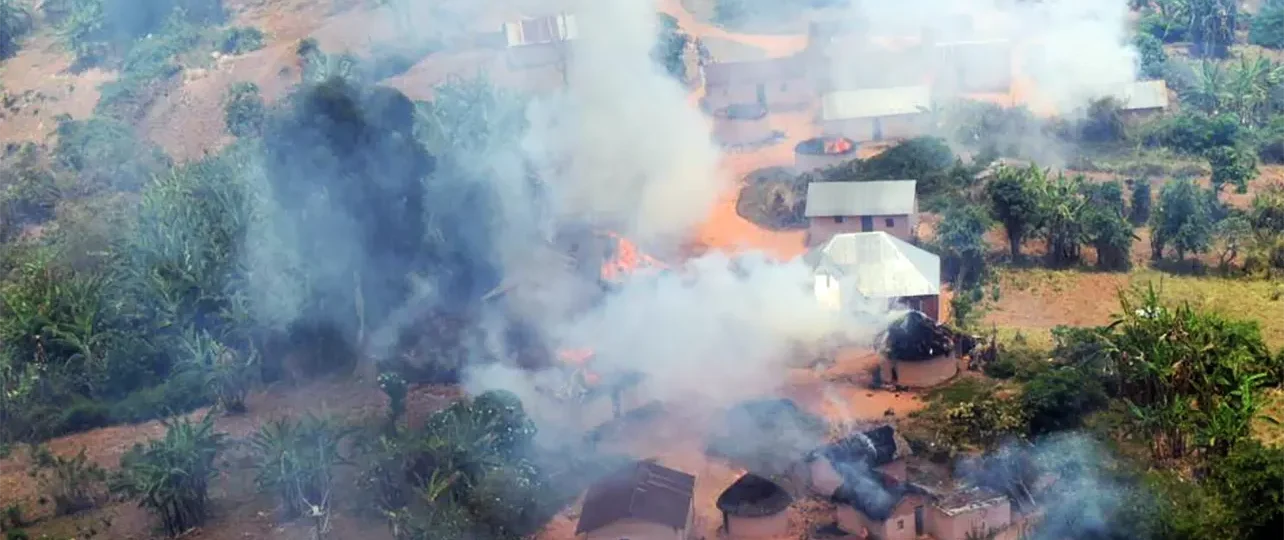

DRONE strikes have killed civilians, destroyed a community radio station, and punched holes through a church roof in the remote highlands of South Kivu, as armed groups and government forces block humanitarian aid and prevent terrified residents from fleeing, Human Rights Watch has warned.
The findings, published ahead of a UN Security Council meeting on the Democratic Republic of Congo scheduled for April 15, paint a picture of systematic civilian suffering in one of Africa’s most neglected conflict zones – where food prices have quintupled, medicine has run out, and phone networks have been dark for more than a year.
“Civilians in South Kivu’s highlands are facing a dire humanitarian crisis and live in fear of abuses by all parties,” said Clémentine de Montjoye, the organisation’s senior Great Lakes researcher. “More attention is needed for this vastly underreported conflict, or this bad situation will get even worse.”
DRONES OVER MINEMBWE
Human Rights Watch documented eight drone strike incidents across South Kivu between January and March 2026, with data from the Armed Conflict Location & Event Data Project showing a sharp escalation since November 2025.
In March alone, at least two Banyamulenge civilians were killed. On March 23, an 86-year-old man was struck while tending cattle near Minembwe. A week later, on March 30, a 14-year-old boy died in a field near his village in Fizi territory. Whether either attack targeted a legitimate military objective remains unclear.
On March 9, an apparent drone strike hit a community radio station in Madegu, near Minembwe – the primary source of information in an area already cut off from telecommunications. A witness described watching journalists flee into a neighbouring field moments before impact. Photographs reviewed by Human Rights Watch showed at least four solar panels destroyed.
A church in Ilundu village was struck at night in a separate incident, with nine photographs and a video documenting two large holes torn through its roof.
“We are being bombed all the time, and many people are being injured,” a medical worker in Minembwe told researchers.
Human Rights Watch said the pattern of targets suggested Congolese army forces or allied fighters were responsible for the strikes. The army’s regional commander was contacted for comment on April 4, but had not responded at the time of publication.
BLOCKADES AND EXTORTION
Since March 2025, Minembwe has been under the control of the Twirwaneho – an armed group drawn from the Banyamulenge community – allied with Rwandan forces and the M23 rebel movement. The city is surrounded by Congolese army and Wazalendo militia forces, a siege that has severed humanitarian supply lines for more than a year.
Medical facilities report critical shortages of medicines and basic supplies. The price of staples such as sugar and salt has risen fivefold compared to other South Kivu towns.
The Twirwaneho have compounded the misery by blocking residents from leaving, reportedly to maintain the group’s image as a protective local force and shield its fighters from exposure. Families have been ordered to provide a fighter or pay a financial levy; those who refuse face retaliation.
On the government-controlled side, Wazalendo fighters have established a gauntlet of extortion checkpoints. One resident counted eight barriers on the 130-kilometre road between Baraka and Misisi, with each stop costing between 1,000 and 2,000 Congolese francs – equivalent to less than a dollar. Along a separate route from Baraka to Fizi, another resident documented more than ten such barriers operated by Wazalendo and Congolese army personnel.
A man recently released from informal Wazalendo detention in Baraka said he had paid hundreds of thousands of francs to secure his freedom. “They beat me badly,” he said. “They harass the population and accuse us of supporting the M23 to make us pay.”
A CONFLICT WITHOUT WITNESS
The South Kivu highlands – spanning parts of Fizi, Mwenga, and Uvira territories – have been classified by the UN as having “severe” humanitarian access restrictions. The situation deteriorated further after the UN peacekeeping mission MONUSCO withdrew from the province in June 2024 under an agreement with the Congolese government.
The withdrawal removed the last significant international monitoring presence from a front line that now involves Congolese army forces, at least four distinct armed factions, an estimated 4,000 Burundian army troops deployed in Fizi and Mwenga territories, and Rwandan forces fighting alongside the M23.
Human Rights Watch called on the UN Security Council to demand that all warring parties allow humanitarian access and safe passage for civilians, and to consider targeted sanctions against commanders credibly linked to abuses. The organisation also urged MONUSCO to explore re-engagement under a December 2025 Security Council resolution that would permit the mission to return for ceasefire monitoring.
“Congolese authorities should rein in the Wazalendo coalition and impartially investigate and prosecute all those responsible for serious abuses, including those interfering with aid delivery,” de Montjoye said.