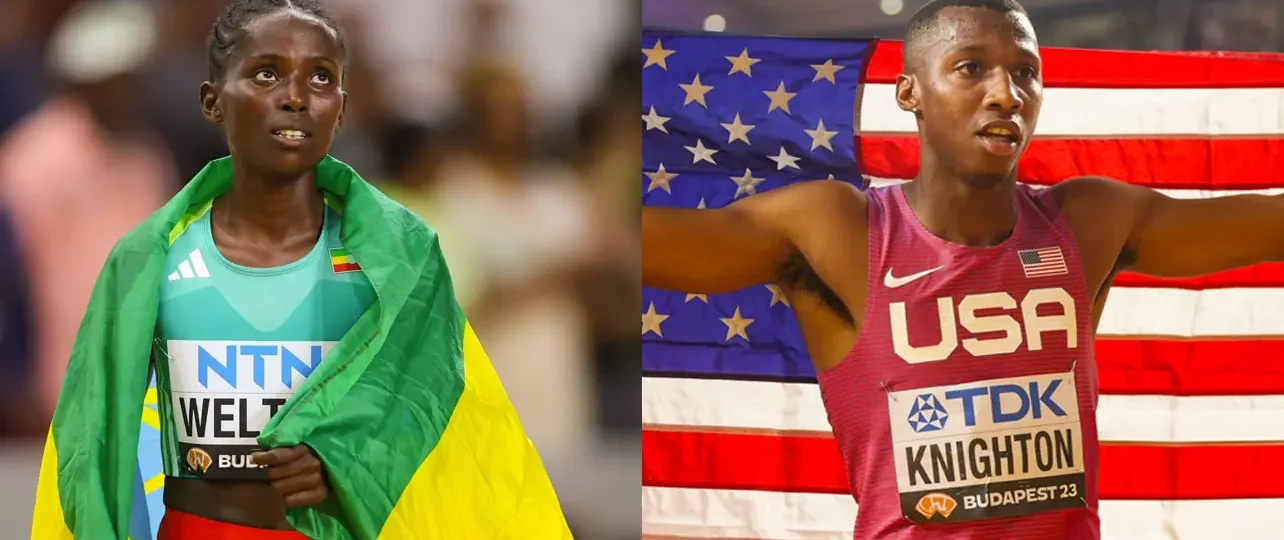

THE 2025 World Athletics Championships have been rocked by twin doping scandals as two of the sport’s brightest stars find themselves banned from competition on the eve of the world’s premier track and field event.
In a devastating one-two punch that has sent shockwaves through the athletics community, Ethiopian middle-distance sensation Diribe Welteji and American sprint phenomenon Erriyon Knighton have both been ruled ineligible to compete in Tokyo, casting a dark shadow over what should have been a celebration of athletic excellence.
Last-Minute Bombshell
The most dramatic development came just hours before competition began Saturday morning, when the Court of Arbitration for Sport (CAS) declared Welteji “ineligible” to compete in the women’s 1,500 meters — less than 24 hours before her scheduled heats.
Welteji, who captured silver in the 1,500m at the 2023 World Championships in Budapest, was accused in May of “refusing to give a sample for a doping test without any justification,” according to CAS. The 26-year-old runner had initially been cleared by Ethiopia’s anti-doping panel, but the Athletics Integrity Unit (AIU) successfully appealed that decision to the sport’s highest court.
The timing couldn’t be more devastating. Ethiopian team officials confirmed that Welteji had travelled to Tokyo, completed her registration, and was mentally preparing for what many believed would be her coronation as world champion. Instead, she watched helplessly as her dreams dissolved in a Swiss courtroom thousands of miles away.
American Star’s Four-Year Fall
If Welteji’s case provided the immediate drama, Knighton’s situation delivered the longer-lasting earthquake. The 21-year-old American sprinter, who has rewritten the record books since turning professional as a teenager, received a crushing four-year suspension on Thursday — the very day the World Championships opened.
The Court of Arbitration for Sport upheld appeals by World Athletics and the World Anti-Doping Agency, overturning an earlier ruling that had initially cleared the Florida-based sprinter. The ban effectively ends Knighton’s prime competitive years and will keep him out of the 2028 Los Angeles Olympics on home soil.
Knighton’s meteoric rise had been one of athletics’ most compelling stories. The Louisiana native became the youngest individual sprinter to earn a World Championship medal when he claimed bronze in the 200m at Eugene 2022. He followed that with silver at the 2023 worlds in Budapest, establishing himself as the heir apparent to American sprint royalty.
His personal best of 19.49 seconds in the 200 meters made him the fourth-fastest man in history at that distance, behind only Usain Bolt, Yohan Blake, and Michael Johnson. Now, instead of chasing those legends in Tokyo, he faces a fight to salvage his career.
A Sport Under Scrutiny
The twin scandals have put athletics’ doping problem back in the spotlight just as World Athletics had hoped to showcase the sport’s cleaned-up image. Both cases involve athletes who had initially been cleared by their national systems, only to see those decisions overturned on appeal by international bodies.
The pattern raises uncomfortable questions about the effectiveness of national anti-doping programs and whether the current system adequately protects clean athletes. Critics point to the timing of both rulings — coming after months of legal proceedings that allowed tainted athletes to continue competing while cases dragged through the courts.
“This is exactly what we don’t want to see,” said one prominent track coach, speaking on condition of anonymity. “Athletes train for years for these moments, and now we have two of the sport’s biggest stars removed at the last minute. It damages everyone — the athletes, the sport, and the fans who came to see the world’s best compete.”
Missing Stars, Diminished Competition
The absence of both athletes significantly diminishes the competitive landscape in Tokyo. Welteji was considered the favourite in a loaded 1,500m field that includes defending champion Faith Kipyegon of Kenya and Scotland’s Laura Muir. Her late withdrawal reshuffles the medal picture entirely.
Knighton’s absence is equally felt in the men’s sprints. The American was expected to challenge for gold in the 200m and potentially make noise in the 100m as well. His suspension leaves teammate Kenny Bednarek as the primary American hope in the half-lap, while opening opportunities for competitors who had been preparing to race in Knighton’s shadow.
Legal Limbo
Both cases highlight the complex intersection of sports law, national sovereignty, and international governance that defines modern athletics. While national bodies conduct initial investigations, the AIU and WADA serve as watchdogs, able to appeal decisions they view as inadequate.
The system, designed to ensure consistent global standards, can leave athletes in legal limbo for months as cases wind through multiple levels of appeal. Both Welteji and Knighton experienced this uncertainty, with their competitive futures hanging in the balance even as they continued to train and compete.
For Knighton, the contamination defence — claiming he unknowingly ingested a banned substance — initially proved successful with American arbitrators but failed to convince CAS judges. The four-year ban suggests the court found his explanation insufficient or his fault in the contamination significant.
Championships Continue Under Cloud
As the World Championships continue through the weekend, the sport faces the familiar challenge of celebrating athletic achievement while grappling with doping’s persistent shadow. Officials will hope that outstanding performances on the track can overshadow the courtroom dramas that have marred the opening days.
But for two athletes who should have been among the meet’s biggest stars, the Tokyo championships represent opportunities lost and careers derailed. Their absence serves as a stark reminder that in modern athletics, the most decisive victories and defeats often happen far from the track, in hearing rooms where lawyers and arbitrators hold athletes’ futures in their hands.
The sport that prides itself on the purity of human performance — faster, higher, stronger — continues its complicated dance with the pharmaceutical shadows that threaten to undermine everything it claims to represent.