THE government of Ghanaian has moved with rare speed and diplomatic muscle against a Russian national accused of secretly recording intimate encounters with dozens of women across West Africa before monetising the footage on international adult websites — and the case is fast becoming a continent-wide reckoning with predatory technology, the silence of big-tech platforms, and the willingness of African governments to defend their citizens against foreign sexual exploitation.
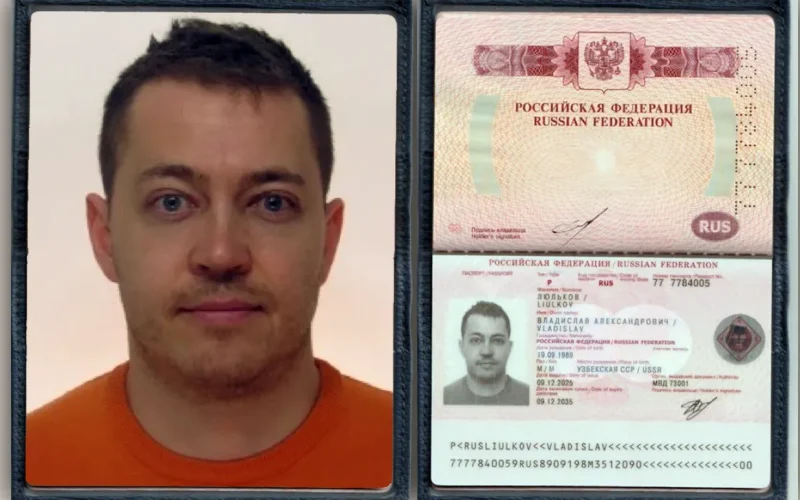
The suspect at the centre of the scandal has been officially identified as Vladislav Aleksandrovich Liulkov, a 36-year-old Russian citizen born in the former Uzbek SSR. His identification ended weeks of public speculation when Ghana’s Minister for Communication, Digital Technology and Innovation, Sam Nartey George, published the man’s passport — bearing number 77 7784005, issued December 2025 and valid until 2035 — on his official social media platforms.
What the passport confirmed was not merely a name. It confirmed a pattern of predation: a self-styled ‘pick-up artist’ and online blogger who travelled to Ghana and Kenya equipped with Ray-Ban Meta smart glasses — a consumer wearable that doubles as a discreet recording device — and systematically lured vulnerable women into private spaces, filmed their most intimate moments without their knowledge or consent, and then sold access to the footage through cryptocurrency-enabled platforms to audiences around the world.
“The matter is not one of morality. It is a clear criminal offence.”
Ghana Communications Minister Sam Nartey George
Preliminary investigations by Ghana’s Cybersecurity Authority and law enforcement agencies place the recordings as far back as March 2025, with additional footage obtained as recently as September 2025. Liulkov is alleged to have used Google Translate to bridge language barriers — a chilling detail that strips away any suggestion of organic human connection and replaces it with the cold efficiency of a man running a commercial operation. Approximately forty Ghanaian women are believed to feature in the footage, which surfaced publicly on February 12, 2026, and spread rapidly across social media platforms and encrypted messaging channels within hours.
Accra’s Legal and Diplomatic Offensive
Ghana’s response has been remarkable for both its speed and its sophistication. Within days of the footage going public, Foreign Affairs Minister Samuel Okudzeto Ablakwa summoned Russian Ambassador Sergei Berdnikov on February 17 to formally register the government’s displeasure and demand cooperation. The Ambassador’s response introduced an early complication — he reportedly questioned whether the name originally circulating, ‘Yaytseslav,’ was a genuine Russian name, a statement that carried the odour of diplomatic evasion. The subsequent passport release by Minister George cut through that fog decisively.
The Cybersecurity Authority is now preparing a full prosecution docket through the Ghana Police Service and the Attorney-General’s Department. Because no extradition treaty exists between Ghana and the Russian Federation, and because the Russian Constitution bars the extradition of its own citizens, Accra is pursuing a dual track: prosecution in absentia before Ghanaian courts, and an INTERPOL red notice that would, in practical terms, confine Liulkov to Russian territory. As Minister George put it bluntly: ‘As soon as he steps outside of Russia into any other country, he will be picked up.’
The government’s posture has been explicitly framed in terms of state responsibility rather than moral condemnation — a strategically sound choice that grounds the prosecution in hard law and removes the risk of the case being recast as a cultural or religious dispute. ‘The matter is not one of morality or private relationships,’ the joint ministerial statement read, ‘but a clear criminal offence under Section 67 of the Cybersecurity Act, 2020 (Act 1038), which prohibits the non-consensual recording and dissemination of intimate images.’ The potential sentence: up to 25 years’ imprisonment.
| LEGAL FRAMEWORK: GHANA’S CYBERSECURITY ACT 2020 |
| ▸ Section 67 — Non-consensual recording and dissemination of intimate images |
| ▸ Maximum penalty: 25 years’ imprisonment |
| ▸ Applies to sharing, rebroadcasting, and redistribution — not only to the original perpetrator |
| ▸ Precedent: In 2022, Solomon Doga was sentenced to 14 years for sharing intimate images without consent |
| ▸ In-absentia prosecution is lawfully available under Ghanaian procedure |
| ▸ INTERPOL red notice mechanism activated — would restrict suspect to Russian territory |
Smart Glasses, Cryptocurrency and the Architecture of Violation
The Liulkov case is not, at its core, about one man’s depravity. It is about a commercial ecosystem that made his operation profitable. Ray-Ban Meta smart glasses — marketed globally by Meta and EssilorLuxottica as a lifestyle accessory for hands-free photography and AI-assisted daily tasks — record video discreetly enough that women in intimate situations had no means of knowing they were being filmed. The glasses represent a category of consumer technology that has outpaced the regulatory frameworks meant to govern its use.
CNN had reported on the growing trend of covert recording using wearable technology before the Ghanaian case broke publicly. The Liulkov affair gave that trend a human face — and a criminal charge sheet. Authorities have confirmed that payments for access to the content were received in cryptocurrency, a financial architecture specifically designed to frustrate the traceability that law enforcement depends upon. Ghana’s cybersecurity agencies are pursuing the digital and financial evidence trail.
One of the women who came forward, identified only as ‘Juliet’ by BBC Pidgin, described being followed, flattered and pressured before eventually going to the suspect’s hotel. She was unequivocal that the videos circulating on social media were manipulated: ‘The videos I see online are cut-and-join. That isn’t what happened.’ Her account underscores a dimension of this crime that legal systems often fail to capture adequately: the videos themselves are not mere evidence of wrongdoing. They are a continuation of the violation — tools of reputational destruction deployed against women who had no say in their creation and no control over their distribution.
“The videos I see online are cut-and-join. That isn’t what happened.”
Juliet, victim (BBC Pidgin)
Kenya’s Silence: A Continent Divided in Its Response
The contrast between Ghana’s aggressive response and the silence that has prevailed in Kenya — where Liulkov is also alleged to have operated — is stark and troubling. Kenyan authorities have not publicly acknowledged the case with the same urgency, leaving Kenyan victims without the state visibility and institutional support that their Ghanaian counterparts have received. It is a disparity that advocacy groups and regional civil society organisations should not allow to pass without scrutiny.
The African continent is not a monolith in its digital rights architecture. Some states have invested in robust cybercrime frameworks; others remain without meaningful legislation. Liulkov appears to have understood this geography of impunity. That he moved between Ghana and Kenya — rather than remaining in a single jurisdiction — suggests the operational logic of a predator who had assessed, at least partially, where the risks were lower.
Victims, Support and the Secondary Crime of Online Complicity
Ghana’s Gender Minister, Dr Agnes Naa Momo Lartey, has confirmed that the Ministry of Gender, Children and Social Protection is providing confidential counselling and psychological support to victims. Her warning about the human toll was unsparing: some of the women, she disclosed, ‘are even suicidal,’ driven to that extremity not primarily by the crime itself but by the mob judgment that descended on them from social media users who chose to pile onto the violated rather than the violator.
This secondary harm has not been overlooked by the authorities. Minister George issued an explicit warning that any individual — including Ghanaian citizens — who shares, rebroadcasts or redistributes the material faces prosecution under the same Cybersecurity Act. In a social media environment in which the re-sharing of violated women’s images is often treated as a form of entertainment, this warning carries constitutional weight and moral clarity in equal measure. It reframes complicity as criminality.
President John Dramani Mahama has personally charged his ministers to see the matter through. ‘Nobody will violate any Ghanaian citizen and go scot-free,’ Minister Lartey affirmed. ‘We are going to pursue this matter fully, and that is the charge His Excellency John Dramani Mahama has given us.’ The language is appropriate — because the prosecution of Liulkov, wherever it ultimately unfolds, must be understood as inseparable from the protection of the women still waiting for the videos of their violation to be removed from the internet.
What This Case Demands of the Continent
The Liulkov case is a sentinel event — a moment that illuminates systemic vulnerabilities that predate this particular perpetrator and will outlast his eventual prosecution. Africa is, by now, the world’s fastest-growing digital consumer market. Its citizens engage with mobile technology, social media and online commerce at rates that have repeatedly confounded the expectations of analysts who assumed the Global North would always set the pace. But the regulatory infrastructure that would protect those citizens from the weaponisation of technology against them has not kept pace.
The African Union must convene an emergency working group on non-consensual intimate image abuse — what advocates call ‘image-based sexual abuse’ — as a continent-wide policy emergency. Technology companies, including Meta, which manufactures the smart glasses used in this case, must be compelled to implement detection and removal protocols for non-consensual intimate content with the same resource intensity they apply to content that threatens their commercial interests. Cryptocurrency exchanges that facilitate payment for such content must be brought within anti-money-laundering and digital-crime frameworks.
Ghana has shown what a state with political will and adequate legal tools can attempt. The Cybersecurity Act 2020, the summoning of the Russian ambassador, the INTERPOL filing, the in-absentia prosecution docket, the victim support infrastructure — all of it represents a template. The question is whether other African governments are watching, and whether they have the legislative foundations to follow suit. For the women in Kenya who have received none of this, the answer matters urgently.
Vladislav Liulkov may currently be beyond Ghana’s physical reach. But his passport is in Accra’s possession, his name is on an INTERPOL watch list, and the women he violated have a state standing in their corner. That is not nothing. It may, in fact, be the beginning of something the continent has long needed: the unambiguous declaration that African bodies are not available for foreign predation — digital or otherwise — without consequence.