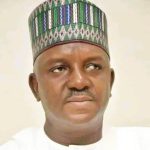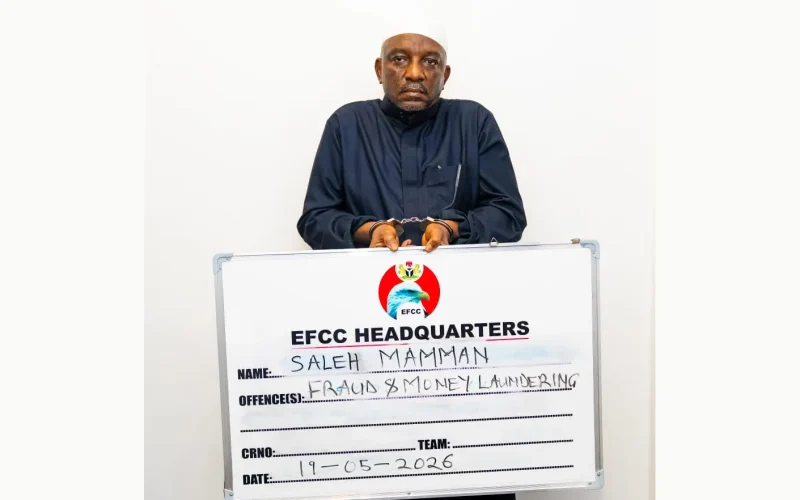
THE long arm of Nigerian law reached into a darkened house in the Rigasa district of Kaduna State in the dead of night and closed around one of the country’s most wanted men. At 3:30 a.m. on Tuesday, 19 May 2026, operatives of the Economic and Financial Crimes Commission (EFCC) arrested Saleh Mamman, a former Minister of Power, after a weeks-long manhunt that had spanned intelligence networks and tested the resolve of Nigeria’s anti-corruption machinery.
Mamman was not merely a suspect on the run. He was a convict – sentenced six days earlier to 75 years in prison by Justice James Omotosho of the Federal High Court in Abuja – for laundering and diverting ₦33.8 billion in public funds meant to light up the homes, hospitals, and factories of 220 million Nigerians.
“Anyone who has taken government or national resources will not go unpunished. The eagle eye of the EFCC will always catch up with you, wherever you are hiding.”
Ola Olukoyede, EFCC Executive Chairman
Announcing the arrest at a press briefing in Abuja, EFCC Executive Chairman Ola Olukoyede said the former minister had been in hiding since his conviction in absentia on 7 May 2026. He was taken into custody alongside two other individuals accused of harbouring a convicted person – a detail that underscored how networks of complicity can surround even the most wanted.
THE CRIME: DARKNESS BY DESIGN
Mamman served as Nigeria’s Minister of Power between August 2019 and July 2021, appointed to one of the most consequential portfolios in the Muhammadu Buhari cabinet during a period when Nigeria’s electricity crisis had reached catastrophic proportions. Rolling blackouts were crippling factories, shutting down hospitals, and bleeding the economy dry. Two flagship hydroelectric projects – the Mambilla plant in Taraba State and the Zungeru plant in Niger State – were meant to be the answer.
Mambilla, a proposed 3,050-megawatt facility in the northeast, had been on Nigeria’s drawing board since the 1970s. Its completion would have made it one of the largest hydroelectric plants in Africa and would have boosted national generation by roughly 30 percent. Zungeru, already under construction, was designed to add another 700 megawatts to the national grid. Together, these projects represented the crown jewels of Nigeria’s renewable energy strategy.
Instead, prosecutors told the court, the minister entrusted with their delivery helped hollow them out.
According to the EFCC’s charge sheet, Mamman conspired with officials from his own ministry and a web of private companies to divert the total sum of ₦33,804,830,503.73 – funds that should have been building dams and turbines. The money was siphoned through private companies and Bureau de Change operators who converted naira into foreign currency for the defendant. In one particularly brazen transaction, the court established that Mamman paid $655,700 – the equivalent of approximately ₦200 million – in cash for a property in Abuja, deliberately bypassing any financial institution in violation of Nigeria’s Money Laundering (Prohibition) Act.
A prosecution witness, retired Colonel Adebisi Adesanya, testified during the trial that Mamman had spent ₦20 million from the Mambilla Hydroelectric Power fund – not on turbines or concrete – but on lodging at a resort, over a single year.
671 DAYS TO JUSTICE
The trial was long, contested, and at times theatrically obstructed. Mamman was first arrested and detained by the EFCC on 10 May 2021, shortly after he was relieved of his ministerial post. Charges were formally filed in January 2025, and the former minister was arraigned before Justice Omotosho in July 2024, pleading not guilty to all 12 counts.
The prosecution presented its case methodically over the following months. After it closed, Mamman’s legal team filed a no-case submission in November 2025, arguing the EFCC’s evidence fell short. Justice Omotosho dismissed that application on 11 December 2025, ruling that the prosecution had established a prima facie case and that there was more than enough on the record to require a defence.
Then Mamman stopped appearing in court. His legal team claimed illness; the judge saw through it, noting that reports of the former minister’s recent political activity in Taraba State contradicted the claimed incapacity. On 7 May 2026, 671 days after arraignment, Justice Omotosho convicted Mamman in absentia on all 12 counts, finding that the prosecution had proved its case beyond reasonable doubt.
“Rather than creating a legacy to tackle the epileptic power supply in this country, the defendant was living large at the expense of ordinary citizens.”
Justice James Omotosho, Federal High Court
Sentencing followed on 13 May 2026. Justice Omotosho imposed 75 years’ imprisonment, ordering that the sentences run consecutively — not concurrently. The judge directed that time would begin to run from the date of Mamman’s actual arrest. Beyond the prison term, the court ordered the final forfeiture of two Abuja properties and all foreign currencies and funds already recovered by the anti-corruption agencies. Mamman was also directed to refund the outstanding balance of the ₦22 billion the prosecution had specifically traced to the two power projects.
The court went further, ordering all security agencies – including Interpol – to arrest the former minister wherever he was found and transfer him to the Nigerian Correctional Service to begin serving his sentence.
THE HUNT AND THE CAPTURE
From 13 May, when the sentence was handed down in the fugitive’s absence, the EFCC opened what its chairman described as intensive intelligence surveillance. Six days later, that effort bore fruit. Mamman was traced to the Rigasa area of Kaduna State – not abroad, not in some remote bolthole, but hiding domestically, relying on the protection of those now also in custody.
One earlier report placed the arrest in Kano; EFCC officials later confirmed Kaduna’s Rigasa district as the actual location – a sprawling, densely populated suburb on Kaduna’s outskirts and a significant distance from his native Taraba State. The two individuals arrested alongside him face potential charges for harbouring a convict.
Director of Public Prosecution at the EFCC, Rotimi Oyedepo, said the arrest reflected stronger collaboration among security agencies in enforcing court judgments. He confirmed that arrangements were underway to transfer Mamman from EFCC custody to a correctional facility, as directed by Justice Omotosho. EFCC investigators also signalled that the probe was far from over: investigations into alleged accomplices who may have assisted in the diversion of funds remain active.
A NATION STILL IN THE DARK
The conviction and capture of Saleh Mamman’s land was particularly forceful because of what was stolen. Nigeria, despite its vast energy potential, remains one of the most electricity-deprived nations on earth. As of early 2026, the country’s installed generation capacity stands at some 13,625 megawatts – but operational output hovers around 4,089 megawatts, less than a third. The national grid has collapsed dozens of times in recent years, and the power sector’s total debt burden has ballooned to over ₦6 trillion.
The Mambilla project, whose funds Mamman was convicted of looting, remains unbuilt. Decades after it was first conceived, after successive governments promised to complete it, after billions more were allocated to it, the site in Taraba still awaits. Zungeru, at least, eventually came online in a partial capacity – but at what additional cost, after what additional delay, the auditors are still counting.
For Nigerian citizens who have powered generators through every administration, who have watched cold storage fail, and surgeries cancelled, and businesses collapse because the lights went out, Mamman’s 75-year sentence is more than a legal verdict. It is an accounting, however delayed, for choices made at the very top of government by a man whose job was to end the darkness.
THE WIDER RECKONING
Nigeria’s anti-corruption crusade has often been accused of being selective, slow, and politically curated. The Mamman case is, by any measure, one of the most significant convictions to emerge from the EFCC in recent years. The charges were filed. The trial ran its full course. The no-case submission was rejected. The conviction was secured on all counts. And when the convict fled, the state went after him across state lines in the middle of the night.
Olukoyede, in his post-arrest statement, was careful to frame the development as a systemic message rather than an individual one. The EFCC, he said, would “continue investigations into corruption allegations involving both public office holders and private individuals.” The harbouring of a convicted former minister by private citizens, he suggested, was itself a dimension of corruption that the commission intended to pursue.
Whether the Mamman conviction signals a durable shift in how Nigeria prosecutes elite corruption – or whether it remains an exceptional case – is a question that only the next administration, the next scandal, and the next trial will answer. For now, one former minister is in custody, his sentence running, his properties forfeited, and his freedom – like the electricity he was meant to deliver, gone.
CASE AT A GLANCE
Convicted: Saleh Mamman, former Minister of Power (2019–2021)
Charges: 12 counts of money laundering and fraudulent diversion of public funds
Amount: ₦33.8 billion (≈21 million USD) earmarked for Mambilla and Zungeru hydroelectric projects
Sentence: 75 years’ imprisonment, to run consecutively
Trial judge: Justice James Omotosho, Federal High Court, Abuja
Convicted: 7 May 2026 (in absentia)
Sentenced: 13 May 2026 (in absentia)
Arrested: 19 May 2026, 3:30 a.m., Rigasa, Kaduna State
Prosecuted by: Economic and Financial Crimes Commission (EFCC)
Assets ordered forfeited: Two Abuja properties; recovered foreign currencies and cash