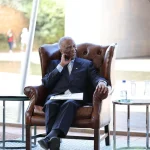

NIGERIA’S government is deploying digital technology to control and repress its citizens, according to a researcher who has studied the trend across Africa.
Chibuzo Achinivu, a visiting assistant professor of political science at Vassar College, said local conflicts and development needs are driving the Nigerian government’s adoption of digital authoritarianism technologies, while foreign suppliers are motivated by economic gain and regional influence.
“Digital authoritarianism is a new way governments are trying to control citizens using digital and information technology,” Achinivu wrote Tuesday in The Conversation. “It is a growing concern for advocacy groups and those interested in freedom and democracy.”
The researcher, who has studied digital authoritarianism in Africa over the last two decades, said technology is being used “to repress voices, keep people under surveillance, and manipulate populations for regime goals and survival.”
These tactics include internet and social media shutdowns, spyware to hack and monitor people’s devices, mass surveillance using artificial intelligence for facial recognition, and misinformation and disinformation propaganda campaigns, according to Achinivu.
Four Key Drivers
Achinivu identified four clear drivers of the trend: regime survival and political control, security and counterterrorism, electoral competition and information manipulation, and modernisation agendas.
“In the African context, digital authoritarianism is on the rise,” Achinivu wrote. “There’s a cohesive relationship between the foreign suppliers of the hardware, expertise and domestic demand.”
States including China, Russia, Israel, France and the United States supply both the technology and instruction to African regimes, with Kenya, Rwanda, Uganda, Nigeria and Ghana among the largest consumers, the researcher said.
The #EndSARS Case
Achinivu’s recent study focused on Nigeria’s turn to digital control tools following the 2020 #EndSARS Movement protests against police brutality.
After Twitter removed a post by then-President Muhammadu Buhari, the platform was banned in Nigeria. Former information minister Lai Mohammed claimed at the time that the ban was due to “the persistent use of the platform for activities that are capable of undermining Nigeria’s corporate existence,” Achinivu noted.
“However, the ban also undermined social movements that were successfully holding the government accountable,” the researcher wrote.
Following domestic and international outcry, the Nigerian government reportedly approached China to replicate its “Great Firewall” in Nigeria’s internet control system, which would allow the state to manage access to certain sites and block unwanted content.
Real-World Repression Goes Digital
Interviews with permanent secretaries and ministers of Nigerian ministries revealed that “repressive government practices in the real world are informing their activity in digital spaces,” Achinivu said.
“They intimated that the repression that occurs during protests in the streets in order to manage ‘lawlessness’ is being replicated online,” the researcher wrote. “Its purpose is to ensure peace and stability.”
Achinivu said countries like Nigeria initially seek foreign suppliers to establish or refurbish their information and communications technology systems for development purposes, including broadband networks and smart city governance systems.
“Though these are often not repressive in nature, they are capable of dual use,” the researcher wrote. “Thus, these development needs provide technologies that are then utilised in an authoritarian fashion for state-building goals.”
Solutions Needed
Achinivu proposed a three-pronged approach to address the problem, starting with international action to curb the sale of repressive tools to states.
“There must be a conversation about the norms of these technologies and their use for repression in both democracies and autocracies,” the researcher wrote.
On the demand side, Achinivu said practices that have undermined freedom and democracy offline must be addressed.
“It seems logical that eradicating digital repression necessitates addressing repression in general,” the researcher wrote.
Finally, Achinivu called for “regulatory, legal and institutional oversight alongside human rights benchmarks” to accompany digital and privacy rights in cyberspace.