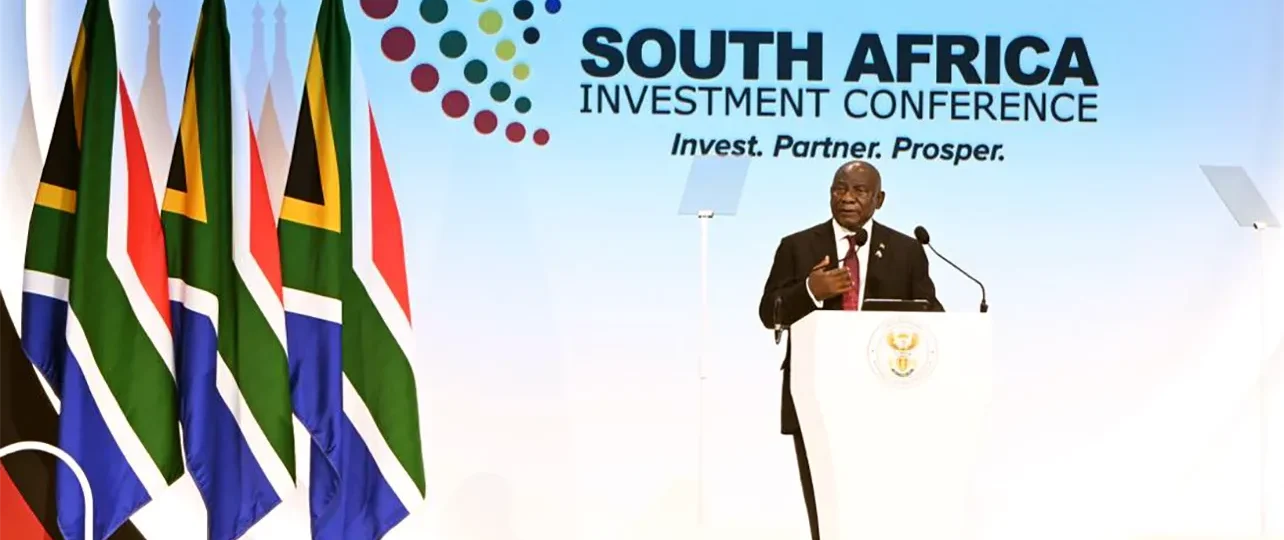

SOUTH AFRICA has launched the most ambitious investment mobilisation drive in its democratic history, opening the second cycle of the Presidential investment campaign with R889.8 billion in confirmed commitments – a figure that rewrites the country’s economic narrative with hard numbers and harder ambition.
Announced by President Cyril Ramaphosa at the sixth South Africa Investment Conference (SAIC) at the Sandton International Convention Centre, the figure comprises R415 billion in confirmed fixed investment and R474.8 billion in development finance institution (DFI) commitments – deployed across 81 projects in all nine provinces, sourced from 22 markets on five continents, and projected to create more than 230 000 permanent jobs.
“This is only the start of an era of new growth and dynamism for South Africa’s economy.”
President Cyril Ramaphosa, SAIC 2026
“This is not ambition for its own sake,” Ramaphosa told more than 1 000 delegates from over 50 countries. “It is the arithmetic of what South Africa requires to achieve meaningful unemployment reduction, to industrialise at scale, to lead Africa’s green transition and to build the infrastructure on which our people’s futures depend.”
The opening salvo sets the tone for a five-year drive targeting R2 trillion in new investment between 2026 and 2030 – more than doubling the first drive’s record. Between 2018 and 2023, South Africa attracted R1.5 trillion in verified commitments against a R1 trillion target, proving the model works. Today’s conference marks the formal handover from recovery to expansion.
A NEAR-TRILLION-RAND OPENING SHOT
The R889.8 billion announced today is not a projection – it is a firm, vetted, signed commitment. Every rand has been verified against the same accountability framework that governed the first investment drive: announced, recorded, and tracked publicly year by year. “We know that as investors you reward execution, not just commitment,” Ramaphosa said, and the architecture of SAIC is built precisely to enforce that discipline.
Of the DFI component, the African Development Bank has confirmed R20.5 billion for the 2026/27 financial year, while the New Development Bank will make approximately R34 billion available over the same period. The centrepiece of the multilateral package is the SA-Afreximbank Investment Facility – anchored by Afreximbank’s R176 billion commitment – a structured instrument designed to channel patient, concessional capital into the sectors South Africa’s second drive prioritises most.
At standard leverage ratios, the DFI commitments alone could mobilise between R393 billion and R786 billion in additional private investment over the drive horizon. As Ramaphosa put it: “That is what partnership at scale looks like.”
NINE PROVINCES, 22 SOURCE MARKETS
What distinguishes this second drive from its predecessor is its geographic and sectoral spread. All nine provinces are represented in the 81 confirmed projects — a rebuke to the long-standing criticism that South Africa’s investment story is a Gauteng story. The 22 source markets span five continents, a direct legacy of last year’s G20 presidency, which, Ramaphosa noted, “elevated South Africa’s global profile and deepened bilateral relationships” now reflected in concrete capital flows.
Sectors targeted include renewable energy – where R29 billion in confirmed investment was announced today alone – mining and critical minerals beneficiation, advanced manufacturing, digital infrastructure, water, agriculture and agro-processing. South Africa’s position as the producer of more than 70 percent of the world’s platinum group metals was cited as a strategic lever for the clean energy transition, with the country positioned as an indispensable partner to the global electric vehicle and battery storage supply chain.
230 000 PERMANENT JOBS: THE HUMAN LEDGER
Behind the rand figures is a human ledger: 230 000 permanent jobs. In a country where unemployment remains among the highest in the world, every confirmed project carries a social covenant as much as a commercial one. Ramaphosa was unequivocal that investment without transformation is incomplete. “Investment projects must include clear local content plans, formal skills transfer initiatives, community development commitments, and transparent environmental safeguards,” he said.
The dual training system – linking training centres, universities and companies to build a pipeline of technicians and project managers – was presented as the skills infrastructure for the investment era now beginning. Youth employment is the centrepiece of this social contract.
THE REFORM FOUNDATION
Investment at this scale does not arrive without a credible policy foundation. The president pointed to Operation Vulindlela – the joint Presidency-National Treasury structural reform initiative – as the engine underneath the headline numbers. Its mandate: reduce the cost and risk of investing in South Africa, “not through speeches but through measurable implementation.”
The electricity sector’s transformation since 2022 – the end of load shedding, the independent national transmission company, the 220 GW renewable energy pipeline, and the 36 GW already in grid connection – was presented as proof of concept. The same reform logic is now being applied to ports, rail, water and digital infrastructure. The 25-year concession for Durban Container Terminal Pier 2 (R11 billion), the allocation of 41 freight rail slots to private operators, and the planned first private train operation in April 2027 are milestones of a logistics reform agenda already in motion.
South Africa’s sovereign credit rating has been upgraded. The country has exited the FATF grey list. Inflation is converging towards the 3 percent target. Four consecutive quarters of growth have been recorded into early 2026. The macroeconomic case for South Africa as a destination of choice has rarely been stronger – and today’s numbers suggest the global investment community has noticed.
AFRICA’S INVESTMENT ANCHOR
Africa as a whole attracts barely 4 percent of global FDI. South Africa accounts for between 15 and 20 percent of the continent’s total – making its investment health a continental barometer. With the AfCFTA Secretariat represented at SAIC and the conference framed explicitly within a pan-African economic architecture, today’s announcements carry implications well beyond South Africa’s borders.
For a continent still fighting to translate its resource endowment and demographic dividend into durable industrialisation, South Africa’s SAIC model – accountable, transparent, sector-specific, socially anchored – offers a template that other economies may study and adapt.
‘R889.8 billion. Eighty-one projects. Nine provinces. Twenty-two source markets. Two hundred and thirty thousand permanent jobs. These are not promises. They are the opening position of a five-year, R2 trillion drive — signed, verified, and now set in motion.’