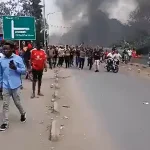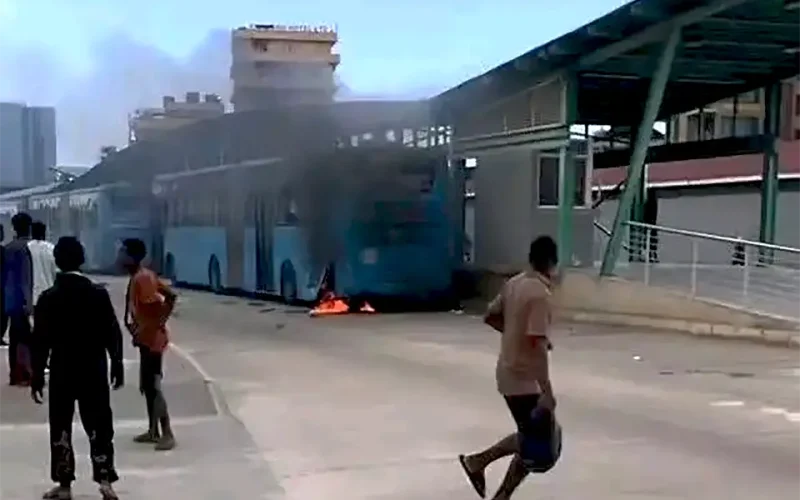
THE smoke rises black and defiant over Dar es Salaam, curling into the East African sky like a question mark written in ash. The question is simple, ancient, and now urgent: Who owns Tanzania?
On the streets where hundreds set polling stations alight on Wednesday, October 29, 2025, the answer is being written not in ballots but in blood and fire. This is a nation at war with itself – or more precisely, at war with a government that citizens believe has stolen their democracy in broad daylight.
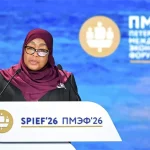
President Samia Suluhu Hassan’s two biggest challengers were excluded from the presidential race, transforming what should have been Tanzania’s democratic festival into what opposition leaders bitterly call “a coronation.” The mechanics of this political heist were surgical in their brutality: CHADEMA, Tanzania’s main opposition party, was disqualified in April for refusing to sign an electoral code of conduct, while party leader Tundu Lissu was arrested at a rally and charged with treason. The presidential candidate for the second-largest opposition party, ACT-Wazalendo, was similarly barred, leaving only minor parties to contest Hassan’s inevitable victory.
The stage was set for a theatrical performance where the ending was never in doubt. But the Tanzanian people – particularly the youth who watched their future being auctioned off – refused to play their assigned role as silent spectators.
“We Have Been Silent for So Long”
A protester shouted in a verified video, “We have been silent for so long. What have we been doing?” That cry captures the volcanic frustration that erupted across Tanzania’s cities on election day. In Dar es Salaam, a metropolis of seven million souls, protesters descended on the Kimara, Ubungo, Magomeni, Kinondoni, and Tandale neighbourhoods. They set a police station on fire and tore down banners of President Hassan. The symbolism was unmistakable: if the state would not listen to their voices at the ballot box, they would speak in the language of disruption.
Human rights activist Tito Magoti framed the uprising in historic terms. “The people are rewriting our political culture from being cows, if I use this word respectfully, to being active citizens,” he explained, noting that Tanzanians had long been perceived as peaceful and non-confrontational.
That perception is now as dead as the democracy protesters believe they’ve lost.
The Government’s Iron Fist
Hassan’s response to this democratic cry was not dialogue but violence. Police fired gunshots and teargas to disperse protesters who returned to the streets on Thursday, the day after the election. The government ordered an overnight curfew in Dar es Salaam, effectively turning the commercial capital into an occupied city.
The casualty count remains murky, shrouded in the same opacity that characterises this entire election. Tito Magoti reported receiving information about at least five deaths in Wednesday’s protests. A diplomatic source claimed solid reports suggested at least ten people had been killed in Dar es Salaam alone. Amnesty International’s regional director reported that one member of the public and one police officer had been killed, calling the deaths “deeply disturbing.”
Digital Darkness: The Internet Blackout
Internet access remained disrupted across the country, a digital suffocation designed to blind the world to Tanzania’s crisis. NetBlocks, an internet access advocacy group, confirmed the nationwide disruption to internet connectivity. In the 21st century, controlling information means controlling reality itself. By cutting Tanzania’s connection to the global conversation, Hassan’s government sought to ensure that what happens in Tanzania stays in Tanzania.
But protesters adapted. Using the Zello app, which allows smartphones to function like walkie-talkies, protesters discussed plans for further demonstrations, including marches on government buildings. Technology that doesn’t rely on internet infrastructure became the organising tool for a movement that refuses to be silenced.
The bitter irony is that Samia Suluhu Hassan once represented hope. When she took office in 2021 after the death of her predecessor, John Magufuli, she won plaudits for easing the repression of political opponents and censorship. She was supposed to be the reformer, the breather of fresh air into Tanzania’s stifled political atmosphere.
But in recent years, rights campaigners and opposition candidates have accused the government of unexplained abductions of its critics. The Tanganyika Law Society confirmed 83 abductions since Hassan came to power, with another 20 reported in recent weeks. UN human rights experts said more than 200 cases of enforced disappearance had been recorded in Tanzania since 2019.
Hassan has become what she was supposed to replace—an authoritarian leader wielding fear as policy. She said last year she had ordered an investigation into reports of abductions, but no official findings have been made public.
A Test of Wills
The unrest presents a major test for Hassan. She stands accused by her own citizens of being perpetrator number one in the theft of their democratic rights. As state-run Tanzania Broadcasting Corporation began airing provisional presidential election results showing Hassan winning commanding majorities in various constituencies, the question becomes not whether she will claim victory, but whether that victory will have any legitimacy.
Government spokesperson Gerson Msigwa directed all civil servants to work from home on Thursday except for those whose duties require them to be present at their workplaces—a tacit acknowledgement that the capital is too dangerous, too volatile, too angry for normal governance.
Britain’s Foreign Office reported that some international flights had been cancelled to and from Dar es Salaam’s airport, and that the airport in the northern city of Arusha and one near Mount Kilimanjaro were closed. Tanzania is effectively under siege from within.
The Endgame: Power or People?
The battle lines are now drawn with brutal clarity. On one side: a government armed with bullets, teargas, curfews, and the apparatus of state violence. On the other hand, citizens are armed with courage, smartphones, burning tyres, and the conviction that their democracy has been stolen.
History will record what happens next in Tanzania. Will people power overwhelm government violence? Or will the iron fist crush the uprising, teaching Tanzanians that political participation is a privilege to be granted or withheld by those in power?
What’s certain is that Tanzania has crossed a threshold. The old social contract—where citizens remained passive in exchange for stability and modest economic growth—has been shredded. Tanzania’s economy grew by 5.5 percent last year, but economic statistics mean nothing when people feel politically dead.
The protesters in Dar es Salaam, Mbagala, Gongo la Mboto, and Kiluvya aren’t just fighting for candidates or parties. They’re fighting for something more fundamental: the right to choose their own leaders, to have their voices count, to live as citizens rather than subjects.
As smoke continues to rise over Tanzania’s cities and the internet remains dark, one thing is luminously clear: this nation will never be the same. Democracy may have died in this election, but something else—fierce, ungovernable, and dangerous to any dictator—has been born in its place.
The people have found their voice. And they are done being silent.