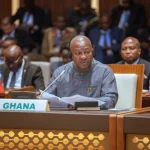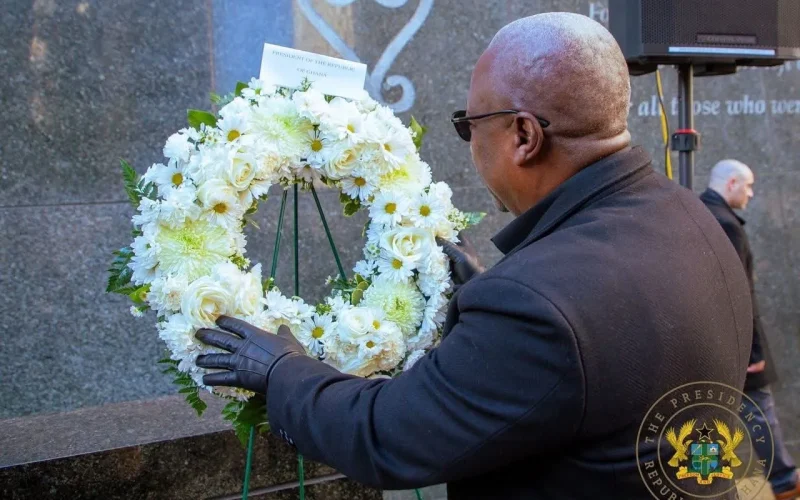
HE began not with statistics or diplomatic pleasantries, but with a declaration about language. “Truth begins with language,” Ghana’s President John Dramani Mahama told delegates at the United Nations, his voice a measured instrument of moral authority. “There is no such thing as a slave. There were human beings who were trafficked and then enslaved.”
The distinction, Mahama insisted, is not semantic hairsplitting. It is the fulcrum on which four centuries of deliberate dehumanisation turned – and the foundation upon which the African world must now stand in demanding justice. With those words, he launched what African and Caribbean diplomats are calling a landmark moment: the tabling of a UN General Assembly resolution that would formally recognise the transatlantic slave trade as “the gravest crime against humanity” and call for reparations.
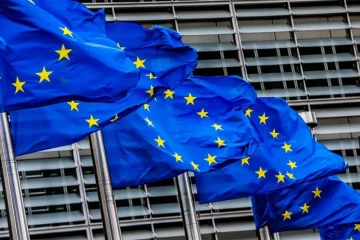
The resolution, backed by the 55-nation African Union and the Caribbean Community, as well as Brazil, faces fierce headwinds. Ghana’s Foreign Minister Samuel Ablakwa confirmed that both the European Union and the United States had already signalled they would not support it. The White House did not respond to requests for comment. But for Mahama and the coalition of nations behind him, the vote is only partly about the tally of hands raised.
“This resolution is a pathway to healing and reparative justice. This resolution is a safeguard against forgetting.”
President John Dramani Mahama, United Nations, March 2026
The Architecture of Atrocity
Speaking with the granular precision of a prosecutor laying out a case before history, Mahama walked the assembly through the machinery of the slave trade — not as an abstraction, but as a lived catastrophe. He described the dungeons of European-built coastal fortresses, the chained passage through the Middle Passage where ten to fifteen percent of enslaved people perished, and the auction blocks where, still naked, human beings were inspected “like livestock” and sold to the highest bidder.
“Remember when you hear these numbers that this is not data; these are human beings,” he said, before detailing the scale: roughly six million Africans trafficked to Brazil; nearly two million to Jamaica – then the most profitable sugar-producing location in the world; approximately 500,000 to the United States; and more than 450,000 to Barbados, an island thirty-four kilometres long and twenty-three kilometres wide.
The violence was not incidental but legally codified. Mahama referenced Barbados’s 1661 Slave Code, which described Africans as a “heathenish, brutish and uncertain, dangerous kind of people” and prescribed that a second act of resistance be punished by severe whipping, the slitting of the nose, and branding. That code, he noted, became a template for the wider Anglo-Atlantic world. A year later, Virginia’s legal doctrine of partus sequitur ventrem – “what is born follows the womb” – ensured that every child of an enslaved woman would also be enslaved, stripping paternity from the record and reducing human life to transferable property.
“Let’s not mince words,” Mahama said. “Business was booming because when labour is virtually free, profit margins are huge. African lives were disposable. If too many of the enslaved died, more were captured from their homes on the continent, enslaved and trafficked.”
‘Well… They Are Loud and Wrong’
Mahama was unsparing in his response to a familiar Western deflection – that one cannot judge the past by present moral standards. “People will sometimes try to put a disclaimer on slavery by insisting that you can’t use the social norms of today to judge the actions and events that took place in past eras,” he said. He paused for effect. “Well… they are loud and wrong.”
To underscore the point, he cited the 1688 Germantown Friends petition, in which a group of American Quakers formally protested chattel slavery nearly two centuries before abolition. They wrote that regardless of skin colour, the principle applied: do unto others as you would have done to yourself. Abolitionist voices, Mahama argued, existed as long as slavery itself – which means the institution was contested from the outset, and its continuation was a choice, not an inevitability.
“Slavery is wrong now, and it was wrong then.”
President John Dramani Mahama
The Normalisation of Erasure
Perhaps the most politically charged section of Mahama’s address was his critique of the United States under President Donald Trump. The Ghanaian leader argued that America’s assault on Black history – the removal of slavery exhibits, the banning of books, the mandated exclusion of race and segregation from school curricula, the defunding of museums and institutions that promote racial awareness — does not happen in a vacuum.
“These policies are becoming a template for other governments as well as some private institutions,” he warned. “At the very least, they are slowly normalising the erasure.”
He offered a damning example: a 2015 McGraw-Hill geography textbook distributed across more than a thousand Texas school districts that described millions of enslaved Africans as “workers” brought from Africa to work on agricultural plantations. The book was withdrawn only after a family lodged a complaint. He also cited animated videos produced by the conservative media organisation PragerU – used as supplemental material in public school classrooms across eleven American states – in which Christopher Columbus defends slavery, and Frederick Douglass is made to contextualise it as a universal historical phenomenon rather than a racialised atrocity.
Mahama had previously rebuked Trump for amplifying false claims of a white genocide in South Africa, calling them an insult to all Africans. His comments at the UN extended that critique into a broader structural warning: that what begins as domestic policy in the world’s most powerful nation tends to export itself.
“This is the type of forgetting that I was referring to,” he said, returning to his earlier framing of the resolution as a “safeguard against forgetting.”
Reclaiming the Continent’s Grandeur
Against the backdrop of historical horror, Mahama offered a counter-narrative rooted in African civilisational achievement. He quoted a Dutch traveller’s account of Benin City – its broad, straight streets, orderly architecture and cleanliness – and the 1531 testimony of a Portuguese sailor who visited Great Zimbabwe, describing a fortress of stone so finely constructed it appeared to need no mortar, with a tower rising more than twelve fathoms high.
He noted that nineteenth-century European visitors to Great Zimbabwe refused to believe indigenous Africans could have built such a civilisation – a denial that served the colonial imperative by making conquest seem less like theft and more like civilisation. “The greatness that is within us,” Mahama declared, “will always outweigh the injustices that have been visited upon us.”
The speech closed with a Nelson Mandela quotation: that human compassion binds people to one another not in pity or patronage, but as fellow human beings who have learned to turn suffering into hope.
The Resolution and What Lies Ahead
The draft resolution before the General Assembly is substantive in its demands. It calls on member states to enter dialogue on reparations that could include formal apologies, the return of looted artefacts, financial compensation, and legally binding guarantees of non-repetition. It stops short of dictating specific modalities, framing the conversation as one of restorative dialogue rather than imposition.
Several Western governments have opposed even the discussion of reparations, arguing that contemporary states should not be held responsible for historical crimes. Critics within the reparations movement counter that this position conveniently ignores the fact that wealth generated by enslaved labour compounded across generations and remains embedded in the economic structures of former colonial powers.
Ghana has been among the most consistent advocates on the continent. The reparations cause has gained momentum across the Global South in recent years, even as backlash has intensified in parts of Europe and North America. The Caribbean Community has formally called for reparations from former colonial powers since 2013. Several Caribbean nations have pursued bilateral negotiations with European governments with limited success.
What Tuesday’s address demonstrated is that the push for reparative justice is no longer a peripheral demand from small island states. It is an organised, legally articulated campaign backed by more than half the world’s nations — and led, now, by one of West Africa’s most prominent democratic voices.
“I speak these words not only for Ghana, but in solidarity with the rest of Africa, the Caribbean, Latin America, the wider Diaspora and, indeed, all people of good conscience.”
President John Dramani Mahama
Mahama ended where he began – with language. “Truth begins with language,” he said. “I hope all of you will vote tomorrow to speak truth to power so that together we can pass this historic resolution and finally acknowledge the full horror of these transgressions against the humanity of approximately 15 million human beings who were enslaved.”
The General Assembly vote is expected on Wednesday. Whatever the outcome, the record has been set. The argument has been made. And, as Mahama might say, the rest is the notes you choose not to play.