THE darkness of July 7, 2007, pressed heavily over Goma as twenty-six-year-old Floribert Bwana Chui faced the most defining moment of his young life. Outside, the shadows harboured men who had come for him – men whose pockets bulged with dirty money, whose consciences had long been silenced by greed. They offered him a choice that would echo through eternity: compromise his faith and live, or stand firm in his principles and die.
“Do I live for Christ or not?” The words that had become Floribert’s mantra now rang with prophetic power in the suffocating night air. “It’s better to die than accept this money.”
As the hours crawled toward July 8th, this young Congolese customs officer – a man who had destroyed batches of contaminated rice rather than allow them to poison his countrymen – made his final stand. The kidnappers had miscalculated. They thought every man had his price. They had never encountered someone who valued the lives of strangers more than his own survival.
When dawn broke on July 8, 2007, Floribert Bwana Chui Bin Kositi was dead. But his story was just beginning.
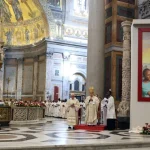
Eighteen years later, the young man who chose death over dishonesty will receive one of the Catholic Church’s highest honours. On June 15, 2025, during the Solemnity of the Holy Trinity, the Basilica of Saint Paul Outside the Walls in Rome will witness something extraordinary: the beatification of a 26-year-old African layman who became a martyr not on a battlefield, but in a government office, not for grand gestures, but for quiet integrity.
Pope Francis himself recognised Floribert’s martyrdom on November 25, 2024, declaring him a “martyr of honesty and moral integrity.” The decree from the Dicastery for the Causes of Saints transformed a local hero into a universal beacon of hope.
Born into privilege on June 13, 1981, in the very city where he would later die, Floribert seemed destined for comfort, not martyrdom. His wealthy family provided him with education in law and economics. His career path at the Congolese Control Office (OCC) promised financial security and social status. Yet somewhere between his law books and his work with street children through the Community of Sant’Egidio, Floribert discovered something more valuable than money: an unshakeable moral compass.
As head of the OCC office in Goma, he stood at the crossroads of commerce and corruption. The contaminated food streaming across the border from Rwanda came with an implicit offer – turn a blind eye, pocket the bribes, and everyone wins. Everyone except the ordinary Congolese who would consume the tainted products.
“Money will disappear quickly,” Floribert would say to those who pressured him. “And what about those who would have consumed these products?” His logic was devastatingly simple, his resolve unbreakable.
The moral dilemma that defined Floribert’s final days crystallised around expired rice shipments and falsified documents. While others saw profit margins and easy money, he saw poisoned families and violated trust. His refusal to participate in the deadly trade made him dangerous to powerful interests who had built empires on such corruption.
When threats escalated to kidnapping, Floribert faced his Gethsemane moment. Like his saviour before him, he could have chosen an easier path. Instead, he chose faithfulness over survival, integrity over compromise, love of neighbour over love of self.
Bishop Faustin Ngabu of Goma captured the essence of his sacrifice: “Floribert Bwana Chui Bin Kositi died for being true and honest to his Christian faith. He was someone who maintained his freedom in an extremely difficult situation.”
Now, eighteen years after that fateful night, Rome prepares to celebrate what Goma has long known: Floribert Bwana Chui was no ordinary government worker. He was a saint in the making, a man whose ordinary job became an extraordinary witness to the Gospel.
The beatification will make him the fourth Congolese blessed, joining a pantheon that includes Blessed Anuarite Nengapeta, Isidore Bakanja, and Father Albert Joubert. But Floribert’s story carries unique power for the modern world – he died not in persecution for openly preaching Christ, but for living Christ in the mundane corridors of bureaucracy.
Following the Rome ceremony, Goma will host its own celebration on July 8, 2025 – exactly eighteen years after Floribert’s martyrdom. Bishop Willy Ngumbi sees profound significance in this homecoming: “This beatification is a source of hope and a reason for thanksgiving to the Lord, who continues to fill us with His wonders.”
In an age of megachurch pastors and celebrity Christians, Floribert Bwana Chui offers something different: the radical witness of ordinary faithfulness. He never built a cathedral or led a crusade. He simply refused to let poisoned food cross his desk, even when that refusal cost him everything.
His martyrdom serves as “a call for everyone to be more committed to justice, peace, and fraternity in faith and trust in the Risen Christ,” Bishop Ngumbi declared. It’s a call that resonates far beyond the hills of Goma, reaching every office worker facing ethical compromises, every civil servant choosing between integrity and advancement, every person who must decide whether to live for Christ or merely talk about Him.
On June 15, 2025, as the ancient walls of Saint Paul Outside the Walls echo with hymns of celebration, the Church will officially recognize what became clear on that dark July night in 2007: sometimes the greatest saints are forged not in grand cathedrals, but in government offices, not through dramatic gestures, but through quiet refusals to compromise.
Floribert Bwana Chui chose death over dishonesty. The Church has chosen to make him a saint.
“Do I live for Christ or not?”
His answer changed everything.