
IN the bustling cafes of Kampala and Nairobi, across university campuses in Accra and Lagos, in the diplomatic corridors of Addis Ababa and the newsrooms of Johannesburg, a familiar sense of déjà vu settles over African observers watching Uganda’s political theatre unfold. The news that Bobi Wine has been cleared to challenge Yoweri Museveni in the 2026 presidential elections should, by all democratic standards, signal hope. Instead, it evokes a weary scepticism born from decades of witnessing Uganda’s carefully choreographed electoral pantomime.
Robert Kyagulanyi, known globally as Bobi Wine, emerged from Kampala’s sprawling Kamwokya ghetto with anthems of revolution on his lips and the dreams of Uganda’s forgotten youth in his heart. The 43-year-old pop star turned politician has become the embodiment of change in a nation where the concept of leadership transition has been virtually extinct for nearly four decades.
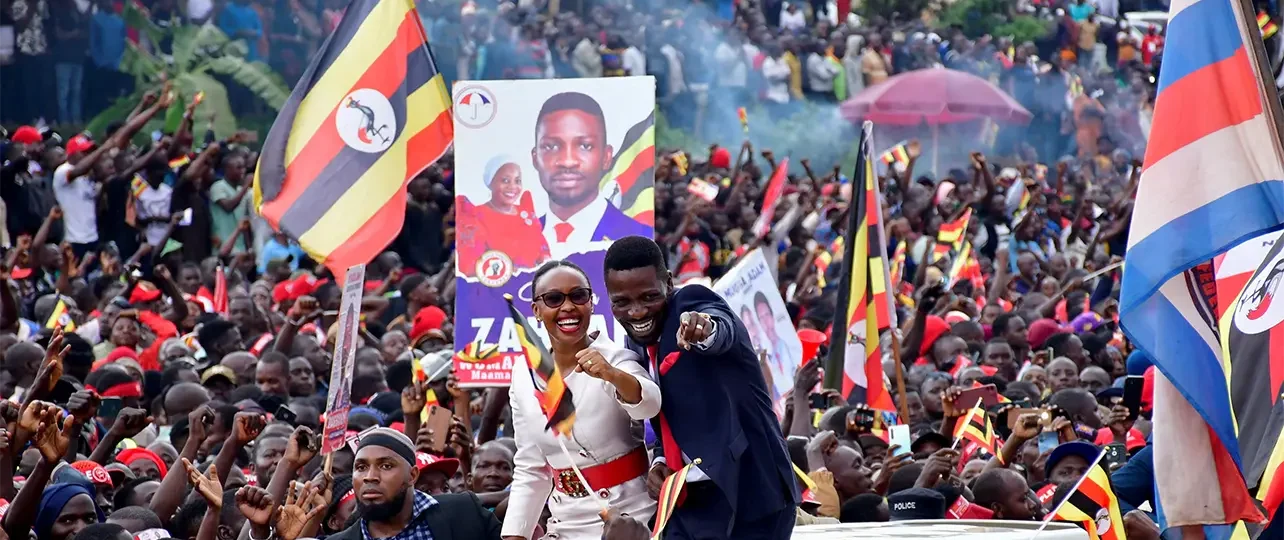
His clearance by Uganda’s Electoral Commission on September 24, 2025, to stand against the 81-year-old Museveni represents, on paper, the democratic process functioning as intended. Wine’s National Unity Platform (NUP) celebrated the decision with characteristic defiance, their leader speaking passionately about fighting for farmers, unemployed graduates, and the “ghetto people” whose futures have been systematically stolen.
Yet across African capitals, the reaction was measured by the cold arithmetic of precedent. Journalists, civil society leaders, and political analysts exchanged knowing glances, their optimism tempered by an institutional memory that stretches back through multiple electoral cycles of Ugandan disappointment.
The Besigye Precedent: A Warning Written in Detention
The spectre haunting any discussion of Uganda’s electoral prospects is not just historical—it is immediate and stark. Dr Kizza Besigye, the veteran opposition leader who spent years challenging Museveni’s grip on power, languishes in detention after being dramatically abducted from Nairobi in November 2024.
The circumstances of Besigye’s disappearance read like a script from an authoritarian playbook familiar to many African nations. One moment, he was in Kenya, exercising the basic freedom of movement; the next, he had vanished into the machinery of Uganda’s security apparatus. When he reappeared, it was in the steel dock of a military court in Kampala, facing charges that could carry the death penalty.
African civil society organisations watched with a mixture of outrage and grim recognition. Human rights advocates across the continent issued urgent appeals for Besigye’s release, but beyond the protests lay a deeper understanding: this was the template, the proven method by which Uganda’s ruling establishment neutralises political threats.
Besigye’s subsequent hunger strike in Luzira Maximum Security Prison, his hospitalisation in February 2025, and his continued detention despite court rulings, painted a portrait of a system that operates by its own rules—rules that have little to do with electoral democracy and everything to do with the preservation of power.
The pattern resonates painfully across Africa, where opposition leaders from Zimbabwe’s Morgan Tsvangirai to Kenya’s Raila Odinga have faced similar systematic persecution, creating a continental climate of scepticism about the possibility of genuine democratic change through electoral processes.
The Military’s Casual Brutality
Perhaps nothing encapsulates the cynicism surrounding Uganda’s electoral process more than the casual brutality of General Muhoozi Kainerugaba, Museveni’s son and head of the military. In January 2025, the younger Museveni publicly threatened to “behead” Bobi Wine—a threat that would trigger constitutional crises in functional democracies but barely registered as news in Uganda’s political landscape.
More chilling still was Muhoozi’s May admission that he was holding a missing NUP official in his “basement,” a revelation delivered with the nonchalant confidence of someone operating above the law. These weren’t the desperate acts of a regime under pressure; they were the casual flexing of institutional power, designed as much to terrorise as to inform.
African political observers, particularly those who have witnessed similar patterns from Harare to Khartoum, noted these incidents not as aberrations but as clear indicators of intent. The message was unmistakable: electoral participation might be permitted, but only within parameters defined by those who had no intention of relinquishing power.
The Ghetto Youth and the Weight of History
Bobi Wine’s appeal lies precisely in his authenticity as the “Ghetto President”—a title that captures both his origins in Kampala’s poorest neighbourhoods and his genuine connection to Uganda’s massive youth population. His music career in the early 2000s provided the soundtrack to a generation’s aspirations, and his transition to politics represented their hopes made manifest.
When Wine speaks of fighting for “ghetto youth whose future is being stolen,” he articulates a reality that resonates across Africa. Uganda, despite its natural resource wealth, remains trapped in patterns of governance that prioritise extraction over development, control over empowerment—a story familiar from Lagos to Luanda, from Accra to Abidjan.
African development experts and civil society leaders, many of whom have invested decades in democratic movements across the continent, recognise the fundamental contradiction at the heart of the situation. How can genuine electoral competition exist when the military leadership openly threatens violence against opposition figures? How can democratic norms take root when disappearances and detentions remain the standard tools of political management?
The Choreography of Controlled Opposition
The pattern has become depressingly familiar to African observers: allow opposition candidates to register, permit limited campaigning, then systematically undermine their capacity to compete through arrests, harassment, and institutional manipulation. The 2021 elections provided a master class in this approach, with Wine ultimately rejecting results he claimed were stolen through “pre-ticked ballots, intimidation by security forces, falsification of results and voter bribery.”
This choreographed democracy has been witnessed across the continent, from Zimbabwe’s consistently disputed elections to the carefully managed transitions in countries like Rwanda and Ethiopia. The African Union’s responses to such situations have often been notably restrained, reflecting the organisation’s principle of non-interference and the delicate balance of maintaining continental solidarity while promoting democratic values.
This pragmatic calculation creates a cynical dynamic where African institutions issue carefully worded statements about democratic processes while maintaining business-as-usual relationships with authoritarian regimes. The result is a form of complicity through inaction, where continental bodies become unwitting enablers of the electoral charade.
The 2026 Calculation
As Uganda approaches the 2026 elections, African scepticism is informed not by pessimism but by pattern recognition. The clearance of Bobi Wine represents the opening act of a familiar drama, one where the appearance of democratic competition masks the reality of predetermined outcomes.
Young Africans watching from Dakar to Dar es Salaam see in Wine’s struggle a reflection of their own frustrated aspirations for genuine change. His National Unity Platform’s calls for international solidarity resonate particularly with civil society movements across the continent that have faced similar repression while fighting for democratic space.
The question facing African civil society and institutions is whether they are prepared to break this cycle of complicit observation. Wine’s challenge to continental bodies to take a stronger stand against rights abuses places African institutions in an uncomfortable position: continue the pattern of diplomatic protests and strategic accommodation, or escalate to meaningful consequences that might actually alter Uganda’s political calculus.
Regional Implications
The stakes extend far beyond Uganda’s borders. In the East African Community, where Uganda plays a crucial role in regional security and economic integration, the country’s internal governance failures have broader implications for continental stability. Tanzania’s John Magufuli showed how authoritarian tendencies could spread across borders; Kenya’s own struggles with electoral legitimacy demonstrate how democratic backsliding becomes contagious.
For the African Union, Uganda’s electoral process serves as either a demonstration of possibility or a confirmation of futility. African scepticism about Wine’s genuine chances isn’t rooted in doubts about his popularity or political skills—it stems from a clear-eyed assessment of the structural forces arrayed against democratic change across the continent.
The Illusion of Choice
What emerges from this analysis is the sobering recognition that Uganda’s electoral process has become an elaborate performance designed to provide legitimacy without genuine choice. Museveni’s clearance to seek a seventh term, potentially extending his rule to nearly half a century, represents not just political longevity but the institutionalisation of pseudo-democratic authoritarianism that has become all too familiar across Africa.
For Bobi Wine, the challenge is not simply electoral—it is existential. Can he navigate the next months without experiencing Besigye’s fate? Can he build a campaign infrastructure while facing the constant threat of detention, harassment, and worse? Can he mobilise Uganda’s youth in sufficient numbers to overcome institutional manipulation of the electoral process?
African observers, watching from across the continent, confront an uncomfortable truth: their scepticism about Wine’s chances is not defeatism but realism. In a system where military leaders casually threaten opposition candidates and veteran politicians disappear into military detention, the mechanics of democratic competition become secondary to the dynamics of power preservation.
The tragedy is not that Bobi Wine will likely face insurmountable obstacles in his quest to unseat Museveni—it is that this outcome is so predictable that it has already been discounted in African political calculations. The clearing of candidates becomes a bureaucratic formality rather than a democratic milestone, the beginning of a process whose conclusion is foregone.
The Continental Mirror
Uganda’s situation serves as a mirror for Africa’s broader democratic struggles. From the perpetual presidencies in Equatorial Guinea and Cameroon to the managed transitions in Rwanda and Ethiopia, the continent grapples with the gap between democratic aspirations and authoritarian realities.
Young Africans, particularly in urban centres, watch Bobi Wine’s journey with a mixture of hope and cynicism born from witnessing similar struggles across their continent. They understand that his fight is their fight, that his potential defeat represents not just Uganda’s loss but Africa’s continued struggle with the promise of democratic governance.
As Uganda moves toward 2026, the continent will watch another performance in the long-running drama of African pseudo-democracy. African scepticism serves not as cynical detachment but as witness to a pattern that has proven tragically consistent across borders: the form of elections without their substance, the appearance of choice without its reality, the promise of change without its delivery.
The ghetto youth whom Bobi Wine champions—not just in Kampala but in slums across Africa—deserve better than this theatrical version of democracy. Until African institutions and civil society are prepared to move beyond carefully worded statements to meaningful action, the cycle of electoral disappointment will continue, and African scepticism will remain, unfortunately, the most realistic assessment of the continent’s democratic future.