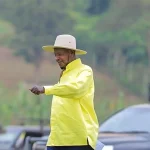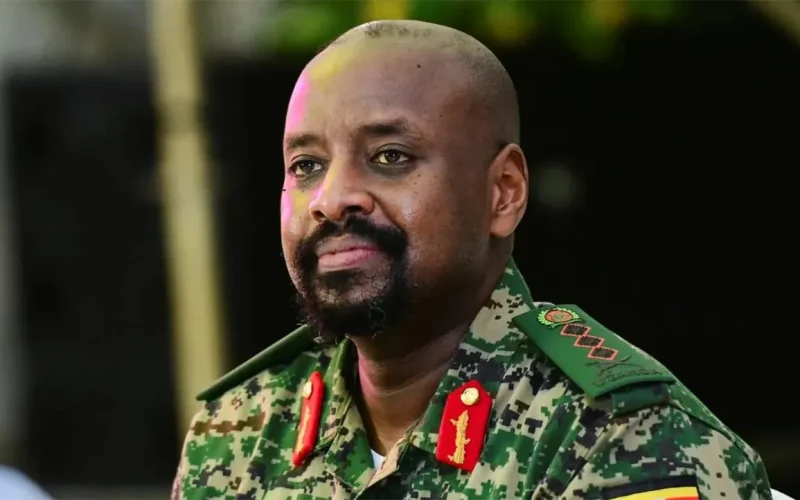
ON a continent where solidarity with Palestine is not merely a foreign policy position but a lived moral inheritance rooted in anti-colonial struggle, General Muhoozi Kainerugaba has chosen to stake out the most contrarian posture imaginable. In a barrage of posts on X this week that generated more than 1.3 million engagements globally, the son of Uganda’s President Yoweri Museveni and commander of the Uganda People’s Defence Force (UPDF) declared that any attempt to destroy Israel would bring Uganda into the war – on Israel’s side.
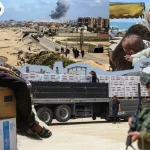
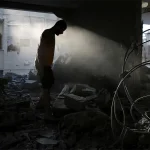
The declaration arrived as Israeli warplanes continued to pound what remains of Gaza and as Israel and the United States prosecute an ongoing military campaign against Iran that has, by available accounts, killed more than 1,500 Iranians and drawn retaliation on Israeli and American targets across the region. Muhoozi, unbothered by the optics, was explicit: “We want the war in the Middle East to end now. The world is tired of it. But any talk of destroying or defeating Israel will bring us into the war. On the side of Israel!”
He did not stop there. In subsequent posts – one of which he later deleted – he claimed he had already offered the services of the UPDF to both Washington and Tel Aviv, and boasted that a single Ugandan brigade could resolve the Iran crisis rapidly without aerial bombardment. He warned Tehran directly: fire missiles at Uganda, Uganda would fire back. He anchored his theology in the book of Deuteronomy, declaring that Uganda stands with Israel because Ugandans are Christians saved by Jesus Christ. The posts were extraordinary for their sweep, their combativeness, and – in the context of African foreign policy norms – their jaw-dropping isolation.
“If Israel needs help, it only needs to ask. Their Ugandan brothers are ready to assist. If Tehran dares hit us with missiles — we shall retaliate with our own missiles.”
Gen. Muhoozi Kainerugaba, March 26, 2026
AN AFFRONT TO CONTINENTAL CONSENSUS
To understand how jarring Muhoozi’s statements are, one must appreciate the weight of what Africa has consistently said about Palestine – and what Palestine has historically meant to Africa’s liberation movements. The African National Congress received material and moral support from the Palestine Liberation Organisation throughout the struggle against apartheid. The PLO was among the first international organisations to open an office in South Africa after 1994. ZANU-PF, Frelimo, the MPLA, SWAPO — the liberation movements that remade the southern half of this continent – drew deeply from the well of Third World solidarity that placed Palestinian self-determination at its centre.
South Africa has taken that solidarity to the International Court of Justice, where it is pursuing a genocide case against Israel over its conduct in Gaza. Namibia has formally intervened in that case. Bolivia, Nicaragua, Colombia — the Global South’s firmest voices — have done the same. The African Union has passed resolutions calling for a ceasefire. The overwhelming weight of continental opinion, reflected in diplomatic positions, civil society statements, and street demonstrations from Lagos to Nairobi to Cape Town, is unambiguously on the side of Palestinian civilians who have endured a campaign of destruction that has shocked the world.
Into this moral landscape, Muhoozi has thrown a lit match. His statements — not clarified, not walked back, and repeatedly doubled down upon — are not a gaffe. They are a statement of identity, allegiance and, arguably, political calculation.
THE GHOST OF IDI AMIN
The irony has not been lost on critics, and it cuts deep. Muhoozi’s celebration of Israel explicitly positions itself as a correction of the Idi Amin era — the time when, in his framing, Uganda’s name was associated with anti-Israel hostility. He has already announced plans to erect a statue of the late Lt. Col. Yonatan Netanyahu, killed during the 1976 Israeli commando raid on Entebbe, at the exact spot of his death inside Entebbe International Airport. Amin, who provided sanctuary to Palestinian hijackers and facilitated the hostage crisis, is the implicit villain of Muhoozi’s historical narrative.
But across African social media, Muhoozi’s critics have invoked Amin not as a symbol of shame but as a voice of clarity — a man who, whatever his monstrous domestic record, articulated with unflinching boldness what Africa’s decolonial stance on Palestine required. Amin’s 1975 address to the United Nations General Assembly, delivered in his capacity as OAU Chairman, called for the expulsion of Israel from the UN and the restoration of Palestinian territorial integrity. That speech, carried live across African capitals, was part of the Third World solidarity architecture that Muhoozi now proposes to dismantle in exchange for the approval of Washington and Tel Aviv.
“Idi Amin, at the UN, called for Palestinian territorial integrity and spoke truth to Zionist power. Muhoozi wants to fight alongside a state bombing civilians into the stone age. Who has the clearer conscience?”
widely circulated reaction on X, March 2026
The CHAR (Conflict, Humanitarian Affairs and Rights) Association has been among the critical voices, highlighting the contradiction between Muhoozi’s posture and the broader trajectory of African solidarity politics. On X, commentators from across the continent have reminded the Ugandan general of Palestine’s concrete role in supporting African independence movements — solidarity that was not abstract or rhetorical but expressed in training camps, diplomatic cover, and resources extended to fighters who were then labelled terrorists by the same Western powers Muhoozi now appears eager to impress.
THE POLITICAL ARITHMETIC
Analysts have been quick to offer a cold-eyed reading of what Muhoozi is actually doing. He is not, most agree, planning to deploy the UPDF to the Strait of Hormuz. He is, rather, positioning himself within a specific political universe — one in which alignment with the United States and Israel translates into security guarantees, intelligence cooperation, weapons supply, and diplomatic cover for the Museveni dynasty’s continued grip on power.
The Museveni government has cultivated deep security ties with Israel across four decades. Israeli military technology, intelligence architecture, and training have been integral to Uganda’s counterterrorism posture — particularly against Islamist threats in the region. That relationship, built quietly and practically, is the substrate beneath Muhoozi’s theatrics. When he says Israel stood with Uganda in the 1980s and 1990s when Uganda was still finding its feet, and asks rhetorically why Uganda would not defend Israel now that Uganda’s GDP has reached $100 billion, he is articulating a transactional logic that many in Kampala’s security establishment find unremarkable.
What is remarkable is the timing and the register. Muhoozi has made these declarations not in a closed briefing room but on the most public platform on earth, at a moment when the human cost of Israel’s campaigns — in Gaza and now against Iran — is being catalogued in real time by the world’s cameras. The optics of a senior African military commander volunteering his soldiers to a war effort that much of humanity views as disproportionate or criminal is, at minimum, a diplomatic liability.
Republican Senator Jim Risch, the chair of the Senate Foreign Relations Committee, has signalled discomfort too — warning that Muhoozi’s more extreme posts crossed a red line and risked triggering a review of the US-Uganda security cooperation agreement. That warning itself reveals the complexity of Muhoozi’s position: his desire to demonstrate pro-Western, pro-Israel credentials has alarmed even his would-be American patrons.
SUCCESSION POLITICS IN UNIFORM
Behind the geopolitical noise lies a nakedly domestic subtext. Muhoozi Kainerugaba is, by wide consensus, the most likely successor to his 81-year-old father as Uganda’s head of state. He runs the Patriotic League of Uganda, a political movement aligned with the ruling NRM. He commands the UPDF. He has threatened opposition politicians with death on this same social media platform without consequence. His pro-Israel declarations fit a pattern: high-visibility, high-controversy statements designed to accumulate international brand recognition, project a persona of decisive leadership, and signal to Washington and Tel Aviv that a Muhoozi presidency would be a reliable partner.
Political commentators in Kampala and beyond have observed that Kainerugaba is making a calculated move — that taking such an internationally visible stance serves as a diplomatic strategy designed to secure strong political backing from both the United States and Israel ahead of future political transitions. The calculation is not irrational. But it comes at a cost — one paid not by the Museveni family but by Uganda’s standing in the broader African community and by ordinary Ugandans who may find themselves rhetorically conscripted into a war their president’s son advertised on social media.
“This is not military strategy. This is succession theatre — played out on a global stage at the cost of Africa’s moral coherence.”
African Mirror analysis
WHAT AFRICA IS WATCHING
The broader African silence on Muhoozi’s declarations is itself instructive. No African head of state has endorsed his position. No African Union spokesperson has echoed his framing. South Africa, currently among the world’s most vocal critics of Israeli conduct, has said nothing publicly — but the silence in Pretoria is its own statement. The contrast with South Africa’s ICJ case could not be more starkly drawn: one African government is before the world court arguing that Israel’s conduct in Gaza constitutes genocide; another government’s army chief is volunteering troops to fight alongside Israel.
That Africa contains both these positions simultaneously is not surprising — the continent is not a monolith. But the continental consensus, as expressed through the African Union, through the ICJ interventions, and through the weight of public opinion from Cairo to Johannesburg, is not where Muhoozi is standing. He is standing somewhere else: closer to Washington, closer to Tel Aviv, and — in the reckoning of many — further from the liberation tradition that gave his country the right to exist as a free republic in the first place.
Palestine, after all, did not merely support Africa in the abstract. Palestinian solidarity with African liberation was expressed at moments of maximum danger, when the survival of movements like the ANC was not guaranteed. That solidarity is not an accounting entry to be cancelled by a change of strategic interest. It is, for many Africans, a moral debt — and one that Muhoozi appears content to repudiate, in public, at scale, with biblical justification attached.
THE RECKONING
General Muhoozi Kainerugaba will not deploy the UPDF to Iran. The deleted post was probably a fever of bravado, not a military order. Uganda has neither the logistics, the international sanctions, nor the institutional will to insert itself into a conflict ten time zones away. But what Muhoozi has done — systematically, over weeks of social media declarations — is stake out a position that places Uganda outside the African moral consensus on Palestine and outside the cautious neutrality that even pro-Western African governments have maintained as Israeli military operations have expanded.
He has done so on the eve of what may become the most consequential period of Uganda’s political history — the transition from Museveni to whoever comes next. He has done so while Gaza continues to bleed, while Iranian cities absorb Israeli airstrikes, and while African publics watch their continent’s alleged leaders calculate what posture is most likely to attract the favour of powerful states that have never, in the final analysis, treated African sovereignty as anything other than an instrument.
Idi Amin was a monster. No informed observer disputes that. But across the digital squares of African discourse this week, it was Amin’s voice at the UN — not Muhoozi’s posts on X — that people were sharing. That says something about the depth of what has been lost, and how far a general who wants to be president has wandered from the shore.