AS the world prepares to ring in 2025, citizens from several African nations have received an unexpected and unwelcome New Year’s present from Washington: a complete ban on entering the United States.
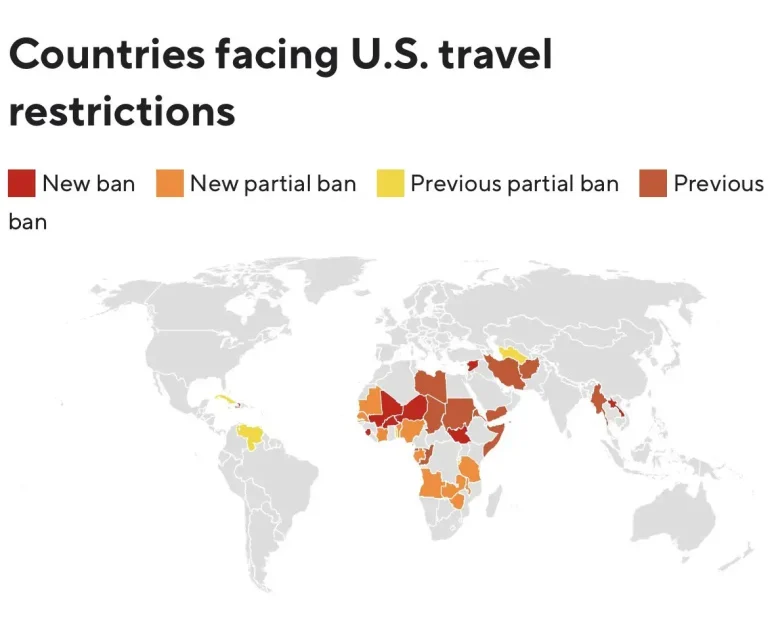
US President Donald Trump signed a proclamation on Tuesday expanding travel restrictions that will prohibit citizens from Burkina Faso, Mali, Niger, South Sudan, and Sierra Leone from entering American territory. The ban takes effect on January 1, 2025.
The action also imposes restrictions on those carrying Palestinian Authority travel documents, and extends bans to Laos and Syria, though the focus of the impact falls heavily on the African continent.
Three Sahel nations – Burkina Faso, Mali, and Niger – find themselves collectively punished despite their ongoing battles against extremist violence. These countries, which recently formed the Alliance of Sahel States after withdrawing from the Economic Community of West African States (ECOWAS), now face diplomatic isolation compounding their security challenges.
Sierra Leone and South Sudan join the list, with the White House citing “demonstrated, persistent, and severe deficiencies in screening, vetting, and information-sharing” as justification for the sweeping restrictions.
Nigeria in the Crosshairs
While Nigeria avoided a complete ban, it has been placed under partial restrictions and increased scrutiny. Trump threatened military action against Africa’s most populous nation in early November over what he described as the persecution of Christians in the country.
Nigerian authorities have strongly rejected these claims, arguing they misrepresent a complex security situation involving banditry, farmer-herder conflicts, and insurgency in the northeast. Officials have emphasised the government’s commitment to protecting religious freedom for all citizens in a nation roughly evenly split between Christians and Muslims.
What About South Africa?
Notably absent from the restricted list is South Africa, despite ongoing tensions between Pretoria and Washington over various policy disagreements. However, the broader pattern of restrictive immigration measures has raised concerns among South African officials about potential future targeting.
Recent months have seen complex negotiations between the US and African nations over critical mineral access, with South Africa holding significant reserves of platinum, chromium, and other strategic materials essential for technology and defence industries.
The Mineral and Health Diplomacy Paradox
The timing of these travel restrictions creates a striking contradiction in US-Africa policy. Even as Washington seeks to secure access to Africa’s vast mineral wealth – particularly rare earth elements and critical minerals needed for semiconductors, electric vehicles, and renewable energy – it simultaneously closes its doors to African citizens.
Recent US initiatives have focused on countering Chinese influence in African mining sectors, with deals proposed for lithium in Zimbabwe, cobalt in the Democratic Republic of Congo, and various minerals across the Sahel region.
Similarly, health partnerships that emerged during the COVID-19 pandemic, including vaccine manufacturing facilities in South Africa and Rwanda, sit awkwardly alongside policies that treat African nations as security threats.
Trump’s expanded travel ban is part of an aggressive immigration enforcement agenda since his return to office in January 2025. The administration has sent federal agents to major US cities, turned away asylum seekers at the Mexican border, and promised to “permanently pause” migration from what he termed “Third World Countries”- a designation that remains undefined but clearly encompasses much of Africa.
The White House justified the expansion partly by referencing a shooting in Washington, D.C. last month involving an Afghan national, though no connection to any of the banned African countries has been established.
Impact on African Families and Students
The ban will have immediate and severe consequences for thousands of African families with relatives in the United States, students hoping to pursue an American education, and professionals seeking business opportunities. Existing visa holders from the affected countries may find themselves unable to return home and re-enter the US.
Medical professionals, academics, and business leaders from these nations now face an impenetrable barrier to one of the world’s largest economies and most influential centres of higher education.
African Responses
As news of the ban spread across the continent, reactions ranged from anger to resignation. Many African observers noted the irony of being excluded from a nation built by immigrants, while others pointed to the measure as further evidence of shifting global dynamics that may accelerate Africa’s pivot toward other partnerships with China, the European Union, and the Gulf states.
The African Union has yet to issue a formal response to the expanded travel ban, though individual member states are expected to protest the measures through diplomatic channels.
As these restrictions take effect on New Year’s Day, they mark not just a policy shift but a symbolic moment in US-Africa relations. For citizens of the affected nations, the message from Washington is clear: despite America’s economic interests in African minerals and markets, its doors remain firmly closed to African people.
The contradiction between seeking Africa’s resources while rejecting its people may define this chapter of transatlantic relations – an irony not lost on a continent that has weathered colonialism, cold war proxy conflicts, and now, in the 21st century, finds itself once again valued for what it possesses rather than who its people are.