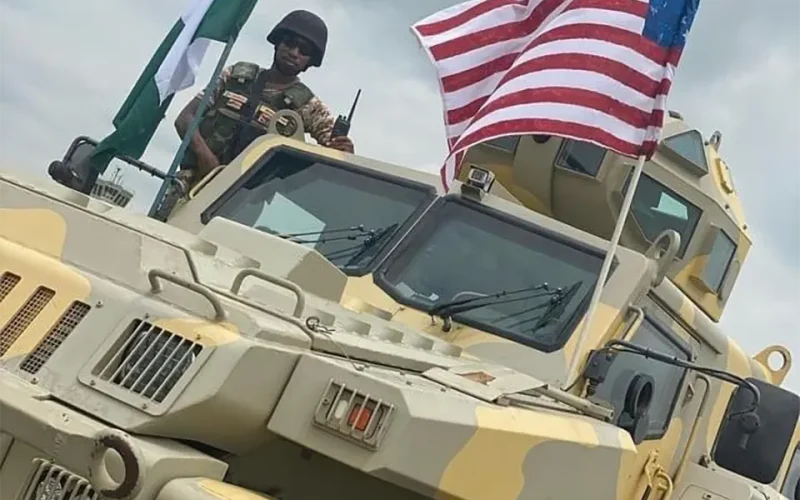
IN a significant escalation of international counter-terrorism efforts, the United States and Nigeria have confirmed a joint military operation that delivered precision airstrikes against Islamic State-affiliated terror cells operating in Nigeria’s volatile North West region, signalling a dramatic shift in how both nations confront extremist violence that has destabilised the area for years.
The coordinated strikes, authorised by US President Donald Trump and executed with Nigerian government cooperation, represent the most overt American military intervention in Nigeria’s long-running battle against jihadist insurgencies that have killed tens of thousands and displaced millions across the country’s northern territories.
Strategic Partnership Takes Kinetic Form
Nigeria’s Ministry of Foreign Affairs confirmed Friday that the operation emerged from what spokesman Kimiebi Ebienfa described as “structured security cooperation with international partners, including the United States of America,” involving intelligence sharing, strategic coordination, and operational support designed to address terrorism and violent extremism within the framework of international law and Nigerian sovereignty.
The acknowledgement comes after President Trump announced Thursday evening on Truth Social that US forces had conducted what he characterised as “powerful and deadly” strikes against Islamic State terrorists who have been “targeting and viciously killing, primarily, innocent Christians” in Northwestern Nigeria.
“The Department of War executed numerous perfect strikes, as only the United States is capable of doing,” Trump declared, issuing a stark warning that further attacks would follow if violence against civilians continued. “If they did not stop the slaughtering of Christians, there would be hell to pay, and tonight, there was.”
US Defence Secretary Pete Hegseth confirmed the Nigerian government’s active cooperation in the operation, writing on social media that his department was “grateful for Nigerian government support & cooperation” and remained “always ready” for further action.
The joint operation unfolds against a backdrop of escalating violence across Nigeria’s northern regions, where multiple terrorist organisations, including Islamic State West Africa Province (ISWAP), Boko Haram splinter groups, and armed bandit networks, have conducted increasingly brazen attacks on both civilian and military targets.
The strikes came just one day after a suicide bombing at a mosque in Maiduguri, Borno State, that killed five people and wounded dozens more, underscoring the persistent threat posed by extremist groups despite years of Nigerian military operations.
For over a decade, Nigeria’s security forces have struggled to contain insurgencies that have transformed the North East and North West into some of Africa’s most dangerous territories. The violence has transcended religious boundaries, with Muslim and Christian communities alike suffering devastating casualties, mass abductions, and economic destruction.
Sovereignty and Cooperation
The Nigerian government’s statement emphasised that all counter-terrorism efforts remain “guided by the primacy of protecting civilian lives, safeguarding national unity, and upholding the rights and dignity of all citizens, irrespective of faith or ethnicity.”
This carefully calibrated language addresses longstanding sensitivities around foreign military operations on Nigerian soil. While the country has previously accepted intelligence and training support from Western partners, direct military strikes by a foreign power represent a significant development in the security partnership.
The Ministry of Foreign Affairs stressed that terrorist violence “whether directed at Christians, Muslims, or other communities, remains an affront to Nigeria’s values and to international peace and security,” pushing back against any characterisation of the conflict as exclusively sectarian while acknowledging the targeting of Christian communities that prompted the American action.
Strategic Implications
Security analysts view the joint operation as evidence of growing international concern about the expanding reach and lethality of jihadist networks in West Africa’s most populous nation. Nigeria’s strategic importance – as Africa’s largest economy and a regional anchor state – makes instability within its borders a matter of continental and global security concern.
The operation also reflects the Trump administration’s stated determination to aggressively confront Islamic extremism worldwide, building on previous US military engagements across the Sahel region, where terrorist groups have exploited porous borders and weak governance.
Nigeria’s government indicated that cooperation with international partners would continue through “established diplomatic and security channels to weaken terrorist networks, disrupt their financing and logistics, and prevent cross-border threats.”
Path Forward
As details of the operation’s scope and impact emerge, questions remain about the tactical outcomes, civilian casualty considerations, and whether the strikes will achieve lasting degradation of terrorist capabilities or serve primarily as a deterrent signal.
The Ministry of Foreign Affairs pledged to keep the public informed through official channels as the security situation develops, though historically, details of military operations in Nigeria’s conflict zones have been closely guarded.
What remains clear is that both Abuja and Washington have demonstrated a willingness to take coordinated, kinetic action against terror networks whose violence has exacted an enormous human toll across northern Nigeria – and that further operations may follow if attacks on civilian populations continue.
The coming weeks will reveal whether this escalation marks a turning point in Nigeria’s protracted struggle against extremism, or simply another chapter in a conflict that has proven remarkably resistant to military solutions alone.