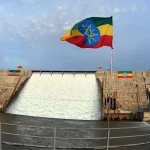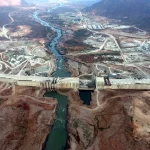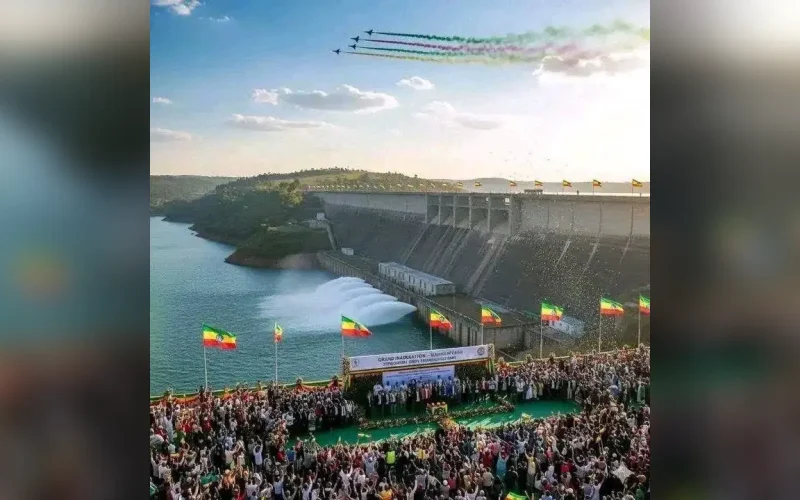
EGYPT has issued its strongest warning yet against Ethiopia’s Grand Ethiopian Renaissance Dam, threatening to take “all measures provided for under international law” — diplomatic language that leaves the door open to military action — as Ethiopia officially inaugurated Africa’s largest hydroelectric project despite fierce downstream opposition.
In an urgent letter to the UN Security Council, Egyptian Foreign Minister Badr Abdelatty declared that Ethiopia’s completion of the $4.2 billion dam represents “a direct threat to international peace and security” and accused Addis Ababa of pursuing “aggressive” policies that amount to “blackmail against Egypt and Sudan.”
The strongly-worded statement marks Egypt’s most explicit threat of potential military intervention in the 14-year dispute over the Blue Nile dam, which Cairo views as an existential threat to its 104 million citizens who depend on the Nile for 90% of their water supply.
“Egypt reserves its right to take all measures provided for under international law and the United Nations Charter to defend the existential interests of its people,” the Foreign Ministry statement concluded, using diplomatic terminology that international law experts recognise as encompassing the full spectrum of responses, including armed force.
The escalation comes as Ethiopia celebrated what Prime Minister Abiy Ahmed called a “transformative moment” in the nation’s history, with the dam promising to provide electricity to millions of the 120 million Ethiopians who currently lack reliable power access.
Egypt’s letter to the Security Council accused Ethiopia of “continuing its policy of imposing a fait accompli” and showing “no concern as to whether its practices undermine the legal framework governing the Eastern Nile Basin under international law.”
Foreign Minister Abdelatty emphasised that Egypt’s previous restraint “was not out of weakness or neglect of Egypt’s legitimate interests, but rather out of a firm conviction in the need to prioritise dialogue and promote peace.” However, he warned that “Ethiopia’s persistence in unilaterally imposing faits accomplis” now requires international intervention.
The dam, with a reservoir capacity of 74 billion cubic meters, sits on the Blue Nile tributary that provides approximately 80% of the main Nile’s flow during flood season. Egypt fears the massive structure could dramatically reduce water flow during droughts and give Ethiopia unilateral control over Egypt’s primary water source.
Cairo’s letter called for “clear and unequivocal” international pressure against “Ethiopia’s irresponsible behaviour” and demanded the global community move beyond “political courtesies” to confront what it characterised as Ethiopian aggression.
The diplomatic crisis represents one of Africa’s most volatile water conflicts, with negotiations between Egypt, Sudan, and Ethiopia stalled for years over filling procedures, operational rules, and drought mitigation measures.
Ethiopia has consistently rejected Egyptian demands for binding agreements on dam operations, arguing the project is essential for lifting millions out of poverty in one of the world’s least electrified nations. The dam’s inauguration on Tuesday represents the culmination of a project financed primarily through domestic bonds and Chinese loans despite sustained international pressure.
Sudan, positioned between the regional rivals, faces complex calculations as it could benefit from regulated water flow and cheap electricity while also risking reduced water access during dry periods.
Egypt’s warning that “any misguided assumptions that its legitimate interests in the Nile can be overlooked are mere illusions” signals Cairo’s willingness to escalate beyond diplomatic channels if Ethiopia proceeds with full dam operations without downstream agreements.
The dispute now heads to the UN Security Council, where Egypt will seek international intervention in what it frames as a threat to regional stability in one of the world’s most strategically important waterways.