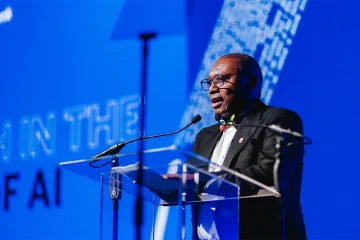
SOUTH Africa has lost one of its most formidable voices of resistance with the death of Molefe “Bra Phin” Pheto at his Magaliesburg farm on Sunday. The 90-year-old poet, playwright, musician, and political activist died just two weeks after being honoured by the Azanian People’s Organisation with the Steve Biko Award for his revolutionary contributions to the liberation struggle.
Pheto’s death marks the end of an extraordinary life that embodied the very essence of Black Consciousness – a movement he helped shape from the streets of Soweto to the stages of London’s exile community.
A Voice Forged in Fire
Born in Alexandra Township in 1935, Pheto’s journey from music student to revolutionary icon began at the Guildhall School of Music and Drama in London, where he studied from 1966 to 1970. But it was his return to apartheid South Africa that would define his legacy and nearly cost him his life.
In 1971, Pheto founded the Mihloti Black Theatre group, an uncompromisingly political collective that performed pieces relevant to the liberation struggle. “We shunned collaboration with white artists, arguing for a pure black arts movement that was unashamedly political,” he once explained. This bold stance made him a target.

The security police came for him in April 1975, launching an interrogation so brutal it would later inspire one of South Africa’s most powerful prison memoirs. For three days and nights, Pheto endured relentless questioning without sleep, standing throughout. When his body finally collapsed on the third morning, he couldn’t move his joints—a testament to the regime’s systematic torture.
“I believed my body was dying as my joints would not obey any of my commands,” he wrote in “And Night Fell: Memoirs of a Political Prisoner in South Africa,” published in 1983. The haunting account of 285 days in detention—217 in solitary confinement—became a cornerstone of resistance literature.
The Sun That Never Came
Perhaps no passage captures Pheto’s indomitable spirit more than his description of waiting for sunlight in a Hillbrow police cell after more than 200 days without seeing the sun. He watched its path across the sky, hoping for even a moment’s touch of warmth through the bars. The sun never reached him, but his hope never died.
“There is no sun in here / Only the rain outside, incessant / There is no shade in here / A mist, grey, blue-black / Through meshed wire-windows,” he wrote from his cell, transforming anguish into art that would inspire generations.
Exile and Resistance
Released in 1976 but warned that police were hunting him again after Biko’s murder in detention, Pheto fled to exile in 1977. In Britain, he became a founding member of the Black Consciousness Movement of Azania (BCMA) and helped organise the legendary Non-stop Picket at the South African embassy.
Even in exile, Pheto remained uncompromising. When Nelson Mandela was released in 1990, Pheto was among those who expressed disapproval of the negotiated settlement, finding it difficult to return to a South Africa he felt had betrayed the revolutionary ideals for which he had suffered.

Return to the Land
Pheto finally returned to South Africa in 1995, purchasing a farm in Magaliesburg that he named “Bangadile” – loosely translated as “they are sulking” or “they have thrown in the towel” in Setswana. The name was both defiant and reflective, acknowledging the struggles of his ancestors while refusing to surrender his principles.
In his colourful house painted in IsiNdebele patterns, Pheto spent his final years farming and writing, completing “The Bull from Moruleng: Vistas of Home and Exile” in 2012. The book unpacked his complex relationship with post-apartheid South Africa while maintaining his commitment to Black Consciousness principles.
A Revolutionary’s Legacy
“NOT just with a heavy heart, but a bleeding one, AZAPO announces the falling of our Political Patriarch and Living Ancestor,” said Nelvis Qekema, AZAPO’s president. “This cofounder of our exiled BCMA was a trumpeter, drummer, poet, author—he was everything.”
Pheto’s influence extended far beyond his own work. As founding president of the Soweto-based Medupe Writers’ Association, he nurtured a generation of poets including Matsemela Manaka, Ingoapele Madingoane, and Maishe Maponya. The organisation grew to become South Africa’s largest poetry and writers’ group before being banned in 1977 alongside other Black Consciousness organisations.
His writings appeared in prestigious compilations alongside Nelson Mandela, Kwame Nkrumah, and Ken Saro-Wiwa, cementing his place among Africa’s most important prison writers and revolutionary voices.

The Bull’s Final Rest
At 90, Pheto embodied the very ideals he championed – uncompromising in his politics, unrelenting in his artistry, and unwavering in his belief that black people must determine their own destiny. His death closes a chapter in South Africa’s liberation story, but his words, his courage, and his example remain as vital today as they were in the darkest days of apartheid.
The sun that never touched his prison cell has finally set on the Bull from Moruleng, but the light he kindled in the hearts of freedom fighters will burn eternal. In death, as in life, Pheto remains undefeated – a revolutionary whose art became his weapon, whose suffering became his strength, and whose legacy will inspire generations yet to come.