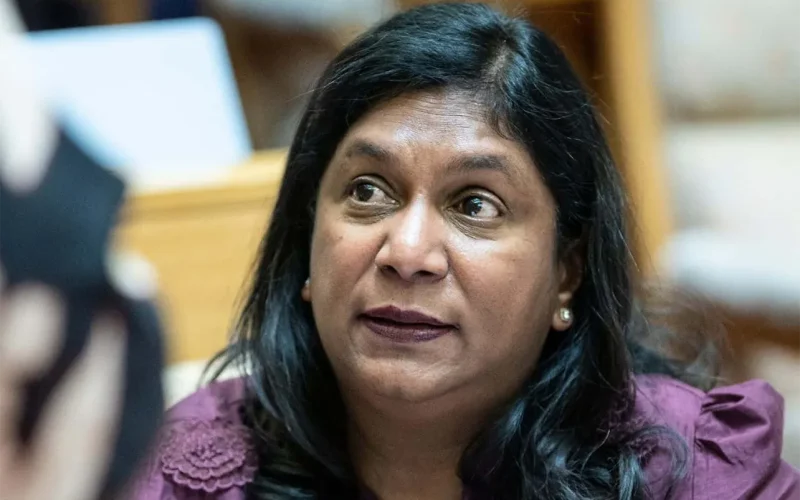
FOR a country that has learned, through hard experience, to distrust the institutions built to protect it, the sight of Advocate Andrea Johnson struggling before the Madlanga Commission was more than uncomfortable viewing. It was, for many South Africans, a moment in which one of the last visible custodians of prosecutorial integrity appeared to falter in full public view — raising uncomfortable questions about the state of an institution created specifically to confront organised crime and corruption within the criminal justice system itself.
Johnson, who had spent three decades in the legal profession, first as an advocate and then as a prosecutor, led IDAC until her resignation this week. Over successive appearances before Parliament’s Ad Hoc Committee and before the Madlanga Commission of Inquiry, she repeatedly struggled to give clear, direct answers on core questions of process and accountability within her own directorate — at points requiring clarification from retired Judge Mbuyiseli Madlanga and commission counsel on basic legal concepts. Her exit does not settle those questions. It leaves them, for now, unanswered.
At the centre of last week’s hearings was the question of how IDAC handled complaints connected to Crime Intelligence Brigadier Dineo Mokwele, and specifically whether a formal complaint had ever been lodged regarding her appointment. Johnson told the commission that the investigation had its origins in a Section 27 affidavit obtained from MP Fadiel Adams, after the Minister’s office referred correspondence to IDAC. She conceded, under questioning, that the initial referral did not itself constitute a Section 27 affidavit — prompting IDAC to approach Adams directly to secure one. She also conceded, more damagingly, that IDAC had arrested and prosecuted Mokwele on the basis of incorrect information, after initially claiming she could have been used to facilitate the looting of Crime Intelligence funds.
The exchange exposed uncertainty over how several related investigations within IDAC had been separated from one another, and whether a distinct probe into an alleged docket interception had, in fact, been conducted at all. The commission has since raised further questions about IDAC’s prosecution of Crime Intelligence head Dumisani Khumalo and other officials. It is the kind of procedural ambiguity that, in an institution mandated to root out corruption with forensic precision, invites scrutiny of its own internal controls.
“Was there ever a complaint?” — the question that repeatedly returned Johnson to uncertain ground.
The Self-Incrimination Question
The more serious cloud hanging over Johnson’s testimony concerns allegations that she disclosed the contents of a police docket to Major General Feroz Khan, a senior Crime Intelligence officer. The docket in question reportedly relates to an assault and intimidation case opened against Khan by a female police officer in July 2018. It must be stressed that these remain allegations, not findings: Johnson has not been convicted of any offence, and the presumption of innocence applies to her as it would to any citizen.
In an affidavit submitted to the commission, Johnson described the allegations as vague and unsupported by particulars. According to reporting on the proceedings, a witness identified before the commission subsequently produced an email said to show communication between Johnson and Khan regarding the docket. Johnson later filed a supplementary affidavit stating that the matter is before the National Prosecuting Authority, which is considering whether she should face prosecution. Citing her constitutional right against self-incrimination, she declined to answer specific questions on the matter — a right available to every South African, but one whose invocation by the country’s top anti-corruption prosecutor carried particular symbolic weight.
The commission proceedings were also interrupted when Johnson requested to leave early, telling the commission that medication she was taking was having an adverse effect on her. The sitting was adjourned at 3 pm.
An Exit Written on Her Own Terms
Johnson’s resignation followed a meeting in which Kubayi and Mothibi reportedly raised concerns with her directly about the evidence led at the commission — including the allegation that she had improperly forwarded the Khan docket, and the questions surrounding IDAC’s prosecution of Khumalo and other Crime Intelligence officials. Her letter to Ramaphosa and Mothibi, however, framed her departure in different terms. She described enduring “unprecedented” attacks in her personal and professional capacity over the preceding five months, arising, she said, from the cases IDAC had conducted against Crime Intelligence officials — attacks she argued had brought “an extreme amount of negative attention” to her, to IDAC, and to the NPA.
Notably, Johnson’s letter did not address, or offer any account of, the specific allegation that has drawn the most sustained scrutiny at the commission: the claim that she disclosed the contents of the Khan docket in 2018. She framed the case against her as one still to be proven, observing that establishing the truth of the allegations would require “the setting up of a commission and a process that is both costly and time-consuming” — an argument for expedience that sat uneasily beside her own repeated invocation, weeks earlier, of her right to silence on that very matter.
Ramaphosa granted the request within roughly a day of receiving it, waiving Johnson’s three-month contractual notice period under section 12(8)(a) of the National Prosecuting Authority Act. The Presidency thanked Johnson for her years of service and offered assurances of “government’s unwavering support” for the NPA’s continuing work. It offered no comment on the substance of the allegations still before the commission, nor on whether Johnson’s departure affects the NPA’s own consideration of whether to prosecute her.
A resignation is not an acquittal. It is, at most, a change of address for the questions that remain unanswered.
Not a Word of Remorse
What is most damning about Johnson’s resignation letter is not what it says, but what it refuses to say. There is not a single word of remorse in it. Not a hint of accountability. Not one sentence acknowledging what her own admitted conduct may have cost others — Brigadier Dineo Mokwele, the young Crime Intelligence professional arrested and prosecuted on what Johnson herself has now conceded was incorrect information, and the whistleblowers, including a protected witness, whose evidence has run through these proceedings and whose safety that evidence put in danger. A letter written by someone genuinely reckoning with the gravity of what has been admitted before a commission of inquiry does not read the way this one reads.
Instead, the letter is laced with condescension, and at points tips into outright gaslighting. Read it and you would be forgiven for concluding that Johnson regards herself as the wronged party — a model of prosecutorial virtue driven from office by forces beyond her control, rather than an official who has, on her own admissions, presided over the wrongful arrest of a decorated officer and the mishandling of sensitive material. The tone is almost theatrically mournful, inviting the country to grieve the loss it is about to suffer with her departure, when the loss South Africans should be reckoning with is the one already inflicted: on Mokwele, on the whistleblowers, and on public confidence in the institution Johnson led.
Perhaps the most revealing passage — and the most brazen — is her own admission that an inquiry into her fitness for office, citing the precedent of the Andrew Chauke matter, could go either way. That is not the language of an officer of the court confident in her innocence; it is an acknowledgement, in her own words, that she may not survive scrutiny. And yet, in the very same breath, she instructs the President and the NDPP against pursuing that scrutiny at all, on the grounds that it would be costly and drawn-out. It is difficult to read that passage as anything other than a threat dressed up as counsel: submit to my version of events, or foot the bill for finding out the truth. For a legal mind of Johnson’s seniority to make that argument, in writing, to the head of state, is not humility. It is presumption.
Accountability is not optional because it is inconvenient, and it is not negotiable because it is expensive. The cost to South African society of IDAC’s failures under Johnson’s leadership is, on the evidence already before the commission, considerable — measured in a wrongful prosecution, in whistleblowers placed at risk, and in an anti-corruption unit whose own head could not give a straight account of how it operates. That is precisely when scrutiny becomes indispensable, not dispensable. A resignation letter that asks the country to count the cost of finding out the truth, rather than the cost of not finding it out, has its priorities backwards. Resignation cannot be allowed to substitute for scrutiny — and it should not be allowed to end the conversation Johnson herself started by walking into that commission room.
The Letter She Might Have Written
With respect, and in the spirit of the accountability her own letter avoided, what follows is the letter this newspaper believes Advocate Johnson could have written instead.
| Dear Adv Mothibi, I have listened carefully to the concerns raised regarding the serious allegations involving me in particular, and IDAC generally. As I continue to listen, I feel the weight of my indiscretions and the betrayal of my countrymen and women. As its head, I recognise the gravity of these matters and understand the disappointment and anger many South Africans feel. I sincerely apologise for any failures in oversight, honesty and accountability under my leadership. These allegations deserve to be treated with the utmost seriousness, and I am committed to cooperating fully with all investigations, correcting what went wrong, and rebuilding public trust through transparency and meaningful action. I know that trust must be earned through actions, not words. I do not deserve the honour, trust and respect associated with the Office of the Director of IDAC, and hereby tender my resignation. Yours sincerely, AJ |
That letter was not the one submitted. The one that was submitted is shorter on humility and longer on self-preservation — which is, in the end, the more instructive document of the two.
What the Symbolism Costs
There is a reason images of Lady Justice endure: blindfolded, scales balanced, sword ready — an emblem of impartiality applied without fear or favour. Johnson stood, by virtue of her office, as one of the modern custodians of that idea in South Africa’s fight against organised and white-collar crime. That is precisely why her halting performance before the commission resonated so widely, and why her sudden departure — on her own terms, with her own notice period waived, and without addressing the most serious allegation against her — will resonate further still. It is not simply one official’s discomfort under cross-examination, or one official’s exit; it is a moment in which the institution she led is compelled to answer, in her absence, for the same standards of transparency and accountability it is charged with enforcing on others.
The presumption of innocence must hold. But so, too, must the public’s right to a prosecuting authority that can explain itself — and the public’s right to see due process, not resignation, determine what happens next. The stakes extend well beyond Johnson’s personal standing. Thousands of cases — pending, prosecuted, or already decided — rest on the credibility of IDAC’s processes. If the architecture of internal referral, complaint-handling and docket security could not be clearly explained by the directorate’s own head, that uncertainty inevitably attaches itself to the cases her office touched, Mokwele’s case chief among them.
The Test That Now Falls to the NPA
Johnson’s resignation removes her from office. It does not remove the matter from the NPA’s docket, nor should it. By her own supplementary affidavit, the question of whether she should face prosecution over the Khan docket disclosure was already before the National Prosecuting Authority before she resigned. That process cannot be allowed to lapse, slow, or quietly dissolve now that its subject has left public office and, with her, the daily scrutiny that came with it. A resignation is not an acquittal, and a private citizen accused of compromising a police docket is no less accountable to the law than a sitting IDAC head would have been. If the evidence supports prosecution, South Africans are entitled to see that process run its full, public course — through the same courts, and to the same standard, that IDAC itself was created to uphold for everyone else.
The Madlanga Commission’s work continues, and Johnson remains entitled to a fair and complete accounting of her conduct before any final conclusions are drawn, whether by the commission or by prosecutors. But the questions raised in recent weeks — about complaint records, about docket security, about the boundary between institutional loyalty and personal relationships within Crime Intelligence — are unlikely to be the last. For an institution named to fight corruption, the cost of appearing unable to account for itself is not merely reputational. It is a cost measured in public trust, and that currency, once spent, is notoriously difficult to replenish.