THERE is a particular species of political tragedy that is worse than the tragedy caused by enemies. It is the tragedy caused by leaders who had the wisdom of counsel at their disposal and set it aside in favour of factional comfort and institutional self-preservation. It is the tragedy of the avoidable.
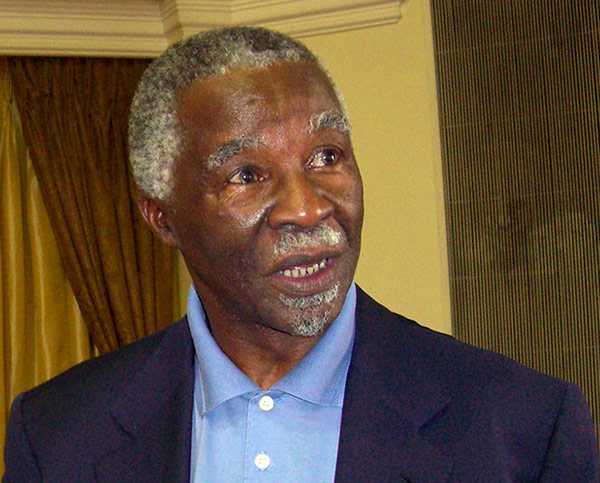
Thabo Mbeki’s March 2023 letter to ANC Deputy President Paul Mashatile, sent to him in his capacity as Leader of Government Business, belongs in the canon of South African political documents that its recipients would prefer history to forget. It will not be forgotten. Not because Mbeki was vindictive – he was not. Not because he used the letter to settle scores – he did not. But because he was correct. Precisely, demonstrably, almost unbearably correct.
And the correctness of a warning that went unheeded is the most damning form of ‘I told you so’ that exists in political life.
Thabo Mbeki did not write to Mashatile in the spirit of a disgruntled former president settling old grievances. He wrote as the founding architect of the very constitutional framework the ANC was busy dismantling with its parliamentary majority. He was a drafter’s witness testifying to what the document meant – and what the ANC had agreed it meant when it was signed.
He invoked the Freedom Charter’s most foundational commitment – ‘The People Shall Govern’ – not as rhetoric but as a governing instruction. He quoted the ANC’s own ‘Ready to Govern’ document. He cited the ANC’s submissions to the Constitutional Assembly. He referenced a 2016 article he himself had written on the Nkandla judgment. This was not an external critic speaking. This was the movement speaking to itself, through the mouth of one of its most senior living architects.
Every political leader who survives into the era of a successor carries a responsibility that transcends personal loyalty: the responsibility to transmit institutional memory, to mark where the lines are, to say clearly – this is where we have been before, and this is where that road leads. Mbeki fulfilled that responsibility in March 2023. The question is what those who received his letter chose to do with it.
THE ANATOMY OF THE FAILURE
What the ANC’s parliamentary leadership did in the three critical National Assembly votes of December 2022 and March 2023 was not merely a political miscalculation. It was a constitutional violation dressed up as party discipline. And Mbeki named it as such with surgical clarity.
Mashatile’s response in the National Assembly – that ‘democracy means the majority rules, that’s it’ – was, as Mbeki correctly identified, a description of parliamentary sovereignty, not constitutional democracy. The distinction is not academic. South Africa chose, at the CODESA negotiations and in the 1996 Constitutional Assembly, to build a constitutional democracy precisely because parliamentary sovereignty had been used under apartheid to legislate oppression by majority decree. The ANC knew this better than any other party. It had lived the consequences of that system.
For a Deputy President of the Republic – serving simultaneously as Leader of Government Business in Parliament – to conflate majority rule with constitutional obligation was not merely embarrassing. It handed the democratic opposition a gift of such magnitude that the DA’s Chief Whip, Siviwe Gwarube, needed only to stand and repeat it to devastating effect.
FEEDING THE VULTURES
This is where the analysis becomes uncomfortably concrete. The political beneficiaries of the ANC’s Phala Phala evasions were not the people of South Africa. They were the EFF, the MK Party, the ATM, and yes – the DA. Not because those parties earned the moral authority to lead South Africa. But because the ANC abdicated that authority through its own choices.
Julius Malema’s EFF has built its entire oppositional brand on the claim that the ANC protects the powerful at the expense of the poor. Every parliamentary vote to shield Ramaphosa from scrutiny was a down-payment on that brand – a contribution from the ruling party to its most aggressive critic. The MK Party took things further, weaponising Zuma’s grievances against Ramaphosa into a movement that peeled away ANC support in KwaZulu-Natal and beyond. The ATM positioned itself as the conscience that the ANC had lost. And the DA – which Mbeki in 2016 had already identified as positioning itself as ‘the great champion and defender of our Constitution’ – was handed that mantle on a silver platter, not by its own virtue, but by the ANC’s conduct.
Mbeki saw it coming. His letter named the mechanism explicitly: every act of self-protection, every deployment of parliamentary numbers to obstruct constitutional oversight, every vote that prioritised the leader over the institution would ‘further alienate the masses of the people’ and serve ‘the purposes of the counter-revolution.’ He was not being dramatic. He was reading the political ecology with the eye of a man who had navigated it for decades.
The 2024 election delivered the verdict. The ANC lost its majority. Ramaphosa’s presidency survived only by entering a Government of National Unity with the DA – the party whose Chief Whip had publicly shamed his Deputy President in Parliament barely a year before.
THE WEAKNESS THAT CANNOT BE HIDDEN
The most enduring damage Phala Phala has inflicted on Ramaphosa is not legal – it is characterological. A leader who needed his party’s parliamentary majority to shield him from scrutiny has confirmed, in the public mind, that there is something to be shielded. Whether or not that impression is legally accurate is now almost beside the point.
Mbeki grasped this too. He wrote that the masses of the people ‘will entertain the suspicion that the Phala Phala matter includes corruption’ – not because those people were wrong to think so, but because the ANC’s behaviour had given them every rational reason to think so. ‘In other words,’ he wrote, ‘we acted as we did because there is something to hide.’
A strong political leader, operating within a movement with genuine institutional confidence in its own president, would have welcomed parliamentary scrutiny. A strong leader would have said: let the committees convene, let the evidence be tested, let Parliament exercise the oversight our Constitution requires – because we have nothing to fear from the truth. That is what Mbeki’s letter demanded. That is what the ANC refused to provide.
The result is a president who enters the second half of his term hobbled – constitutionally beholden to his principal opposition partner, politically diminished in the eyes of his own constituency, and historically marked as the leader whose ethical evasions completed the ANC’s slide from dominant party to plurality partner.
THE OBLIGATION OF THE LIVING ARCHIVE
There is a broader principle at stake here that extends beyond the specifics of Phala Phala. It is the principle that those who govern carry not only the authority of the present but the custodianship of an institutional memory that took decades – and in South Africa’s case, generations of sacrifice – to accumulate.
Mbeki is not infallible. His presidency carries its own contested legacy – on HIV/AIDS, on Zimbabwe, on the treatment of his critics within the movement. He knows this better than anyone. What is striking about the March 2023 letter is precisely that it is not the work of a man defending his own record. It is the work of a man defending the record of the movement – the constitutional framework, the political theology of ‘the people shall govern,’ the institutional obligations that the ANC wrote into law and then proceeded to violate.
Those who hold office today have an obligation – not of sycophancy, not of blind deference – but of genuine engagement with what their predecessors transmit. When Mbeki writes that ‘our Membership and especially our Leadership must be fully schooled in the policies of the Movement,’ he is not being condescending. He is being precise. A movement that does not know what it believes cannot defend what it built.
The ANC’s leadership received a letter in March 2023 that offered them a constitutional roadmap, a historical warning, and a political lifeline. They set it aside. The political vultures – the EFF with its performative radicalism, the MK Party with its mobilised grievance, the ATM with its moral posturing, and the DA with its constitutional choreography – were circling. Mbeki saw them.
He was too dignified to say: ‘I told you so.’
But he told them. And now, three years on, with the GNU his successor assembled proof of the magnitude of the ANC’s self-inflicted wound, the letter from Killarney stands as the most eloquent political post-mortem of a crisis that never had to happen – written before the patient died.