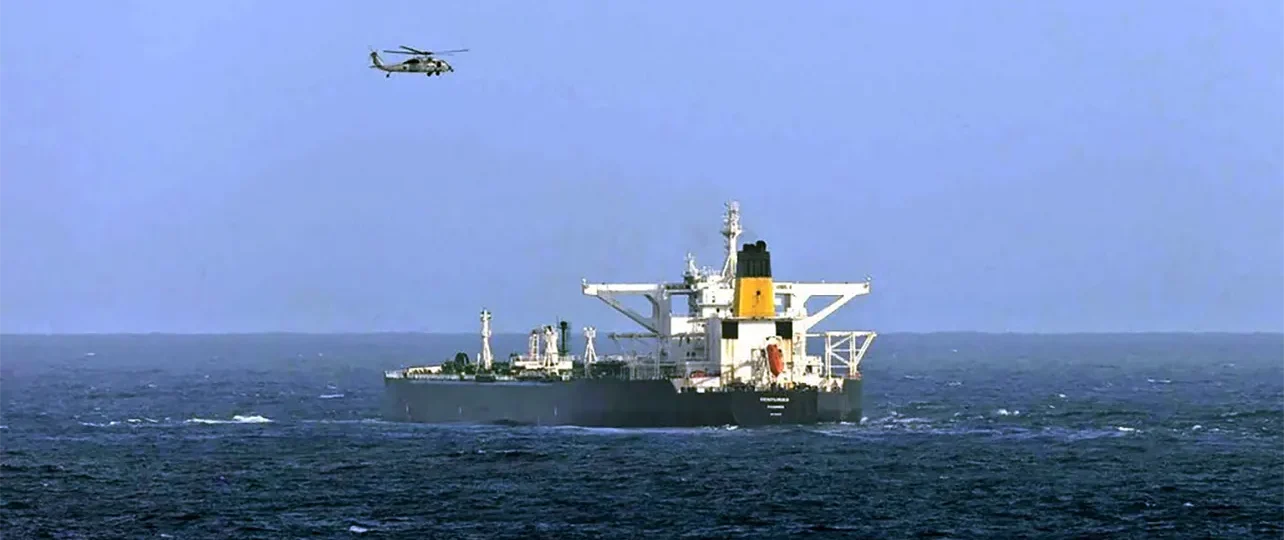

AS a U.S. Coast Guard cutter pursues the Bella 1 tanker through Caribbean waters, waiting for elite forces capable of seizing the vessel by force, the operation raises profound questions about the boundaries of national authority and the architecture of international law itself.
The dramatic chase — now in its fourth day, with military helicopters and special operations teams poised to rappel onto the deck of a ship that has refused American boarding orders — represents far more than routine sanctions enforcement. It crystallises a fundamental tension in the post-World War II legal order: When does one nation’s assertion of extraterritorial authority cross the line from legitimate enforcement into something closer to the territorial aggression the international system was designed to prevent?
The Sovereignty Paradox
The parallel to Russia’s annexation of Ukrainian territory is uncomfortable but unavoidable. Both involve powerful states using force to assert claims that much of the international community views as illegitimate extensions of sovereign power beyond recognised boundaries.
Russia justified its 2022 invasion partly through claims about protecting ethnic Russians and countering Western influence — unilateral determinations that violated Ukraine’s territorial sovereignty. The United States now asserts the right to interdict vessels on the high seas based on its own designation of Venezuela’s government as illegitimate and its unilateral sanctions regime, which most of the world has not adopted.
The legal mechanisms differ, certainly. The U.S. operates under its domestic sanctions law, claiming jurisdiction over vessels it alleges are evading American economic restrictions. Russia claimed historical grievances and security imperatives. But the underlying question remains the same: What gives one state the right to use military force to impose its will beyond its borders when international consensus is absent?
The Limits of Unilateral Authority
Traditional international law recognises limited circumstances for extraterritorial enforcement: piracy, slave trading, and actions authorised by the United Nations Security Council. U.S. sanctions against Venezuela — imposed unilaterally, not through UN mechanisms — fall outside these categories.
“There are limited teams who are trained for these types of boardings,” said Corey Ranslem, CEO of maritime security group Dryad Global, describing the specialised Maritime Security Response Teams now being deployed. His words capture both the operational challenge and a deeper truth: these boardings are exceptional acts that test the boundaries of international maritime law.
The U.S. claims authority because the vessels allegedly fall under American jurisdiction through complex ownership structures or by carrying Venezuelan oil in violation of U.S. sanctions. But this expands the concept of jurisdiction far beyond traditional territorial bounds — much as Russia’s claims about “protecting” Russian speakers expanded the concept of humanitarian intervention beyond recognition.
The Resource Reality
The Coast Guard’s struggle to execute Trump’s declared “blockade” reveals another dimension of this legal and moral complexity. The service, stretched thin with search and rescue operations and drug interdiction, now faces demands to enforce a policy that Admiral Kevin Lunday warned comes at a time when “the Coast Guard is less ready than in any other time in the past 80 years since the end of World War Two.”
The United States has assembled a massive military force in the Caribbean — an aircraft carrier, fighter jets, Ospreys, warships — to pressure a neighbouring government through economic strangulation. This projection of military power to enforce unilateral economic policy invites comparison to historical blockades that were considered acts of war.
During the Cuban Missile Crisis, President Kennedy carefully avoided calling his interdiction of Cuba a “blockade” precisely because that term implied an act of war under international law. Trump has embraced the term openly, apparently unconcerned with its legal implications.
The Precedent Problem
If the United States can seize vessels on the high seas based on its own sanctions determinations, what stops China from doing the same to enforce its claims in the South China Sea? What prevents Russia from interdicting ships it claims are supplying Ukraine with weapons in violation of its security interests?
The answer cannot simply be that America’s cause is just while others’ are not. International law exists precisely because nations disagree about justice. The framework restrains strong powers from acting unilaterally, not because their grievances are never legitimate, but because allowing might to make right inevitably produces chaos.
The current operation against the Bella 1 thus poses hard questions that transcend the specifics of Venezuela policy: Does sovereignty mean anything if powerful states can enforce their domestic law extraterritorially through military force? Can the international legal order survive if major powers increasingly operate outside it? And if the United States believes international law no longer serves its interests, what alternative framework does it propose?
A System Under Strain
The post-1945 international order, imperfect as it has always been, rested on a basic bargain: states would resolve disputes through law and multilateral institutions rather than unilateral force. That system has been fraying for years — from the Iraq War to Russia’s invasions to China’s island-building — but each violation further weakens the structure.
The Bella 1’s continued flight from Coast Guard pursuit, with American special operations forces preparing to seize it by force, represents another stress point. Whether the administration ultimately decides to board the vessel or not, the message has been sent: the United States will enforce its will in international waters, consensus or no consensus, traditional legal frameworks notwithstanding.
This approach may achieve tactical victories in pressuring the Maduro government. But it comes at a strategic cost measured in the erosion of the very legal principles that have, however imperfectly, constrained international anarchy for nearly 80 years. In asserting the right to act unilaterally, the United States weakens its ability to object when others do the same.
The helicopters hovering over the Caribbean, waiting to rappel onto a fleeing tanker, thus carry more than armed officers. They carry a question the international community must answer: Is this enforcement of legitimate authority, or is it simply power seeking a legal pretext? The answer will help determine whether international law retains meaning in an age of great power competition — or whether sovereignty has become nothing more than what the strong say it is.