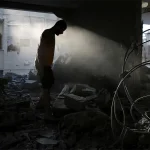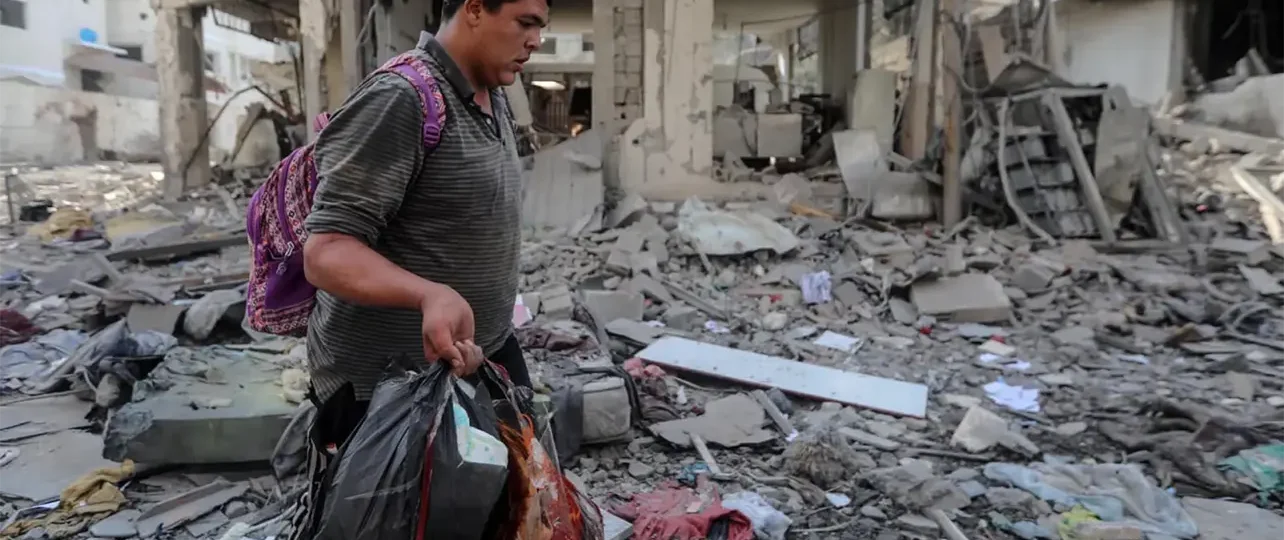

A few days ago, I stood by the window of our destroyed home in Gaza City and watched with deep sorrow as buyers carried away the last of our remaining furniture. We purchased it during the ceasefire earlier this year when we thought this war was over and we could resume our lives. Now, we have decided to start selling it for cheap rather than leave it behind to be destroyed by the Israeli army, which is poised to invade and take full control of the city.
By Rasha Abou Jalal
Already, the intensity of airstrikes has increased, and Israeli troops are slowly advancing into the Zeitoun neighbourhood east of Gaza City and in Jabalia to the north. We hear that they are systematically demolishing buildings in those areas as they move ahead.
Among the pieces of furniture I watched being carted away was the couch I used to sit on to write my journalistic reports. I grieved greatly as I watched it go. But taking it with us if – or when – we are forced to flee to the south is not an option. There are no vehicles that would be able to transport it because Israel has choked off fuel supplies.
Around me, I saw our neighbours smashing their furniture and selling it as firewood for cooking. They were throwing it down from the third floor of their war-battered building to the ground, breaking it into pieces.
“We will not leave for the south or anywhere else. We will stay here in Gaza, and we will die here.”
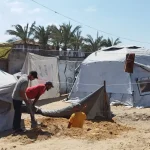
In another neighbourhood, I saw many residents already packing up – clothes, food, water, blankets – and departing for the south. My younger brother Mahmoud and his family are among those who have already left. He has now built a large tent for his family in the al-Mawasi area of Khan Younis along the coast in the south of the Strip.
Mahmoud told me over the phone when he arrived: “You must leave Gaza City with your family. When the invasion happens, whatever remains of the city will be destroyed.”
On the other hand, I met my neighbour Ghaliya, a 39-year-old mother of three. She told me with a confident smile, “We will not leave for the south or anywhere else. We will stay here in Gaza and we will die here.”
I don’t know if she meant it literally. But I have heard this view from many city residents – that they prefer to stay in their city and die here rather than face the misery of displacement and live as homeless people without shelter.
Back to the beginning
The decision taken by Israeli Prime Minister Benjamin Netanyahu in early August to occupy Gaza City, where I live, and to expel the around 900,000 people currently here – including residents and people displaced from other areas – was the final nail in the coffin of the hope we clung to that this bloody war would end.
Instead, we appear to be returning to the beginning, when Israel ordered more than one million people to leave northern Gaza within 24 hours in early October 2023. Since then, this brutal war has continued for over 22 months, during which more than 62,000 Palestinians have been killed, over 156,000 injured, and more than 70% of Gaza’s buildings destroyed.
My husband decided to leave that house, and we moved on 19 August to a tent on the ruins of our own home – destroyed at the beginning of the war – in the western part of Gaza City.
When Netanyahu – wanted by the International Criminal Court on war crimes charges – announced the decision to occupy Gaza City, my family and I were living in my friend’s house in the north of Gaza City after having been forced to flee numerous times. My friend and her family had managed to escape to Egypt early on in the war.
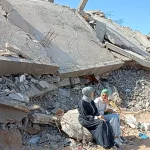
Following Netanyahu’s decision, my husband decided to leave that house and we moved on 19 August to a tent on the ruins of our own home – destroyed at the beginning of the war – in the western part of Gaza City. My husband believed this might buy us some time, anticipating that the Israeli army would likely begin invading from the north and the east.
That was the first practical step we took in a series of steps we’ve prepared to try to protect ourselves as Netanyahu pursues his plan to occupy Gaza City and expel its residents, leading to the potential final measure – fleeing from western Gaza City to the south of the Strip if the situation worsens.
Anticipation and fear
For now, I am still desperately holding on to hope that the Egyptian and Qatari mediators will be able to broker a political solution between Hamas and Israel that leads to a comprehensive end to the war and the release of all the Israeli hostages held by Hamas.
But facing yet another displacement, my thoughts drift back to what my life was like when I first fled Gaza City with my family in October 2023. I feel like I am heading back to hell again.
Thinking about it, I’ll be honest, there is a voice inside me that tells me to stay in Gaza no matter how bad things get, because in Gaza, where I grew up, there are many people I know who can help me. But in the south, I don’t know many people.
Over the course of 15 months, we were forced to move more than nine times between the cities in the south of Gaza. Each time, we had to leave our place of residence either to escape bombing, Israeli ground incursions, or in search of water. The living conditions in each location were extremely tragic and there was no privacy.
This continued until Hamas and Israel reached a ceasefire on 15 January 2024 that allowed us and hundreds of thousands of other displaced people to return to Gaza City.
Now, residents of Gaza City are once again living under the threat of displacement. The atmosphere in the city has changed drastically since Netanyahu’s announcement. People are living in anticipation and fear. The streets are quieter, and most conversations I overhear are about whether to head south or stay, no matter the consequences.
People ask themselves impossible questions: Will we lose our homes again? Will we find a place to take shelter if we are forced out? Will there be enough water and food?
Many say they would rather die in their homes than become refugees with an unknown fate once again.
Some talk about relatives who have already fled, while others insist on clinging to the city until the very end, convinced that the south no longer offers anything better.
If people do go to the south, there are fears that, this time, the displacement might be permanent. People speak with deep concern about reports of plans to transfer Gaza’s population to South Sudan or other countries, which sparks anger and profound fear of losing our land and identity forever. Many say they would rather die in their homes than become refugees with an unknown fate once again.
For me, it feels as though the city is living on the edge of an explosion – a heavy silence fills the homes while clipped conversations in the markets or while fetching water repeat the same haunting question: Where will we go this time?
Starvation and displacement
All of this is happening while we are also facing a harsh famine that has continued since Israel closed the Strip’s crossings in early March and banned the entry of food and aid.
Since early August, Israel has allowed some goods to enter Gaza, but the quantities are insufficient and have not made a noticeable impact in ending the famine.
Various food items – such as sugar, rice, pasta, and flour – have been allowed in, but they are sold at extremely high prices that exceed the purchasing power of most Gaza residents, the majority of whom have lost their jobs and businesses during the war and now have no source of income.
Meanwhile, Israel continues to prevent the entry of essential and basic foodstuffs such as red meat, chicken, eggs, milk, vegetables, and fruits.
On 19 August, Gaza’s Ministry of Health recorded three new deaths due to starvation and malnutrition, bringing the total number of victims of famine and malnutrition to 266, including 112 children. Of those deaths, 144 have occurred since 25 June, and the number keeps climbing every day.
My family is fortunate to be able to buy food from the limited supplies in the market at extremely high prices, and we wait in long lines to collect water from trucks that distribute it. But it’s never enough.
Like most Gaza City residents, my children have become thin, with a constant sense of fatigue and an inability to walk long distances. We suffer from hair loss and joint pain, and even ordinary wounds we sustain during household chores no longer heal due to the weakened immune system caused by poor-quality food.
If we are forced from Gaza City, we worry that our bodies will not be capable of making the journey south. Because there is no gas for vehicles, we will be displaced on foot.
What will we carry with us?
My daughter Saida, 13 years old, who suffers from widespread skin allergies due to the extreme heat and the lack of necessary medicines to treat her, asked me: “Mom, what will we take with us when we leave Gaza for the south?”
It was the hardest question I have ever faced in my life. I thought for a while and asked myself: “What will we carry with us? Food and water? Clothes? Blankets and bedding? The tent? Or should I just carry my laptop to continue writing to the world?”
My daughter’s voice broke my chain of thought as she repeated the question again: “Mom, did you hear me? What will we carry with us?” I gave her a shallow answer: “Whatever we can carry, my child.”
Then she asked me again: “Why do we have to be displaced south again? Mom, I want to live in Gaza City, where I grew up, where my friends live, and where my school is.”
I stayed silent as a tear escaped my eye.
Now, I sit inside my new tent in western Gaza City with my five children, waiting for the unknown. As I watch families fleeing in front of my tent, I look at myself in a small, hand-held mirror – with a storm of conflict raging inside me – and ask myself: “Displacement to the south? But will we ever return to the Gaza where I was born and raised again?”
Edited by Eric Reidy.
–––––
The New Humanitarian puts quality, independent journalism at the service of the millions of people affected by humanitarian crises around the world. Find out more at www.thenewhumanitarian.org.