THERE are many ways a politician can end their career. A sex scandal. A corruption conviction. A spectacular policy failure. But Senzo Mchunu has chosen a path far more excruciating: death by a thousand self-inflicted wounds, delivered live on national television, with millions watching him tie the noose, kick away the chair, and then helpfully explain why gravity is actually quite misunderstood.
Welcome to the Madlanga Commission, where South Africa’s suspended Police Minister has been treating us to a masterclass in political self-destruction so comprehensive, so thoroughly executed, that one almost has to admire the commitment to the craft.
There is something profoundly tragic about watching Mchunu sink deeper into political estrangement – not because his adversaries outplayed him, but because those entrusted to guide him seem unable to read the national mood. His advisors have built an echo chamber so thick that the lie has been repeated until it now sounds like the truth.
You see the same pattern unfolding before the Madlanga Commission, where South Africans, exhausted, disillusioned, and increasingly unforgiving, are demanding honesty, accountability and an end to the ANC’s endless shenanigans. The public has grown weary of corruption dressed up as governance.
Mchunu’s performance is textbook ANC circa 2024 – that peculiar vintage of brittling arrogance marinated in the conviction that absolutely anything can be explained away if you just use enough words. Never mind that voters brutally punished the party at the polls. Never mind that only a marriage of convenience with smaller parties keeps them clinging to power like barnacles on a sinking ship. The comrades still have their blue lights, still lap up luxury on the public dime, and still regard ordinary citizens as simpletons who should gratefully accept whatever nonsensical explanations are tossed their way.
And once again, the voters are poised to punish the ANC, not out of spite, but because of the stubbornness – inkani in isiZulu – that its leaders continue to display, Mchunu included.
Johannesburg was a rubbish heap until – miraculously! – It cleaned itself up for G20 visitors. There’s a man-made water crisis while tank mafias laugh all the way to the bank. But don’t worry, the comrades have an explanation for everything. They always do.
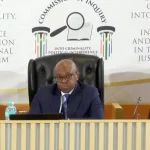
And so it was with the bald-headed, suited man who sat before Commissioner Madlanga, radiating the kind of super-confidence that comes right before a spectacular fall.
The Echo Chamber of Delusion
We’ve watched this movie before. President Jacob Zuma mastered the delicate dance of apologising without ever admitting wrongdoing – a political art form refined over years of survival. Mchunu seems to believe he can replicate that formula, positioning himself as the de facto president of the ANC while the political terrain tells a very different story.
Look closely, and the signs are unmistakable: the quiet manoeuvring, the silencing of dissent, the tightening of control over those who dared drift from his script. These are not the marks of a reflective leader; they are the reflexes of a man protecting a grand plan only he believes still holds.
Mchunu thought he knew it all. He believed he could explain everything. Simple yes-or-no questions became soliloquies. Straightforward queries transformed into Byzantine dissertations that added precisely zero value to his case.
The lowlight? His attempt to redefine the word “immediate.” This is from a former teacher who rose to become KwaZulu-Natal’s number one citizen, running a government with a R50-billion-plus budget. One can only imagine what his English classes were like.
Viewers glued to the proceedings were searching desperately for traces of excellence, for some spark of intelligence that would explain how this man ascended to such heights. They were looking for the brilliance that convinced President Cyril Ramaphosa to put him in charge of the nation’s crime-fighting efforts.
Instead, they got words. Mountains of meaningless words. A cabinet minister digging his own grave with his mouth, one verbose shovelful at a time.
A Greatest Hits Compilation of Blunders
The mistakes were breathtaking in their elementary nature. Mchunu casually admitted he disbanded the National Political Killings Task Team without bothering to test the allegations against them. He relied on information from Mary de Haas, a retired academic so discredited that her own former institution, the University of KwaZulu-Natal, ran screaming in the opposite direction after her dismal parliamentary performance.
But the pièce de résistance? Mchunu confidently told the Commission he’d also relied on Patricia Mashale, whom he described as “a former police officer.” Evidence leader Mahlaphe Sello then delivered the knockout punch: Mashale was never a police officer. She was an administrative clerk.
You could almost hear Mchunu’s credibility shatter. A simple Google search – the kind a teenager does before citing Wikipedia – would have revealed this fact. But that would require an affinity for facts, something our protagonist appears to have misplaced somewhere between KwaZulu-Natal and Pretoria.
The blunders continued like a greatest hits compilation. Mchunu never properly consulted his two deputies or National Police Commissioner Masemola before disbanding the task team. He couldn’t distinguish his policy role from the Commissioner’s operational responsibilities. And when he claimed the Constitution gave him authority over operational matters, “but in italics,” Commissioner Madlanga burst into laughter – the kind of laughter that echoes through history.
More troublingly, Mchunu admitted that when Mashale displayed signs of having intelligence information, he sicced the Inspector General of Intelligence on her. That’s not governance; that’s the abuse of power by a cabinet minister against an ordinary citizen, dressed up in bureaucratic language.
The Mashale Saga: Shakespearean Absurdity
Let’s linger on the Mashale saga, because it’s almost Shakespearean in its absurdity. This “whistleblower” – celebrated, lionised, cited as justification for dismantling a task team – turns out to have never served as a police officer. During the commission, Mchunu admitted she’d complained about the Political Killings Task Team, but Commissioner Sesi Baloyi helpfully pointed out that Mashale’s statements never actually referenced the PKTT at all.
Cherry on top? Mchunu never verified the accuracy of her Facebook allegations. Facebook! He treated them as “environmental information” and conveniently failed to disclose that the Inspector General of Intelligence had cautioned about their reliability.
South Africa’s crime-fighting strategy was apparently being shaped by unverified Facebook posts from someone who was never a cop. You couldn’t write this as satire; no one would believe it.
The December 6 Mystery: A Raid He Knew Nothing About
When KwaZulu-Natal Police Commissioner Lt-Gen Nhlanhla Mkhwanazi accused Mchunu of acting on behalf of criminal cartels – specifically regarding December 6 raids on alleged cartel members’ homes – Mchunu had a simple response: “I knew nothing about it.”
Nothing. Nada. Zilch. The Police Minister was apparently just focused on “governance, systemic reforms, budgets and the consolidation of temporary task teams” while major raids were happening. Move along, nothing to see here.
It’s a fascinating defence: I’m either complicit or completely incompetent. Pick your poison.
When Your Own Lawyer Can’t Save You
Enter Advocate Thembeka Ngcukaitobi, one of South Africa’s legal eagles, brought in to rescue Mchunu from the quicksand of his own making. With sleight of hand and courtroom brilliance, Ngcukaitobi bent the boundaries of re-examination, crafting questions designed to restore his client’s confidence, building a stage upon which Mchunu could profess his innocence.
It was a masterstroke. A perfectly curated theatre. A final chance for redemption.
And then Mchunu opened his mouth.
Even with Ngcukaitobi’s brilliance as scaffolding, Mchunu faltered catastrophically. His answers were incoherent, long-winded, dripping with the same arrogance that had brought him to this precipice. The eagle had built him wings, but Mchunu chose to stumble off the cliff instead.
When Advocate Sello Mahlape SC intervened and cut short Ngcukaitobi’s daring manoeuvre, the moment was lost forever. What could have been Mchunu’s chance to reshape public perception dissolved into futility like sugar in acid.
Five Questions That Destroyed a Career
If you need a blueprint for how to obliterate your credibility in real-time, study these five questions Mchunu spectacularly failed to answer. They’re not gotcha questions. They’re not legal technicalities. They’re the kind of basic, fundamental queries that any competent minister should handle in their sleep:
1. Why disband the PKTT without verifying a single allegation?
Mchunu admitted – actually admitted, out loud, on camera – that he never investigated the human rights abuse claims, never verified the budget concerns, never looked into the alleged irregular conduct. Yet somehow, these phantom issues became the “context” for disbanding an active task team investigating political killings.
It’s like burning down your house because someone on Facebook said they smelled smoke, but you never bothered to check if there was actually a fire.
2. Why take no action on serious allegations involving General Dumisani Khumalo?
Parliament was alerted. Khumalo holds one of the most senior posts in Crime Intelligence. Serious allegations were made. And what did our intrepid Police Minister do?
Nothing. Didn’t ask questions. Didn’t inquire. Didn’t follow up. The dog didn’t bark, and Mchunu wants us to believe that’s perfectly normal behaviour for someone supposedly concerned about integrity in law enforcement.
3. Why not consult the President or Parliament about alleged political interference?
Here’s where it gets delicious. Mchunu was supposedly so concerned about political interference by the former Police Minister that he… didn’t tell anyone important about it. Not the President. Not Parliament. He just kept it to himself like a state secret, even though such allegations – if genuine – would constitute a constitutional crisis requiring immediate escalation.
The Commission asked the obvious question: Why didn’t you raise this? Mchunu’s answer was essentially the sound of crickets chirping.
4. Why cite “budget irregularities” when you have zero evidence?
This might be the most spectacular unravelling. Mchunu repeatedly claimed the PKTT had irregular expenditure. When pressed on who told him this, he couldn’t say. The CFO – you know, the Chief Financial Officer, the person whose entire job is finances – confirmed she never discussed PKTT budget issues with him.
So where did this “irregularity” narrative come from? Thin air, apparently. Or perhaps the same Facebook posts that informed the rest of his decision-making process.
It’s a justification retrofitted so clumsily that you can see the duct tape and superglue holding it together.
5. Why do your actions contradict your stated reasons?
And here’s the coup de grâce, the contradiction so blatant it would make a philosophy professor weep: Mchunu claimed task teams were wasteful and needed to be consolidated. A noble goal, fiscally responsible, good governance and all that.
Then, in the same month he disbanded the PKTT, he created a brand new task team focused on taxi violence in the Eastern Cape – using funds outside the budget.
Read that again slowly. Task teams are wasteful, so we’re shutting one down to save money, but we’re also creating a new one using off-budget funds. The logic is so circular it’s practically a Möbius strip.
Either Mchunu is phenomenally incompetent at basic reasoning, or the PKTT wasn’t shut down for the reasons we’ve been told. Pick your scandal.
The Question Nobody Wants to Answer
Was the PKTT targeted, or was it genuinely dysfunctional?
Mchunu wants us to believe it was the latter – a bloated, irregular, problematic unit that needed to be put out of its misery. But he can’t prove a single allegation. He consulted no one who mattered. He investigated nothing. He created contradictory policies in the same breath.
Meanwhile, the PKTT was actively investigating political killings and, according to testimony, had conducted raids on December 6 targeting alleged cartel members – raids that Mchunu claims to know nothing about, despite being the Police Minister.
The math isn’t mathing, as the kids say.
If you disband a unit investigating criminal cartels, if you don’t verify your reasons, if you rely on Facebook posts and discredited sources, if you abuse your power against citizens who question you, if you can’t keep your story straight under questioning – what conclusion are we supposed to draw?
Either this is staggering incompetence on a scale rarely witnessed, or the PKTT was shut down because it was getting too close to something someone didn’t want exposed. There’s no third option that makes Mchunu look good.
The Verdict That Hasn’t Been Rendered (But Everyone Can See)
The Madlanga Commission is on a long break, resuming in the new year for the second half of Mchunu’s testimony. He would do well to use this intermission to think hard and deep about his performance – or lack thereof – and how he might emerge with some semblance of dignity.
But let’s be honest: we all know how this movie ends.
The truth is painfully simple: all he needs to do is acknowledge the misstep, take responsibility for poor judgment, and allow the country to heal. South Africa will move forward; it always has. But if leaders insist on clinging to denial, the alternative is a nation that fractures further… and that is a price this country cannot afford to pay.
Senzo Mchunu’s political career now lies fatally wounded, undone not by enemies, not by conspiracies, but by his own arrogance and incompetence displayed in glorious technicolour for all to see. Ngcukaitobi gave him a stage, a chance, a fleeting moment of grace.
Mchunu squandered it spectacularly.
As to why he has not resigned remains a mystery. You can’t take on Crime Intelligence with shoddy characters in your corner. You can’t dismantle task teams based on Facebook posts. You can’t redefine the word “immediate” and expect to be taken seriously.
There is no saving him now. The hole has been dug, the grave prepared, and Senzo Mchunu himself provided the shovel, the instructions, and – true to form – a lengthy, meaningless explanation of why holes are actually quite beneficial when you think about it.
The only question remaining is whether he’ll stop talking long enough to hear the dirt landing on top of him.