THERE is a version of Lewis Hamilton the world knows well – the one in the helmet, chasing apex after apex, rewriting the record books with seven world championship titles. The greatest Formula 1 driver of all time. A man so dominant that his sport had to contend with the uncomfortable question of whether the records would ever stop falling.
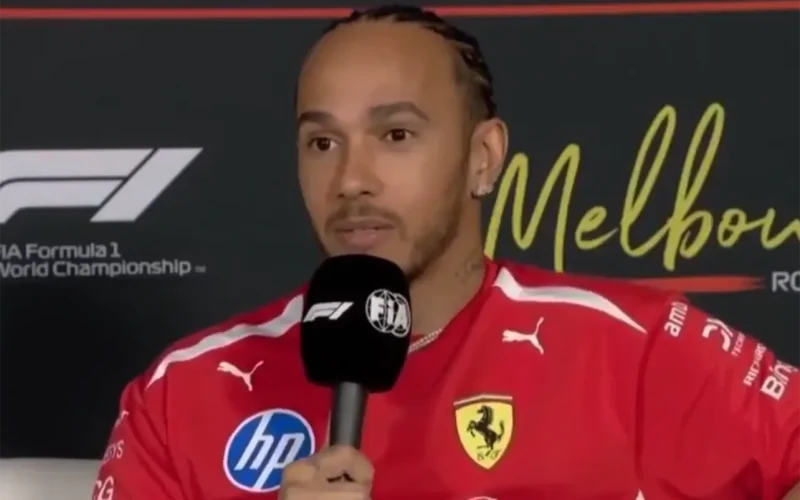
But in Melbourne, at the Australian Grand Prix, a different Hamilton stepped forward. Not the driver. The man. And what he said deserves to echo far beyond the paddock.
*”I’m half African. I’ve got roots from a few different places there. Benin, Senegal, Nigeria.”*
He said it plainly, without fanfare. As a statement of fact and of pride. And in that simplicity was something profound – one of the most recognised sportsmen on the planet planting his flag, firmly and lovingly, in African soil.
Hamilton grew up in Stevenage, England. His father, Anthony, who famously worked multiple jobs to fund his son’s karting career, is of Grenadian and African heritage. That heritage – traced to Benin, Senegal, and Nigeria – courses through Hamilton’s identity, and increasingly, through his public voice.
In a sport historically dominated by European wealth and whiteness, Hamilton has spent years refusing to be silent. He took a knee before races. He changed his name to include his mother’s surname, Larbalestier, and kept his father’s, Hamilton – a man who embodied Caribbean and African heritage. He has spoken about racism in motorsport, in society, and in his own life with a directness that has made many in his sport uncomfortable.
His words in Melbourne are a continuation of that same unflinching honesty – but this time, they carry a different register. Not anguish. Pride. Vision. Fire.
*”It’s something I’m really proud of, that part of the world. I think it is the most beautiful part of the world.”
Africa is the oldest inhabited continent on Earth. The cradle of humanity itself. It is home to 54 nations, over 1.4 billion people, more than 2,000 languages, and ecosystems that range from the Sahara to the Congo Basin rainforest to the Great Rift Valley. It gave the world its first civilisations, its first art, its first philosophy of what it means to live together – *Ubuntu*, the idea that a person is a person through other people.
It is a place of staggering natural wealth. Africa holds approximately 30% of the world’s mineral reserves, including vast deposits of cobalt, lithium, gold, diamonds, platinum, and uranium – the very materials that power the modern world’s phones, electric cars, and clean energy ambitions. The continent has 60% of the world’s uncultivated arable land. The Congo River alone has the potential to power the entire African continent twice over.
Hamilton knows this. And he names it without euphemism.
*”It’s so so important for the future, that continent. They have all the resources to be the greatest and most powerful place in the world — and that’s probably why they’re being controlled the way they are.”*
This is not the comfortable language of charity galas and development aid. This is the language of political clarity. Hamilton is naming a system – the ongoing economic and geopolitical arrangements through which Africa’s resources flow outward, enriching foreign corporations and governments, while the majority of Africans remain excluded from that wealth.
The history is not subtle. The transatlantic slave trade extracted tens of millions of people from West and Central Africa – from the very nations Hamilton named: Benin, Senegal, Nigeria – and built the wealth of Europe and the Americas on their labour. The Scramble for Africa in the 19th century carved the continent into colonies drawn with rulers on maps, with no regard for the peoples, languages, and kingdoms that had existed for centuries.
The colonial era formally ended – but the economic architecture it created did not. France still holds the foreign reserves of 14 African nations through the CFA franc system. Mining contracts across Central and Southern Africa continue to deliver profits to European and American shareholders while local communities bear the environmental and social costs. The IMF and World Bank attach conditions to loans that shape the economic policies of sovereign nations.
I’ve been to ten African countries. I loved Kenya – Formula 1 driver Lewis Hamilton pic.twitter.com/46q4XGNrZS
— Kenyans.co.ke (@Kenyans) March 5, 2026
Hamilton, with the clarity of someone who has spent a lifetime navigating institutions built before he was considered welcome in them, sees this clearly. He doesn’t use the word “neo-colonialism.” He doesn’t need to. He just says: *”Take it back.”*
*”I’m really looking forward, hoping that the people who are running those different countries all unite and come together and take Africa back. That’s what I want to see. Take it back from the French, take it back from the Spanish, from the Portuguese and the British.”
There is a tradition of this vision. Kwame Nkrumah, the first President of independent Ghana, dreamed of a United States of Africa – a continent unified in political and economic purpose, capable of negotiating with the world on its own terms. Thomas Sankara, the revolutionary president of Burkina Faso who was assassinated in 1987, told African nations to stop repaying debts incurred under colonialism: “Who are these creditors?” he asked. “They are those who have colonised us.” The African Union today holds that same dream of integration – the African Continental Free Trade Area (AfCFTA), launched in 2021, aims to become the world’s largest free trade zone, uniting 1.3 billion people in a single market.
Hamilton’s vision aligns with this tradition. He is not calling for chaos or conflict. He is calling for what every colonised people has always ultimately called for: *sovereignty*. The right of a people to determine their own future, to benefit from their own land, to build institutions that serve their own communities.
Coming from a man with his platform – speaking at a Formula 1 race broadcast to hundreds of millions of people globally – this is not nothing. This is the kind of moment that starts conversations in living rooms, in schools, in parliaments.
Hamilton has won seven world championships. He has 103 race victories – more than any driver in history. He has driven for Mercedes, fought for decades at the pinnacle of a sport that requires not only talent but access to resources that almost no one has.
But his greatest victories may not be the ones recorded in the statistics. They may be moments like this one – a man standing in a paddock at the Australian Grand Prix, looking into a camera, and saying: “Africa is mine, and I am proud of it, and I want its people to have what is theirs.*
In a world where powerful voices so often retreat to vagueness, where athletes are told to stay in their lane, where African identity is too often filtered through the lens of tragedy rather than triumph – Hamilton chose clarity. He chose pride. He chose love.
And he said, without apology: “Take it back.”
“The time is coming. The continent is rising. And now, it has one more voice.”
Lewis Hamilton says he doesn't want to retire from Formula 1 until he can race in a grand prix in Africa ?? pic.twitter.com/o3ctoAjkJr
— BBC Sport (@BBCSport) March 5, 2026