THE United States has begun pulling non-essential staff and dependents from its embassy in Abuja, Nigeria, issuing one of its starkest diplomatic signals in years that security in Africa’s largest economy and most populous nation is deteriorating in ways Washington can no longer manage from behind compound walls.
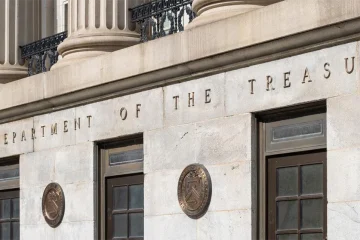
On 8 April 2026, the US Department of State authorised the voluntary departure of non-emergency government employees and their family members from the US Embassy in Abuja, citing what it described simply – and pointedly – as a ‘deteriorating security situation.’ The embassy will remain open, the State Department said, but with limited ability to provide emergency services to American citizens across Nigeria.
In the same breath, Washington updated its Nigeria Travel Advisory, keeping the country at Level 3 — ‘Reconsider Travel’ — while expanding the far more severe Level 4 ‘Do Not Travel’ designation to cover 23 of Nigeria’s 36 states. Five states were newly added to that list: Plateau, Jigawa, Kwara, Niger, and Taraba. They joined an existing roster of northern and southern states already deemed too dangerous for American nationals.
Twenty-three of Nigeria’s 36 states are now rated ‘Do Not Travel’
the US government’s highest risk designation
THE GEOGRAPHY OF DANGER
The breadth of the advisory’s geographic reach is its most alarming feature. In the north, Borno, Yobe, Kogi, northern Adamawa, Bauchi, Gombe, Kaduna, Kano, Katsina, Sokoto, and Zamfara — alongside the newly designated quartet of Jigawa, Kwara, Niger, and Taraba, as well as Plateau — are flagged for terrorism, armed banditry, and kidnapping. These are not fringe backwaters. They are the territorial spine of Nigeria’s middle belt and northwest, home to tens of millions of people and central to the country’s agricultural economy.
In the south, the picture is equally grim. Abia, Anambra, Bayelsa, Delta, Enugu, Imo, and Rivers — with the sole exception of Port Harcourt — carry Level 4 warnings driven by the twin threats of kidnapping and civil unrest. The Niger Delta, the very region that generates a significant share of Nigeria’s oil revenue, is now a terrain that Washington formally advises its citizens not to enter.
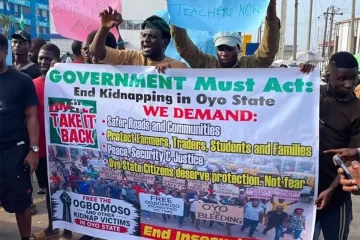
The advisory attributed the southern security deterioration to ‘armed groups and protests’ in the Niger Delta and Southeast. It noted that Boko Haram and affiliated terrorist organisations continue to plan and execute attacks, ‘sometimes collaborating with criminal gangs’ — a detail that speaks to the blurring lines between ideological insurgency and profit-driven criminality.
THE CIVILIAN THREAT PICTURE
Washington’s advisory is explicit about the risks facing ordinary people — American or otherwise — in Nigeria. Violent crime, including armed robbery, carjacking, rape, and kidnapping for ransom, is described as ‘widespread’ and not confined to any single region. Foreign nationals and dual citizens returning to Nigeria are singled out as frequent targets, perceived by criminal networks as wealthy by default.
The advisory’s warning about soft targets — markets, shopping centres, hotels, places of worship, large gatherings — reflects a doctrinal shift in how terrorist operatives are operating. The unpredictability of such attacks, the State Department warned, ‘significantly heightens the risk for both residents and visitors,’ making avoidance strategies nearly impossible to implement for those who live and work in urban centres.
Citizens were urged to adopt ‘proof of life’ protocols with family members in the event of kidnapping — a grim but now standard piece of travel security advice that speaks to how normalised the threat of abduction has become in parts of Nigeria.
‘Violent crime is common throughout Nigeria’
US State Department, 8 April 2026
HEALTHCARE: A COMPOUNDING VULNERABILITY
Beyond the security threats, the State Department raised a separate, systemic alarm about Nigeria’s healthcare infrastructure. Medical facilities across much of the country ‘generally do not meet US or European standards,’ the advisory stated, with limited access to medicines, unreliable emergency services, and requirements for upfront payment before treatment. In conflict-affected or rural areas, emergency medical access can be near nonexistent.
The healthcare caveat matters in geopolitical terms: it signals that the US government cannot guarantee it can extract injured staff or citizens to adequate care even if it retains diplomatic presence. It also implicitly acknowledges that Nigeria’s parallel healthcare crisis — distinct from its security one — forms part of the same compounding risk environment.
WHAT THE WITHDRAWAL REALLY MEANS
Authorised departures, in the language of US diplomacy, occupy a precise rung on a carefully calibrated ladder. They are not ordered evacuations — those come later, and they carry more alarm. An authorised departure means Washington has concluded that the environment is dangerous enough to allow staff to leave, but has not yet determined that it must compel them to go. It is a yellow warning light, not yet red — but the direction of travel is unmistakable.
The last time the US took comparable steps in a major African capital, it was a harbinger of deeper instability. Washington’s decision to restrict the embassy’s capacity to assist American citizens in Nigeria is especially significant: there are an estimated 17,000 registered US citizens living in the country, a number that likely undercounts the actual figure significantly. Those individuals now face the prospect of an embassy whose emergency reach has been formally curtailed.
The advisory also follows, by only months, a December 2025 presidential proclamation that placed Nigeria on a list of countries facing partial US travel restrictions — a measure linked to security assessments and immigration compliance data showing elevated visa overstay rates among Nigerian nationals. That backdrop colours this week’s advisory: relations between Washington and Abuja are not at their warmest, and this escalation will not warm them.
ABUJA’S SILENCE AND TINUBU’S TEST
At the time of publication, the Nigerian federal government had issued no formal response to the US advisory. That silence, whether strategic or reflexive, will itself be read as a statement. President Bola Tinubu, who has invested considerable political capital in projecting Nigeria as a stabilised, investment-ready power, faces a sharply different narrative from Africa’s most consequential Western partner.
Nigeria’s security challenges — from Boko Haram’s persistent insurgency in the northeast to the escalating banditry and kidnapping crisis across the northwest and middle belt, and the sustained unrest in the south — predate the Tinubu administration and will outlast it. But the diplomatic optics of a US embassy visibly shrinking its footprint in the capital carry weight that domestic explanations alone cannot neutralise.
For foreign investors, regional partners, and ordinary Nigerians watching their country’s international standing, the image of American diplomatic staff departing Abuja on security grounds is not simply a bureaucratic footnote. It is a judgment — and a public one.
| For investors, partners, and ordinary Nigerians, the image of American diplomatic staff leaving Abuja is not a bureaucratic footnote. It is a judgment. |
| AT A GLANCE: US ADVISORY ON NIGERIA — KEY FACTS |
| • Date of authorised departure: 8 April 2026 |
| • Nigeria overall Travel Advisory: Level 3 — Reconsider Travel |
| • States at Level 4 ‘Do Not Travel’: 23 of 36 (newly added: Plateau, Jigawa, Kwara, Niger, Taraba) |
| • Northern threat profile: terrorism, armed banditry, kidnapping — Borno, Yobe, Kogi, Kaduna, Kano, Katsina, Sokoto, Zamfara and others |
| • Southern threat profile: kidnapping, civil unrest, armed groups — Niger Delta, Southeast states |
| • Exception: Port Harcourt (Rivers State) not classified at Level 4 |
| • Embassy status: Remains open but with limited emergency service capacity |
| • US Consulate General Lagos: Continuing routine and emergency services |
| • Health warning: Medical facilities fall below US and European standards; emergency services unreliable |