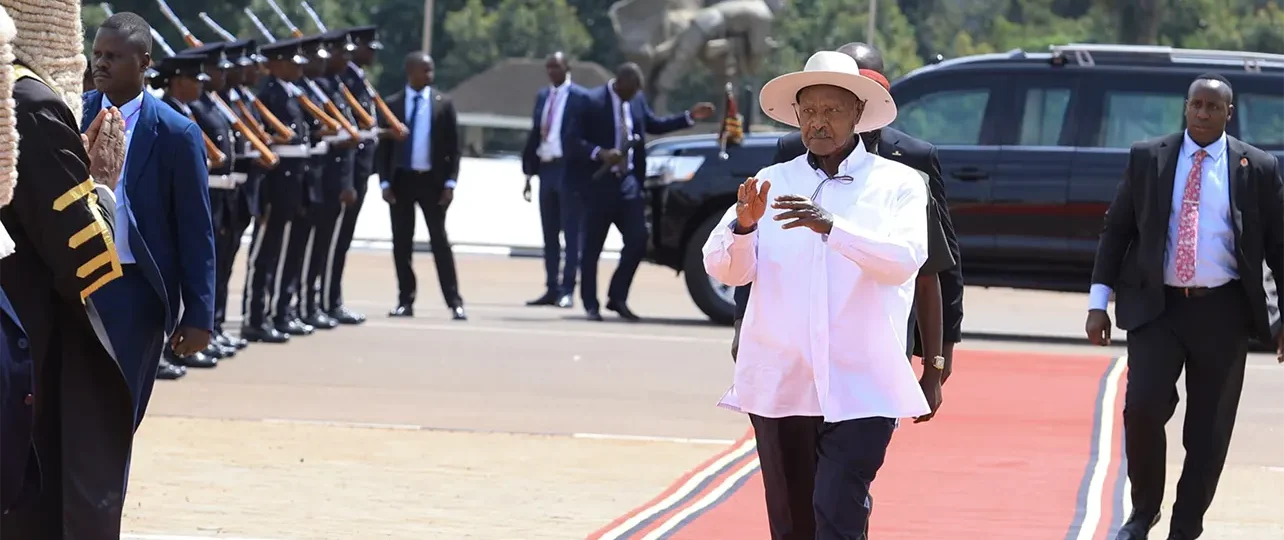

STANDING before the 5th Session of Uganda’s 11th Parliament at Kololo Ceremonial Grounds in June 2025, President Yoweri Kaguta Museveni delivered a State of the Nation Address that was, in equal measure, a victory lap and a forward charge. The numbers he laid before the nation were not rhetorical flourish – they were the statistical architecture of a country that has, quietly and determinedly, remade itself.
Uganda’s economy has reached an estimated $60 billion by the close of the 2024/25 financial year, up from $53.6 billion the previous year. The country now carries a GDP per capita of $1,263 – officially crossing the threshold into lower-middle-income status. For a country that, in 1986, was almost entirely dependent on subsistence agriculture and six narrow commodity exports, this is not merely progress. It is a transformation.
Perhaps no single data point captures Uganda’s economic ascent more dramatically than its export performance. Total exports of goods and services for the twelve months to March 2025 reached $11.8 billion – up from $9.56 billion during the same period in 2024, a leap of more than 23 percent. Goods exports alone hit $9.3 billion, compared to $7.3 billion the previous year, representing growth of 26 percent.
The drivers are both traditional and strikingly new. Gold leads the export ledger at $3.7 billion, a reflection of Uganda’s growing role in refining and re-exporting regional mineral wealth. Coffee – the crop most synonymous with the country – generated $1.8 billion, confirming Uganda’s rank among Africa’s premier coffee producers. But what distinguishes this export boom from those of previous generations is its diversity.
Beyond the headline commodities, Uganda has added 20 new products to its export basket in the past decade alone – according to a Harvard Economic Growth Lab study cited by Museveni in his address. Products once unimaginable as Ugandan exports – ICT equipment, serums and vaccines, new pneumatic tyres, batteries, gas turbines, and electronic circuits – are now finding markets across the continent and beyond. The Harvard study further identified an opportunity for Uganda to develop 50 additional complex products, pointing to a pipeline of economic diversification with significant depth.
Museveni has said Uganda’s economy has entered a stronger phase of growth, arguing that the country’s shift from subsistence to commercial production is now visible in exports, household incomes and the expansion of a new middle class.
Addressing the nation at Kololo Ceremonial Grounds, Museveni said: “With the limited waking up, where 67% of the homesteads, as compared to 9% in 1962, are now in the money economy, Uganda has graduated from the Least Developed Countries to a Lower Middle Income Country.”
He said the country’s progress is reflected in broad economic indicators. “Our economy has expanded 17 times in the last 40 years of recovery, expansion, diversification, value addition, entering the knowledge economy and transformation,” he said.
Museveni also highlighted Uganda’s export performance, saying the country had widened its trade basket significantly. “In the last 15 years alone, the Country has added 31 new products to its export basket,” he said. “Uganda now exports manufactured goods, including pharmaceuticals, refined gold, steel, ICT products, ceramics, plastics, and dairy products, already talked about. Uganda’s exports reached USD18bn in the twelve months ending in March 2026.”
The president placed particular emphasis on dairy, which he described as one of the clearest examples of economic transformation. “By 1986, the production of milk in Uganda was 200 million litres per annum. It is now 5.4 billion litres, saving USD 1.56 billion of imports and earning USD 285.4 million in export earnings,” Museveni said.
He argued that the move into the money economy is what has allowed more Ugandans to participate in formal economic activity. “However, for People to participate in the vertical and horizontal integration of the economy of the Country, they had to join the money economy first and move out of the traditional, pre-capitalist economy of working for ekidda kyoonka,” he said.
Museveni said the transformation is also producing a new social class, but warned that its character matters. “A middle class is coming up,” he said. “The question is: ‘What sort of middle class are we witnessing coming up? Are they the comprador bourgeoisie that are agents of foreign interests (importers, commission agents, etc) or are they part of the national bourgeoisie that build the capacity of the Country through being big or small farmers, manufacturers, service providers, and ICT operators?
He tied the economic message to a call for discipline and delivery. “No more sleep; no more kukongola; no more corruption; no more kugumaaza; no more politeness towards non-performers,” he said.
Museveni said the government’s model is already changing rural livelihoods, citing households in Kisozi that have moved into coffee, bananas, dairy, goats and poultry. “As of today, all the 2048 homesteads have joined the money economy,” he said.
The president said Uganda’s next phase will depend on deeper production, stronger value addition and continued support for farmers and small businesses. “We are now set for further and faster growth and transformation,” he said. “With these measures and those earlier mentioned, we shall have massive production and will also create jobs.”