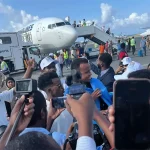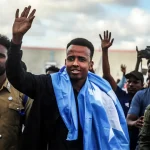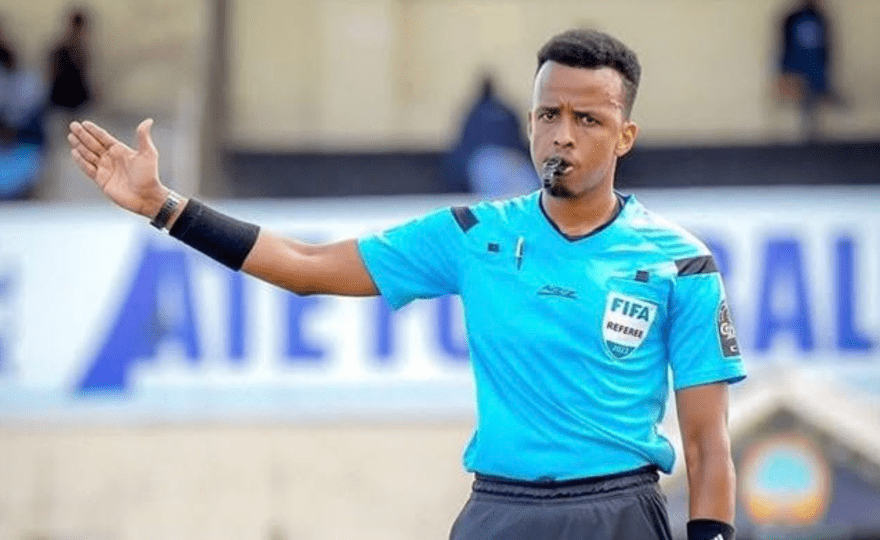

THE whistle that Omar Abdulkadir Artan will never blow echoes louder than the ones he was appointed to blow. On Monday morning – with 48 hours remaining before the opening ceremony of the 2026 FIFA World Cup – the 34-year-old Somali referee, Africa’s finest, arrived at Miami International Airport clutching a diplomatic passport and a FIFA appointment. He left carrying nothing but a boarding pass back to Istanbul. The United States sent him home.
His story is the most powerful metaphor yet for what this World Cup has become: a tournament hosted by a country that does not want the world.
Artan is not a peripheral figure. Born in Mogadishu in 1992, he became a FIFA-listed referee in 2018 – part of a generation of Somali footballers and officials who rebuilt the country’s sporting infrastructure from the rubble of three decades of civil war. In January 2024, he made history as the first Somali to referee an Africa Cup of Nations match. In 2025, he was crowned by the Confederation of African Football as the continent’s best referee – its top official – having overseen the return leg of the CAF Champions League final between Pyramids FC and Mamelodi Sundowns. He was one of only seven African referees selected by FIFA from across 54 nations to officiate at the World Cup finals. He was one of 52 referees in the world deemed worthy of this honour.
Somali President Hassan Sheikh Mohamud had personally praised him in April, describing him as “a symbol of inspiration for the new generation of Somalis.” His appointment was the closest thing Somalia’s battered sporting identity had to a moment of global arrival.
Then the United States border turned all of it into ash.
Ciise Aden Abshir, Senior Adviser, Somalia Ministry of Youth and Sports
“Denying him entry to the United States and preventing him from officiating scheduled matches harms not only him personally but also undermines football’s commitment to fairness, merit, and the spirit of fair play.”
A VISA SECURED, THEN OVERRIDDEN
What makes the Artan affair particularly egregious is the sequence of events that preceded Monday’s deportation. Somalia is among the nations subject to President Donald Trump’s sweeping travel restrictions – a list that has cast a long, discriminatory shadow over what FIFA and its host partners promised would be a celebration of global unity.
Confronting the visa obstacle head-on, the Somali embassy in Nairobi intervened, obtaining a diplomatic passport for Artan in recognition of his FIFA status and national significance. Only days before his departure, a FIFA representative, speaking anonymously to the Kenyan outlet The Eastleigh Voice, confirmed that his visa situation had been fully resolved: “I can confirm that the visa issues have been fully resolved and he will now be available to officiate at the FIFA World Cup.”
The confirmation proved worthless. On arrival at Miami International Airport, U.S. Customs and Border Protection turned him back without explanation. Neither FIFA nor U.S. immigration authorities have issued any substantive public statement. The silence is its own verdict.
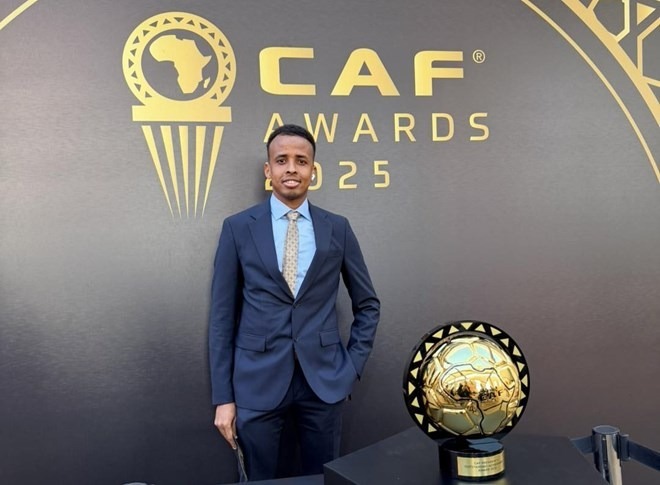
AFRICA’S BEST REFEREE IS NOT ALONE
Artan’s deportation is the sharpest single image in a broader, uglier picture. The 2026 World Cup – co-hosted across the United States, Canada and Mexico – has been marred since its earliest planning stages by the collision between FIFA’s stated values and Washington’s politics of exclusion.
The pattern of disruption preceded Artan by days. Iraq, making its first World Cup appearance in 40 years, was welcomed to Chicago’s O’Hare International Airport with hours of detention rather than ceremonial fanfare. Striker Aymen Hussein – the man who scored the goal that ended Iraq’s long World Cup exile – was held by U.S. officials for nearly seven hours before being released. The team’s official photographer, veteran Talal Salah, was detained for more than ten hours, had all his electronic devices searched and investigated by Customs and Border Protection, and was ultimately denied entry. He was put on a flight back to Baghdad via Madrid. Iraq would begin its historic World Cup campaign without anyone to photograph it.
The U.S. Customs and Border Protection spokesperson described Salah’s exclusion as resulting from “vetting concerns” — a phrase that explains nothing while justifying everything. When pushed for more detail, CBP offered only the bureaucratic mantra: “All travelers seeking entry into the United States, including athletes, coaches, and staff, are subject to CBP inspection and vetting.”
“This will be the worst edition ever. The Iraq team got humiliated at the border. There’s no special FIFA visa, like for the Russia World Cup, or a free visa like in Qatar.”
Moez Kacim, International Sustainable Tourism Strategist
Iran’s experience has been turbulent since the draw itself. When federation officials — including president Mehdi Taj, a sitting AFC vice-president — were denied U.S. visas, Iran boycotted the World Cup draw ceremony in Washington in December, describing the exclusions as “non-sporting.” FIFA was formally notified. Gianni Infantino promised to investigate. The matter was eventually resolved, but the signal had been unmistakable: in Trump’s America, even FIFA credentialling bends to executive prerogative.
African fans have been caught in the widest net. Supporters from Senegal and Côte d’Ivoire — two of the continent’s most football-passionate nations, both with qualified teams — face partial U.S. entry restrictions, effectively barred unless they held valid visas before January 2026. Fans from Sierra Leone and the Republic of Congo confront full travel bans regardless of their teams’ presence. The Americans exempted players and team personnel. The supporters were left outside, pressing their faces against the glass.
Senegal fan Djibril Gueye, speaking to the Associated Press at the Africa Cup of Nations in Morocco earlier this year, captured the absurdity with controlled fury: “I don’t know why the American president would want teams from certain countries not to take part. If that’s the case, they shouldn’t agree to host the World Cup.”
FIFA’S SILENCE IS A POLITICAL CHOICE
The institution most conspicuously absent from this unfolding scandal is FIFA itself. The governing body has invested enormous reputational capital in marketing the 2026 tournament as “safe, welcoming and inclusive.” Those three adjectives now read as either delusion or deception.
The Trump administration’s travel restrictions include a formal carve-out for athletes and team officials attending the World Cup — a provision that should, by any reading, have covered a FIFA-appointed referee travelling on a diplomatic passport. That the exemption apparently did not protect Artan suggests either a catastrophic administrative failure or a deliberate determination that the travel ban supersedes FIFA’s own authority over its officials. Neither possibility reflects well on FIFA’s vaunted agreements with Washington.
Critics, including investigative journalist Romain Molina — who first broke the Artan story — have noted that FIFA appears to be allowing the United States to dictate the terms of its own tournament, leaving the governing body institutionally paralysed in the face of a host nation’s domestic politics. Amnesty International warned in March that U.S. immigration enforcement posed the most serious danger to World Cup visitors. The organisation was not wrong.
THE WEIGHT OF WHAT HAS BEEN STOLEN
It is worth sitting with what has actually been taken from Omar Artan. He rose from Mogadishu — a city the world associated for decades with chaos and collapse — through the unglamorous, painstaking work of refereeing domestic Somali league football, season after season, match after match. He passed FIFA’s international standards, took on continental duty, officiated at AFCON, and handled a CAF Champions League final. He was voted the best on an entire continent. He was then chosen, in a rigorous global selection process, by football’s supreme body to stand on the world’s largest stage.
And a border officer at Miami International Airport, with no explanation offered or owed, erased it. Not because Artan had done anything wrong. Not because his credentials were insufficient. Not because FIFA had any reservation about him. But because he carries a Somali passport — because of where he was born.
That is not an immigration decision. It is a statement about whose excellence the world is prepared to honour, and whose it is prepared to discard.
“Omar Artan is among Africa’s most respected referees and deserves the support of the entire football community.”
Ciise Aden Abshir
A TOURNAMENT THAT HAS ALREADY LOST SOMETHING
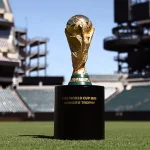
The 2026 World Cup will kick off on 11 June. The matches will be played. The goals will be scored. A champion will be crowned in July.
But something will already be missing. The whistles of Africa’s best referee will not be heard. An Iraqi photographer will not be there to document his nation’s return to football’s biggest stage. Senegalese and Ivorian fans, who have followed their teams across the world, will watch through screens. And Somalia — a country that has fought its way back from the edge of extinction, and produced a man FIFA judged among the world’s finest — will have nothing to show for it.
FIFA President Gianni Infantino has called this World Cup a “once in a lifetime opportunity” to showcase the greatness of America. The Artan affair showcases it perfectly — just not in the way Infantino intended.
The question that will outlive this tournament is whether football’s governing body will act, or whether it will continue to allow a host nation’s domestic politics to determine who is and who is not welcome at the world’s game. The answer, so far, has been silence. And silence, in the face of this, is complicity.