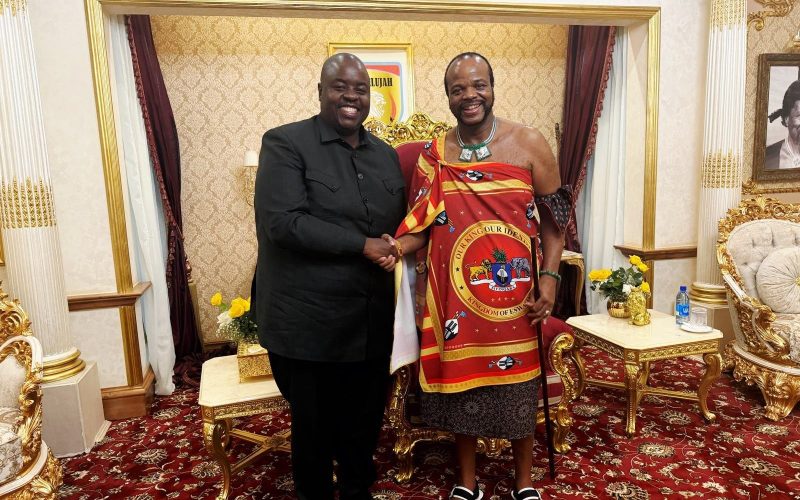
THERE are men who measure a good month by a salary increase. Sir Wicknell Chivayo measures his in sovereign instruments. In the space of roughly a week, the Zimbabwean businessman first welcomed a Gulfstream G550 – list price US$34 million – onto the tarmac at Robert Gabriel Mugabe International Airport, then flew on to the Kingdom of Eswatini, where he was received in private audience by His Majesty King Mswati III at the Royal Palace. He left Mbabane a citizen of the kingdom, diplomatic passport in hand, and – by his own telling – newly adopted as the monarch’s “young, fellow African son.”
The announcement arrived, as Chivayo’s announcements tend to, in block capitals and several breathless paragraphs of social media devotion. “Bayede Wena Wethu,” he opened – the royal salute traditionally reserved for kings – before describing the audience as one of the greatest honours of his life, and confessing surprise that His Majesty followed his philanthropic work online. He also reported that the King had warm words for his backing of “revolutionary parties” in the region, naming ZANU-PF and President Emmerson Mnangagwa specifically – a detail that will surprise nobody who has followed Chivayo’s decade-long, gravity-defying proximity to Harare’s ruling party.
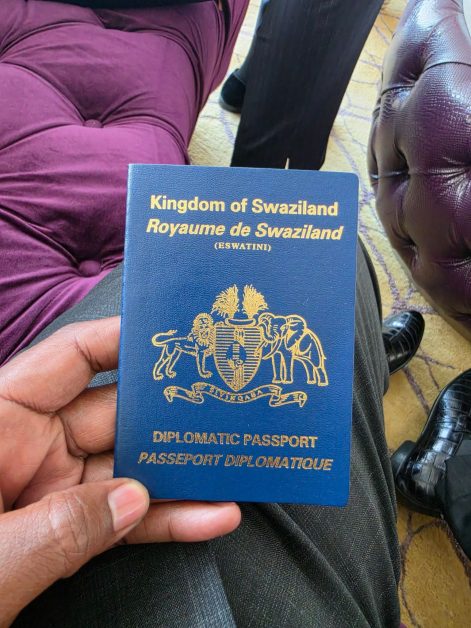
This is now passport number three. There is the original, Zimbabwean, acquired the conventional way: by being born in Chivhu in 1982. There is the Kenyan one, acquired rather less conventionally, and currently the subject of an immigration scandal in Nairobi after a leaked internal document linked his name to a batch of passport applications that also featured relatives of a sanctioned Sudanese paramilitary commander – a coincidence Kenyan civil society has, fairly, struggled to find charming. And now there is Eswatini’s, complete with diplomatic cover, granted not through any process ordinary Emaswati endure but through royal instruction, on the strength of a single courtesy call.
THE COLLECTION, SO FAR
| PASSPORT | STATUS | WHAT YOU NEED TO KNOW |
| Zimbabwe | Birthright, since 1982 | The constant in the collection. |
| Kenya | Acquired 2025; under official scrutiny | Named in a leaked immigration document alongside relatives of a US-sanctioned Sudanese RSF commander. |
| Eswatini | Granted June 2026, with diplomatic passport | Bestowed by King Mswati III after a single royal audience at the Royal Palace. |
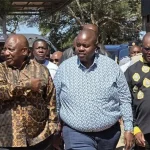
It would be unfair to suggest Chivayo collects heads of state purely for the photographs, except that the photographs are, by volume, most of the evidence. Kenya’s William Ruto, Tanzania’s Samia Suluhu Hassan, Malawi’s Peter Mutharika, South Africa’s Cyril Ramaphosa, Mozambique’s Daniel Chapo, Nigeria’s Bola Tinubu, Zambia’s Hakainde Hichilema and now Eswatini’s Mswati III have all, at one point or another, opened a palace or a State House door to a private businessman whose only formal title is managing director of Intratrek Zimbabwe. Few private citizens anywhere on the continent can claim a comparable circuit of audiences, briefings and “matters of mutual interest” with sitting monarchs and presidents. Fewer still can claim it while simultaneously fighting allegations of fraud and money laundering at home.
That last detail tends to get lost somewhere between the jet and the throne room. Chivayo’s Intratrek and IMC Communications have, between them, picked up close to a billion dollars in Zimbabwean state contracts, concentrated heavily in the energy sector – most notoriously the long-delayed Gwanda solar project – and critics, including voices within Zimbabwe’s own institutions, have accused him of converting political closeness into commercial advantage. He denies it, as he is entitled to, and no court has found otherwise. But it is the backdrop against which “philanthropist” and “infrastructure investor” now sit, somewhat awkwardly, beside “owner of a jet that cruises at 51,000 feet” and “newly minted Swazi diplomat.”
There is something almost touching about the earnestness of the Facebook tribute – the King’s intellect, his openness to renewable energy and modernisation, his concern for “ordinary Emaswati.” Eswatini, after all, is an absolute monarchy where the contrast between royal hospitality and ordinary hospitals has drawn criticism for decades; enthusiasm for unlocking the kingdom’s “good credit rating” arrives in a country whose own citizens have spent years pointing out exactly how unevenly that credit tends to be enjoyed. None of which, it seems, came up over the royal tea.
On current form, nobody should be surprised if Sir Wicknell is photographed shaking hands with a king before he is photographed in a courtroom. Bayede, indeed.