THE cold came down hard from the Lebombo Mountains. Temperatures dropped to thirteen degrees in some parts of the Kingdom, and rain was falling over Mbabane. None of it mattered. Long before dawn, the emaSwati were already queuing outside Somhlolo National Stadium – named for the founding king who dreamed of a great serpent devouring its own tail and saw, in that vision, the white man coming.
On a day that will be remembered in the annals of southern African history, they came instead in motorcades and military escorts: the presidents, the kings, the former strongmen, and the deposed. They came to celebrate a man who has held the last absolute throne on this continent for forty unbroken years.
| Forty years on one throne. In an age of constitutions, term limits and popular uprising, King Mswati III of Eswatini has outlasted them all – and made the world come to him. |
Born Makhosetive Dlamini on 19 April 1968, King Mswati III ascended to the Swazi throne at the age of eighteen, becoming one of the world’s youngest monarchs at the time – and remaining, to this day, Africa’s last absolute monarch. The Ruby Jubilee – forty years of reign, fifty-eight years of age – is what his government branded the 40/58 Double Celebration. The day was declared a national public holiday, and the Kingdom prepared accordingly.
The roll call of guests at Somhlolo reads like a who’s who of southern African power, past and present. Among those who made the journey were King Letsie III of Lesotho, Presidents Duma Boko of Botswana, Daniel Chapo of Mozambique, Cyril Ramaphosa of South Africa, Hakainde Hichilema of Zambia, and Emmerson Mnangagwa of Zimbabwe. The region’s sitting heads of state came almost in full.
But this was no ordinary diplomatic gathering. Among those also taking their seats in the stadium’s distinguished enclosure were former President of Madagascar Andry Rajoelina, former President of Botswana Seretse Khama Ian Khama – and former President of South Africa Jacob Gedleyihlekisa Zuma. When Zuma entered, sections of the crowd erupted into the unmistakable strains of Umshini Wami, the anthem of a man who remains the most polarising figure South African post-liberation politics has produced. The song rose over the stadium like a tribal call — electric, defiant, entirely unreconstructed.
| When the Zulu King entered, the echo of two thrones resonated across the stadium. Mswati is Misuzulu’s uncle. The nephew repaid the debt — presence for presence, blood for blood. |
Then came the kings. His Majesty King Misuzulu ka Zwelithini, sovereign of the eleven-million-strong Zulu nation, arrived to the respectful acknowledgment of the packed venue. His Majesty King Mabhudu Israel Tembe of the Tembe nation – whose territory straddles the northern KwaZulu-Natal coastline and southern Mozambique – was also present, alongside the wives of the KwaZulu Royal household who had entered before him. King Letsie III of Lesotho followed later, accompanied by princes, princesses, and members of the Basotho Royal household.
The Zulu King’s presence carried its own profound symbolism. Mswati III is his uncle — and it was Mswati who stood firmly with Misuzulu during the bitter succession battles that followed the death of King Goodwill Zwelithini. The nephew repaying the uncle, throne to throne, across two kingdoms that share blood older than the borders drawn by colonial cartographers. Former President of the Democratic Republic of Congo Joseph Kabila added yet another layer to what had become an extraordinary tableau of African power converging on a small landlocked kingdom.
The stadium itself became a living archive. During the proceedings, Eswatini television screened footage from the 1986 coronation – the very event whose fortieth anniversary was now being marked. There, on screen, was the young Samora Machel, President of Mozambique, arriving with his wife Graça, welcomed with excitement and guided to the same area where presidents sat on this occasion. The image carried the weight of history: Machel was killed six months after that coronation when his Tupolev Tu-134 crashed in the Lebombo Mountains at Mbuzini – a catastrophe that remains one of southern Africa’s most contested tragedies, with the hand of apartheid South Africa never conclusively ruled out. The ghost of Samora lingered in the cold mountain air.
| The stadium became a living archive. The footage of Samora Machel at the 1986 coronation – killed six months later in the Lebombo Mountains – reminded every witness that Africa’s history is never safely in the past. |
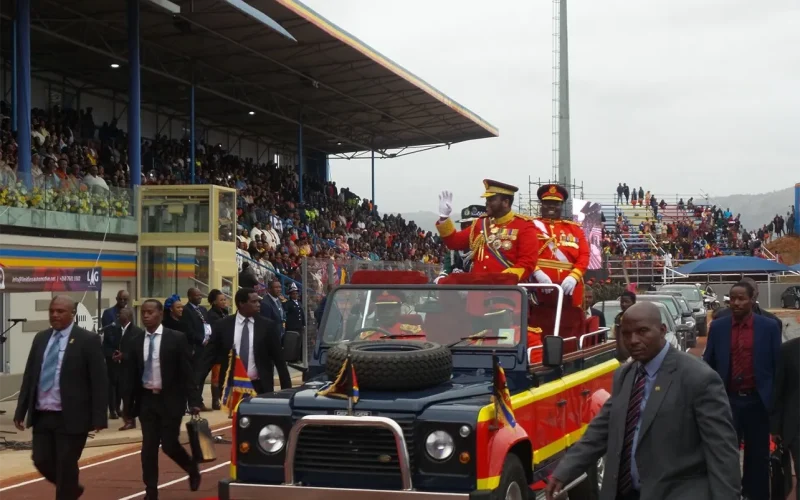
King Mswati III himself arrived in an open Land Rover Defender – an entrance as theatrical as it was deliberate – amid fanfare, brass bands, and cascading praise singing. Spectators waved miniature Eswatini flags and raised the royal salute, Bayethe Wena Waphakathi, in thunderous unison. He delivered an address lasting close to an hour – in SiSwati, with English interpretation – thanking God, the nation, and the international community for four decades of solidarity and support.
The diplomatic significance was not lost on those who track regional affairs. Zimbabwe’s ambassador to Eswatini described the occasion as one of the most significant on his country’s national calendar, with President Mnangagwa’s attendance serving simultaneously as a gesture of personal solidarity with the King and an opportunity to reinvigorate the two countries’ Joint Permanent Commission – a bilateral framework covering trade, investment, and public service cooperation.
But the celebration cannot be read stripped of its contradictions. Critics and pro-democracy movements have long argued that the scale of royal expenditure sits in uncomfortable proximity to the reality that roughly one-third of Eswatini’s population lives below the World Bank poverty line. Political parties remain banned. The space for organised dissent is narrow. The governance model that King Mswati III presides over is, by any standard of comparative constitutional analysis, a singular exception on a continent that has, with all its stumbles, trended broadly toward democratic forms.
And yet the presidents came. Ramaphosa, whose African National Congress carries the liberation struggle in its very DNA, came. Hichilema, whose own democratic credentials were forged in a detention cell, came. The optics will not be lost on civil society movements across the region who have long argued that SADC’s soft-touch approach to Eswatini’s political architecture amounts to continental complicity by omission.
The presence of Jacob Zuma – facing corruption charges in a South African court – seated in the VIP gallery alongside serving democratic heads of state produces its own uncomfortable symmetry. Ian Khama, who fled Botswana amid profound disputes with his successor, added yet another layer of complexity to a guest list that seemed, at moments, less a celebration of longevity than a reunion of the continent’s most consequential survivors.
| The guest list read less as a celebration of longevity than a reunion of the continent’s most consequential survivors. Every man in that Royal box has a story that would fill a chapter of Africa’s modern history. |
What Somhlolo witnessed on this cold April day was not merely a birthday party, nor simply a diplomatic courtesy call dressed in ceremonial cloth. It was a mirror held up to southern Africa’s political soul — its reverence for tradition, its tolerance of autocracy wrapped in royal regalia, its deep cultural loyalty to the institution of kingship, and its unresolved, perhaps unresolvable, tension between democratic aspiration and ancestral authority.
As South African Maskandi musician Khuzani Mpungose entered the stadium and the crowd — which had been there since before dawn, which had endured the cold, which had queued in darkness to witness history — erupted in joy, the contradiction crystallised perfectly. The people of Eswatini were not there under compulsion. They were there because the throne, for all its controversies, remains at the centre of their identity. That is the most important political fact of the day — and the hardest one for outsiders to metabolise.
Forty years. One throne. One man. And an entire continent watching — some with admiration, some with unease, all of them unable to look away.