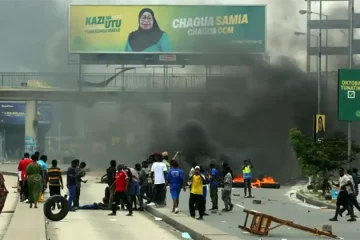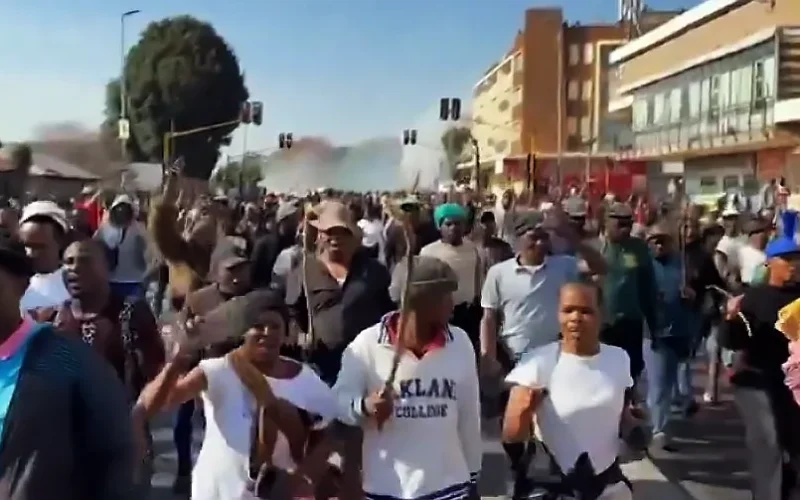
EIGHT days after a self-appointed deadline for undocumented foreigners to leave South Africa quietly expired without government intervention, Pretoria is discovering that the price of its silence is being paid not on the streets of Durban or Johannesburg, but in the chancelleries of Abuja, Accra and beyond. What began as a domestic anti-migrant mobilisation, driven by vigilante formations operating under banners such as the “March and March” movement, has hardened into a continental diplomatic crisis that is straining South Africa’s relationships with the very nations whose solidarity underwrote its liberation.
The clearest measure of how far the rupture has travelled came on Tuesday in Abuja, when Nigeria’s Senate spent an entire plenary session debating whether to sever diplomatic relations with Pretoria outright, nationalise South African-owned businesses operating in Nigeria, or both. That the chamber ultimately pulled back from the brink — deferring both proposals to a two-week committee investigation — offers only fragile reassurance. The mere fact that nationalisation and a diplomatic break were tabled, debated and taken seriously by Africa’s most populous democracy is itself the story.
OSHIOMHOLE’S “BALANCE OF MADNESS”
The Senate’s mood was set by Senator Adams Oshiomhole, the former Edo State governor, whose intervention has become the emotional centre of Nigeria’s response. Reacting to remarks by South Africa’s Minister in the Presidency, Khumbudzo Ntshavheni, that Pretoria would not compensate Nigerians for properties looted, burnt or abandoned during the unrest, Oshiomhole told the chamber: “Following comments by a South African minister to the effect that compensation will not be paid to Nigerians whose properties were looted, shops burnt, and even lives taken, that the government of Nigeria reciprocate by appropriating the profit accruing from South African shares in all South African companies in Nigeria, including their bank, IBTC… that the money be seized and used to pay Nigerians.”
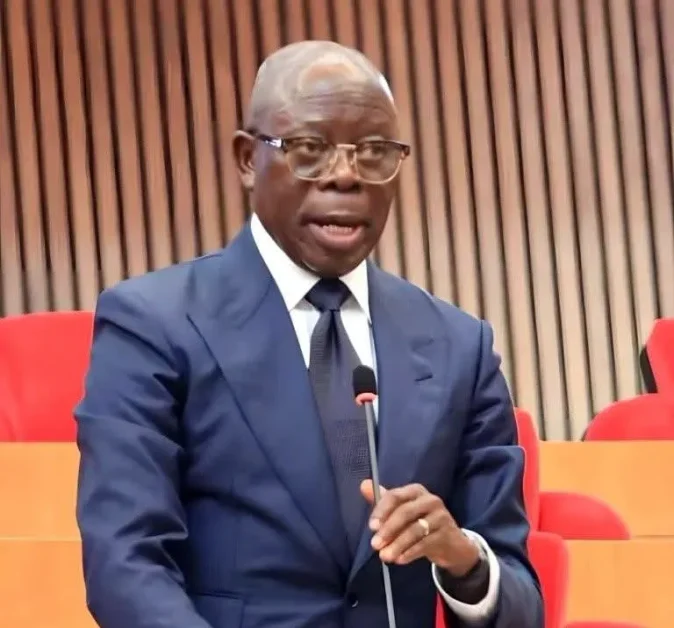
It was Oshiomhole who, in an earlier debate in May, coined the phrase that has since defined Nigeria’s harder-edged posture toward Pretoria: a doctrine of “balance of madness,” under which Nigeria would meet economic and reputational harm with economic and reputational retaliation, targeting flagship South African investments such as MTN and MultiChoice’s DStv. “If you hit me, I’ll hit you. That’s appropriate in diplomacy,” he told senators. “When we balance this madness, there will be sanity.” The rhetoric briefly rattled investors: shares in MTN Nigeria wobbled on the exchange amid speculation over possible state intervention.
Deputy Senate President Barau Jibrin, presiding over Tuesday’s session, pulled the chamber back from the edge, urging colleagues not to act on “things that are said on social media” without verification and noting that Ntshavheni’s actual position — that only illegally occupied informal-settlement structures, as opposed to legally titled property, would be excluded from compensation — was narrower than the outrage suggested. The Senate settled instead for condemnation, a demand for written safety assurances from Pretoria, and a mandate to the Committees on Foreign Affairs and Diaspora Affairs to report back within two weeks on the state of the bilateral relationship, including a review of trade and aviation agreements. The House of Representatives, in a parallel and more concrete step, has urged the Federal Government to suspend the issuance of new business permits to South African firms.
Ntshavheni, for her part, has shown no inclination to soften her position. Responding to criticism from former Kaduna Central senator Shehu Sani, she was unambiguous: “I didn’t stutter. Any form of property obtained illegally won’t be compensated for.” She went further, renewing a request that Nigerian authorities identify locations she described as drug-related “dens,” a remark that has done little to cool tempers in Abuja and has been read by many Nigerians as tone-deaf at best.
A visit that wasn’t, or was
Nigeria is not the only capital recalibrating its relationship with Pretoria. In Accra, the killing of 40-year-old Ghanaian national Bashiru Isak during the June 30 unrest has produced its own diplomatic aftershock. Ghanaian officials confirmed that a planned engagement involving President Cyril Ramaphosa, originally scheduled for early August, would be postponed, with government communications spokesperson Felix Kwakye Ofosu telling local broadcasters that Accra had “sent them a communication indicating that it would be best to defer the visit in view of the present climate around xenophobia.”
What followed was a small diplomatic skirmish over language. Ghanaian outlets initially reported that Accra had rejected the visit outright; South Africa’s Presidency pushed back hard, with spokesperson Vincent Magwenya insisting no state visit had ever been requested and that the correspondence concerned only the routine Ghana–South Africa Bi-National Commission, due to have been hosted in Accra from 4 to 7 August. Diplomatic notes exchanged between the two governments on 6 July, cited by South African media, reportedly made no explicit reference to xenophobia at all — a discrepancy Pretoria has seized on to frame the episode as disinformation rather than diplomatic censure. Whichever version proves closer to the truth, the optics are damaging: an African head of state’s engagement with a fellow AU member state has become entangled in a dispute over whether it was postponed because of xenophobic violence or merely rescheduled for administrative reasons — and neither government appears fully in control of the narrative.
The weight of history
What gives these disputes their particular sting is the historical debt they invoke. Nigerian lawmakers have repeatedly reminded the Senate of Lagos’s role as a frontline state in the anti-apartheid struggle — hosting the 1977 World Conference for Action Against Apartheid under General Olusegun Obasanjo, nationalising British Petroleum’s Nigerian interests in protest at British complicity with the apartheid economy, and, by one commonly cited estimate, spending in excess of sixty billion dollars in cumulative support for the liberation movement. Former Senate Leader Yahaya Abdullahi, recalling his own involvement with Nigeria’s anti-apartheid committee and support for the ANC, SWAPO and FRELIMO, used Tuesday’s debate to warn that the unrest risked being read — rightly or not — as evidence of a coordinated effort to destabilise the ANC government from both ends of South Africa’s political spectrum.
That history is precisely why the current crisis cuts deeper than a conventional trade or consular dispute. For a generation of pan-Africanist statesmen and lawmakers across the continent, South Africa’s post-apartheid democracy was itself a collective African achievement, financed in blood, treasure and diplomatic capital by neighbours who are now watching their citizens repatriated in the hundreds — nearly a thousand Nigerians and a comparable number of Ghanaians, with hundreds more registered to follow — after having their shops looted and, in Isak’s case, their lives taken.
What Pretoria risks
For now, institutional restraint has prevailed on both sides. Nigeria’s Senate leadership, echoing the caution shown by Ghana’s government communicators, has chosen investigation over immediate retaliation, and the ECOWAS Parliament has referred the matter to its Political Affairs committee rather than escalating unilaterally. But restraint is not the same as resolution. Nigeria’s Senate has given itself only two weeks before its committees report back with recommendations that could include a formal review of bilateral trade and aviation agreements — the kind of technical, slow-moving retaliation that does lasting economic damage long after the television cameras have moved on.
South Africa’s government would be unwise to read the Senate’s caution, or the confusion over the Ghana visit, as evidence that the storm has passed. The African Union has been asked to develop early-warning and accountability mechanisms for xenophobic violence — an initiative that, if it gains traction, would formalise continental scrutiny of South Africa’s internal security failures in a way Pretoria has never previously faced. MTN and MultiChoice, both heavily exposed to Nigerian consumers and regulators, remain hostages to a political mood that could turn against them with little warning. And a generation of African leaders who once treated Pretoria as a senior partner in continental diplomacy are now openly questioning whether that deference is still deserved.
South Africa built its post-apartheid identity on the promise that it belonged to the continent that had fought for its freedom. The events of the past fortnight suggest that promise is now being tested in the very capitals that made 1994 possible — and that Pretoria’s answers, so far, have not been convincing.