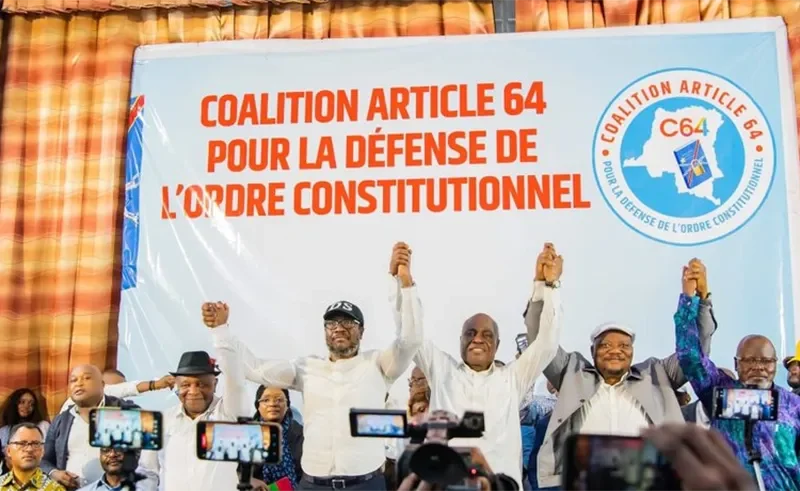
ON 12 June, the streets around Kinshasa’s Palace of the People became the latest testing ground for a question that keeps recurring across Africa’s fragile democracies: how far will an incumbent go to hold on to power, and how much of that effort can be outsourced to deniable hands? The answer, according to a Human Rights Watch investigation released this week, is that the Democratic Republic of Congo’s security forces did not merely fail to protect demonstrators opposing a proposed law that could extend President Félix Tshisekedi’s tenure beyond two terms — they joined, and at times enabled, an assault carried out by a group aligned with his own party.
The rights group interviewed 38 people between 12 and 22 June, including members of the Article 64 Coalition for the defence of the constitutional order, known as C64, who were injured that day, and members of Force of Progress, the pro-government group accused of attacking them. What emerges is not a chaotic street clash but a coordinated operation: political offices stormed in the morning, a peaceful march intercepted at police barricades by early afternoon, and, by evening, a besieged opposition headquarters where the wounded had sought shelter.
A Coalition Denied, Then Attacked
The trigger was procedural. Kinshasa’s governor rejected C64’s application to hold a sit-in outside parliament on 11 June, offering an alternative site that the coalition declined. Congo’s constitution guarantees the right to peaceful assembly, though the country’s demonstrations law gives authorities room to block or disperse gatherings deemed a threat to public order — the same elastic clause governments from Kampala to Dar es Salaam have leaned on this year to keep dissent off the streets.
Before the planned march even began, Force of Progress members raided the offices of several opposition parties within the C64 coalition. Investigators verified footage of activists from one party defending their headquarters and documented a ransacked office belonging to another opposition formation, along with an injured woman inside it. According to accounts gathered from seven Force of Progress members themselves, the operation was neither spontaneous nor deniable at the ground level: two party leaders had instructed them, at a meeting two days earlier, to target opposition offices and leaders, with promises of payment for those who disrupted the demonstration.
Two party leaders clearly instructed us to target opposition leaders and their parties.
Tear Gas, Barricades, and a Trapped Opposition
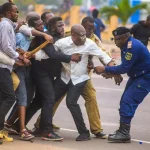
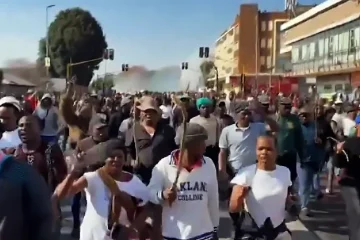
By midday, C64 members had regrouped and set off toward parliament from an opposition party office on Triomphal Boulevard. Police met them with a triple barricade near the city’s landmark Robot roundabout. Protesters describe raising their hands as a gesture of non-violence as they approached; officers responded with tear-gas canisters fired directly into the crowd. One demonstrator described being struck by a canister and left bleeding from the leg. A specialised task force combining army units, the Republican Guard and intelligence personnel stood alongside police — a show of force disproportionate, rights investigators argue, to a march that had until that point been peaceful.
What followed blurred the line between state security and partisan militia entirely. Witnesses say Force of Progress members, identifiable by their own open declarations of affiliation and in at least two cases recognised personally by protesters, joined the police lines and hurled stones and bottles — some filled with urine — at demonstrators. Verified video shows the two forces operating in parallel: officers throwing tear gas while men in civilian dress voice support for the ruling party and pelt protesters with projectiles a few metres away.
Some protesters, cornered, fought back. But the more striking sequence came afterwards, when wounded C64 members retreated to the headquarters of the opposition party ECiDé. Rather than securing the building, security forces and Force of Progress members followed the crowd there and kept attacking. Footage verified by investigators shows police looking on as Force of Progress tries to force open the compound’s gate, and shows an officer lobbing a tear-gas canister over the wall and firing another directly at the building from close range — with injured demonstrators and opposition politicians still trapped inside.
Among more than a dozen protesters documented with injuries were prominent opposition figures Martin Fayulu, Delly Sesanga, Jean-Marc Kabund and Ados Ndombasi — a roll call that signals this was not a fringe skirmish but an assault reaching the top tier of Congo’s opposition leadership. Security forces also detained several dozen protesters, according to the National Human Rights Commission.
The Accountability Theatre — and Its Limits
To its credit, Kinshasa did not simply deny the violence. The justice minister and the National Human Rights Commission moved quickly to interview C64 members, and on 19 June, the Prosecutor General’s Office at the Court of Cassation announced an investigation. Three days later, the ruling Union for Democracy and Social Progress (UDPS) itself filed a complaint asking the same court to pursue people it says falsely operated under the Force of Progress name to discredit the party — a defence the party’s secretary-general, Augustin Kabuya, repeated directly to investigators in early July, insisting the party never authorised violence and that an impostor group was tarnishing its brand.
That defence will be familiar to anyone who has tracked ruling-party militias elsewhere on the continent: informal enforcers are cultivated, deployed, and then disowned the moment cameras capture their conduct. It is a structure that offers governments the coercive benefits of street violence with a built-in alibi — one that seven of the alleged perpetrators, in their own interviews, have already complicated by describing direct instructions from named party figures and cash incentives for disruption. Whether Congo’s judiciary treats that testimony as the basis for real prosecutions, or lets the investigation quietly stall once international attention moves on, will determine whether the state’s response is accountability or camouflage.
International standards leave little room for the tactics documented on 12 June. The United Nations Basic Principles on the Use of Force and Firearms direct law enforcement to exhaust non-violent means first and, when dispersing unlawful but peaceful assemblies, to use the minimum force necessary. Tear-gassing a building where the wounded have taken shelter and standing by as an allied militia tries to breach its gate sits well outside that threshold.
Why This Matters Beyond Kinshasa
The immediate stakes are Congolese: a proposed constitutional change that could extend Tshisekedi’s time in office is now inseparable from the question of what his government is willing to do to insulate that project from public challenge. But the pattern on display — a legal pretext to deny protest space, a party-aligned militia used for the violence a uniformed force cannot easily be blamed for, and an investigation announced with fanfare but no guaranteed teeth — is a continental one. It has surfaced in different forms in Uganda’s succession politics, in Tanzania’s recent crackdown on dissent, and in other capitals where incumbents have treated constitutional term limits as a negotiating position rather than a settled boundary.
For Congo’s opposition and civil society, the events of 12 June are also a test of whether documentation and international scrutiny can still move the needle. The investigation the Prosecutor General’s Office opened is real, and so is the political cover UDPS is scrambling to construct. What remains to be seen is whether accountability reaches beyond the young men paid to throw stones and up to the party officials who, by multiple independent accounts, instructed them to do so — the test, ultimately, of whether the rule of law in Congo answers to political power or constrains it.