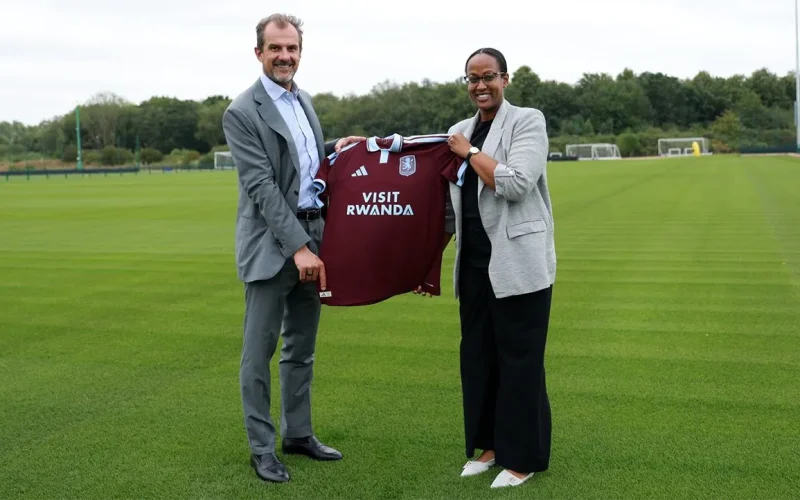
ASTON Villa Football Club has confirmed that Visit Rwanda, the tourism arm of the Rwanda Development Board (RDB), will become its Principal Partner, Official Tourism Partner and Official Coffee Provider from the 2026/27 season, in what the Premier League club has called the most important sponsorship agreement in its history. The Rwandan flag-carrier brand will now sit on the front of the shirts worn by Villa’s men’s, women’s and academy teams, replacing the gambling operator Betano, whose logo is being stripped from Premier League shirt-fronts league-wide under a self-imposed betting-sponsorship ban that takes effect this season.
The three-year deal, negotiated by Villa’s president of business operations Francesco Calvo in his first major commercial signing since taking the role, is reported by The Athletic to be worth up to £20 million (roughly US$26.8 million) a season if performance bonuses are met — a figure that would make it not only the biggest sponsorship in Villa’s 152-year history, but also close to double what Visit Rwanda was paying Arsenal for a lesser, sleeve-only placement. Villa’s return to the UEFA Champions League this season, after last term’s Europa League triumph, hands Rwanda a far larger global audience than the deal’s price tag alone suggests.
A CALCULATED HANDOVER, NOT A RETREAT
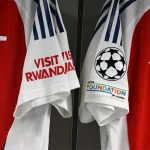
The timing is not incidental. Visit Rwanda’s eight-season sleeve partnership with Arsenal — English football’s original Rwandan sponsorship experiment, launched in 2018 — formally ended at the close of the 2025/26 season, with the Gunners moving to the workforce-payments firm Deel. Both parties described the split as “mutually agreed,” framed by Arsenal as reflecting Rwanda’s push to diversify into new sports and markets. That framing survives first contact with the record: the RDB did not step back from football sponsorship; it traded up. Front-of-shirt at a Champions League club, on a deal worth roughly double the old Arsenal rate, is an escalation dressed as a rotation.
Rwanda’s football sponsorship portfolio now spans four major European clubs. Paris Saint-Germain’s arrangement, running since 2019 and renewed through 2028, began at roughly €8–10 million a year and now extends to PSG’s training kit, Parc des Princes signage and the club’s United States and Canada academy programmes. Bayern Munich has carried Visit Rwanda branding on Allianz Arena’s pitch-side LED boards since 2023, and Atlético Madrid holds an active, undisclosed-value partnership. Aston Villa is simply the newest — and, on the numbers, the most expensive — name on that list.
| Club | Duration | Reported value | Placement | Status |
|---|---|---|---|---|
| Arsenal FC (England) | 2018 – June 2026(8 seasons) | ≈£10m / US$13.5m per year | Left shirt sleeve, Emirates Stadium boards | Concluded; replaced by Deel |
| Paris Saint-Germain (France) | 2019 – 2028 | ≈€8m–€10m per year (2019 base); undisclosed renewal terms | Training/warm-up kit, Parc des Princes, PSG US academies | Active; renewed to 2028 |
| Bayern Munich (Germany) | 2023 – ongoing (5-yr deal) | Undisclosed | Allianz Arena LED pitch-side hoarding | Active |
| Atlético Madrid (Spain) | Active partnership | Undisclosed | Club branding/activations | Active |
| Aston Villa FC (England) | 2026/27 – (3-yr deal) | Up to ≈£20m / US$26.8m per year | Front of men’s, women’s & academy shirts; Principal Partner; Official Coffee Provider | New — replaces Betano |
Figures as reported by club statements, the BBC, The Athletic, SportsPro, Sportcal and Inside World Football. Some contract values are undisclosed or estimated.
WHAT KIGALI ACTUALLY BOUGHT — AND GOT
Strip away the outrage cycle that now greets every Visit Rwanda unveiling, and the RDB’s own accounting of the Arsenal years is difficult for critics to simply wave away. By the tourism board’s figures, visitor arrivals reached 1.3 million in 2024 and tourism revenues rose to US$650 million — a 47 percent increase since the Arsenal partnership began in 2018. Arsenal itself noted that its shirt is seen an estimated 35 million times a day globally, a reach no traditional destination-marketing campaign could buy at any price. For a small, landlocked country of roughly 14 million people competing for global travel and investment attention against far larger, better-resourced economies, that kind of unpriced media exposure is close to unmatched value for money.
“Together, Arsenal and the Rwanda Development Board have exceeded the original goals of the partnership — promoting conservation and sustainable tourism, inspiring millions of supporters to discover the country, and creating a lasting foundation for tourism growth.”
Rwanda Development Board, on the conclusion of its Arsenal partnership
The PSG relationship has produced a parallel, harder-to-quantify but genuine developmental return: the PSG Academy Rwanda, established in Huye in the Southern Province in 2020, has trained more than 400 young Rwandans in elite coaching methodology, mentorship and education. Whatever one makes of the optics of a Gulf-financed European superclub running youth football in a Great Lakes state accused of destabilising its neighbour, the academy is a concrete, ongoing institution, not merely a logo. On strict return-on-investment terms — tourist arrivals, foreign exchange, destination awareness, footballing infrastructure — Rwanda’s sports-sponsorship strategy has, by most available metrics, worked.
THE BILL CRITICS SAY IS BEING HIDDEN IN PLAIN SIGHT
That is precisely the problem, according to Amnesty International, which moved within hours of the Villa announcement to warn that Rwanda would use the partnership to sportswash what it called the country’s “terrible” human rights record. Felix Jakens, Amnesty International UK’s head of campaigns, said Villa “should be well aware that Rwanda is seeking to leverage this partnership to create positive PR” while serious abuses continue at home and in the region. The warning echoes, almost word for word, the campaign that dogged Arsenal’s partnership in its final eighteen months, led by the Gunners for Peace supporters’ group and amplified by direct diplomatic intervention: DR Congo’s foreign minister, Thérèse Kayikwamba Wagner, wrote to Arsenal in February 2025 urging the club to terminate what she called its “blood-stained sponsorship deals.”
The regional backdrop has, if anything, hardened since Arsenal’s exit. Just last month, the Democratic Republic of Congo filed a case against Rwanda at the International Court of Justice, accusing Kigali of breaching multiple international treaties by dispatching forces and backing armed groups — chiefly the M23 rebel movement — to carry out unlawful military operations in eastern DRC. Rwanda has consistently denied the allegations, but the UK government suspended a portion of its aid to Kigali in February 2025 over the M23 relationship, and human rights organisations have separately documented the deaths in custody of government critics, including retired general Frank Rusagara, who died in prison in March 2025 in circumstances Human Rights Watch said should stand as a warning about the treatment of those who challenge the Kagame government from within.
A PAN-AFRICAN READING: SOVEREIGNTY, SOFT POWER AND THE PRICE OF VISIBILITY
For African newsrooms, the temptation is to file this story under the familiar “sportswashing” template imported wholesale from coverage of Gulf state sponsorships, and stop there. That framing is not wrong, but it is incomplete. It also flattens a harder question this continent should be asking of itself: why is a state whose entire tourism GDP is a fraction of a single Premier League front-of-shirt deal able to extract more visible global brand equity from football than almost any other African government body — and why have so few other African states, sovereign wealth funds or DFIs attempted anything comparable at scale?
Rwanda’s critics are right that the RDB’s football strategy functions, in effect, as reputational insurance — a steady drip of positive, apolitical imagery released into markets that also consume UN panel reports, ICJ filings and Human Rights Watch briefings about the same government. But Rwanda’s own tourism data suggests the insurance is not merely cosmetic; it is converting into hard currency, visitor numbers and, through the PSG academy model, footballing infrastructure that outlives any single sponsorship cycle. The uncomfortable truth for both camps is that sportswashing and genuine development dividend are not mutually exclusive categories. They are, in Kigali’s case, running concurrently, funded from the same marketing budget.
What changes with Aston Villa is the scale and permanence of visibility. A sleeve patch invites a passing glance; a shirt front, on a club now competing in the Champions League, is inescapable — on every replica shirt sold in Africa’s own football-mad markets, on every broadcast graphic, on every highlights reel shared across the continent whose own conflict Rwanda stands accused of fuelling. Whether Villa’s boardroom weighed that asymmetry, or simply banked the biggest cheque in its history after losing its betting sponsor, is a question English football’s own governance bodies — and Amnesty International, which is explicitly demanding the Premier League “play their part” — will now have to answer.
WHAT TO WATCH
Three threads will determine whether the Villa deal becomes Rwanda’s next PR triumph or its next crisis. First, the ICJ case: a preliminary ruling or provisional measures order against Rwanda would land squarely inside the first season of the Villa partnership and invite the same pressure campaign that ultimately reshaped, if not ended, the Arsenal relationship. Second, Premier League and UEFA sponsorship governance, which remains largely silent on state-linked tourism sponsors even as it tightens rules on gambling and, increasingly, ownership. Third, and most consequential for African audiences: whether any African football body, government tourism agency or the Confederation of African Football itself ever asks why a continent that supplies so much of world football’s talent and audience has yet to build an equivalent instrument of collective sports diplomacy — rather than simply reporting on other nations that have.