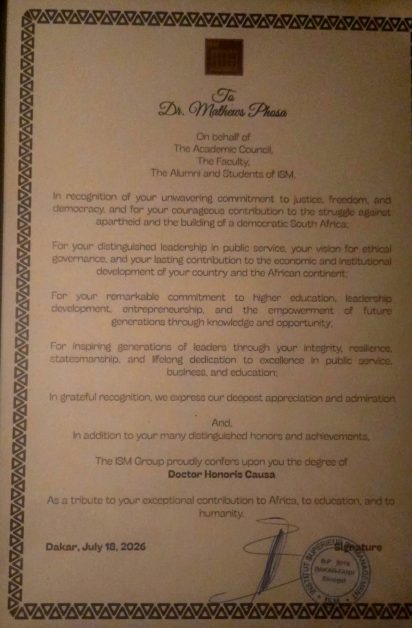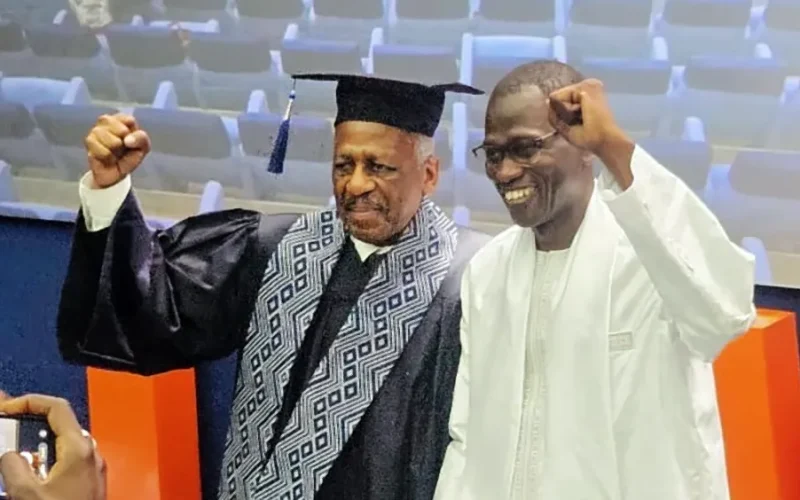
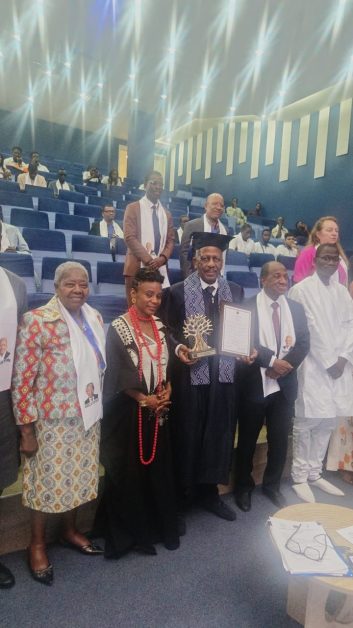
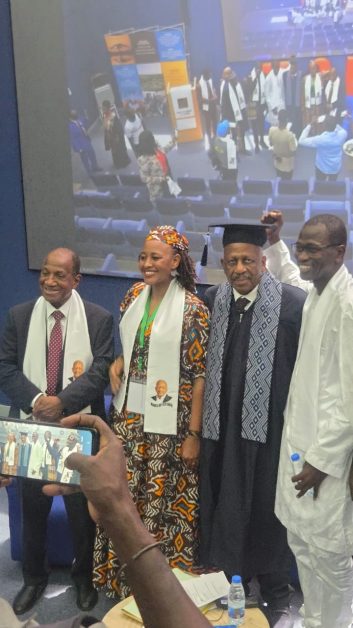
SPEAKING at the Institut Supérieur de Management (ISM) here on Nelson Mandela Day, ANC veteran and businessman Dr Mathews Phosa used the occasion of an honorary doctorate to deliver a pointed assessment of South Africa’s thirty-year democratic experiment, arguing that the country’s constitutional achievements have been steadily eroded by corruption, weakened institutions and the loss of skilled administrators from the public service.
Phosa’s address, delivered under the theme “Nelson Mandela Day: Renewing Africa’s Promise,” moved beyond commemoration to issue a direct challenge to the continent’s political class: political liberation, he argued, was only ever the opening chapter of a longer struggle for dignity, prosperity and technological sovereignty that remains unfinished.
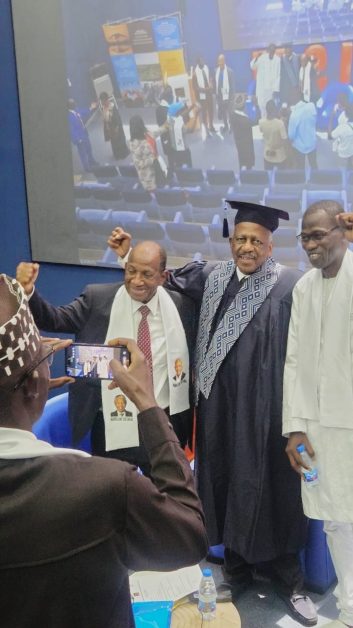
The choice of venue was deliberate. Dakar hosted the 1987 conference between the African National Congress and a delegation of white South African intellectuals and businesspeople – a meeting credited with helping open channels of dialogue nearly seven years before South Africa’s first democratic election. Phosa invoked that history directly, framing the 1987 talks as proof that “dialogue is stronger than division” and that even the deepest political conflicts can be defused when adversaries are willing to engage.
He drew a further parallel between Nelson Mandela and Senegal’s first president, Léopold Sédar Senghor, noting that both men voluntarily relinquished power after limited terms in office – Senghor in 1980, Mandela in 1999 – at a time when many of their contemporaries elsewhere on the continent were entrenching themselves indefinitely.
The most striking section of the address was Phosa’s unsparing account of what he called the corrosion of South Africa’s post-1994 institutions. He acknowledged the real gains of the democratic period – expanded access to housing, healthcare, education, electricity and social protection – but argued these achievements have been undercut by the exit of experienced administrators from government, the politicisation of appointments, and a gradual entrenchment of corruption that he said has cost the country far more than misappropriated funds.
Phosa linked corruption directly to unemployment, undelivered schools and hospitals, and declining public trust, describing it as “a betrayal of the hopes of ordinary people” rather than a purely financial offence. He pointed to the emergence of South Africa’s Government of National Unity as evidence that voters are actively recalibrating their trust in the ANC and the wider political system, framing the coalition arrangement as proof that no party holds an indefinite mandate and that public confidence must be continually re-earned through delivery rather than historical credibility alone.
That argument lands against the backdrop of a run of accountability stories The African Mirror has tracked in recent months – from the Madlanga Commission’s evidence on police-crime syndicate links to the prosecution of senior officials under the National Prosecuting Authority (NPA) and IDAC – which have kept the question of institutional integrity squarely in the national conversation.
/
Six Pillars for Africa’s Next Chapter
Phosa set out a six-pillar framework he argued should anchor the continent’s next phase of development: deeper intra-African trade and investment; cooperation in frontier technologies including artificial intelligence, biotechnology and space science; industrialisation that moves Africa beyond exporting raw materials; mobilisation of African capital for African infrastructure; unified strategic diplomacy; and sustained investment in education, skills and health.
He was explicit that the technology pillar carries particular urgency. Framing sovereignty in the twenty-first century as extending beyond flags and parliaments to “a meaningful voice in the technologies that will shape our economies,” Phosa argued that Africa’s leverage lies less in what lies beneath its soil than in its markets, its young population and its capacity to negotiate collectively rather than compete nation-by-nation for investment on terms set elsewhere. His formulation – that the continent is “open for partnership” but “not for sale” – was among the address’s sharpest lines.
Call for a New Dakar Conference
The address culminated in a concrete proposal: a new Dakar Conference, convened not to commemorate 1987 but to bring together political and business leaders, academics, scientists, young Africans and civil society to confront questions of integration, democratic institutions, job creation, resource beneficiation and the governance of artificial intelligence. Phosa was pointed in warning against the gathering becoming, in his words, another forum remembered chiefly for speeches and unimplemented resolutions, insisting instead on a platform for measurable commitments.
Throughout, Phosa returned to the philosophy of Ubuntu – “I am because we are” – as the ethical frame he argued Africa should bring to global debates over artificial intelligence governance, positioning the continent’s contribution as a set of values rather than only a market or a resource base.
Phosa said: “The challenges before us are immense, but Africa has faced greater challenges before. Our ancestors confronted colonialism. Our liberation movements confronted injustice.
Our leaders confronted division. nd our people chose hope. Today, we face a new generation of challenges: Climate change, economic inequality, technological disruption, threats to peace and security. But we also possess new opportunities.
“We have a young population full of energy, entrepreneurs full of ideas, scientists capable of innovation, communities full of resilience and a continent rich in resources and possibility.
The choice before us is clear. We can remain spectators in the making of history. Or we can become authors of the future. We can allow others to define Africa’s place in the world. Or we can confidently define it ourselves. We can accept dependency. Or we can build partnerships based on mutual respect. We can allow technology to divide humanity.
Or we can ensure that technology strengthens our shared humanity. On this Nelson Mandela Day, we do more than celebrate the birth of an extraordinary man.
We recommit ourselves to the values by which he lived. Service before self. Justice before expediency. Unity before division. Hope before despair.”
A Veteran’s Warning Ahead of 2027
Phosa’s address is notable less for its historical framing than for its willingness, from within ANC ranks, to name corruption and institutional hollowing-out as central failures of the democratic project rather than peripheral irritants. Coming from a veteran of the party’s National Executive Committee and a former Mpumalanga premier, the critique carries a different weight than similar arguments made by opposition figures or civil society, and is likely to be read in Johannesburg and Pretoria as part of an ongoing internal reckoning within the governing alliance as it navigates coalition government under the GNU.
For the wider continent, the speech adds Phosa’s voice to a growing chorus of pan-African figures – from AU technocrats to Global South diplomats – arguing that Africa’s position in the emerging AI and biotechnology order will be determined less by individual national policy than by the continent’s capacity to negotiate as a bloc. Whether his proposed new Dakar Conference gains institutional traction or joins a long list of well-intentioned continental gatherings will depend on whether AU member states and the private sector treat the six-pillar framework as an agenda rather than a rhetorical flourish.