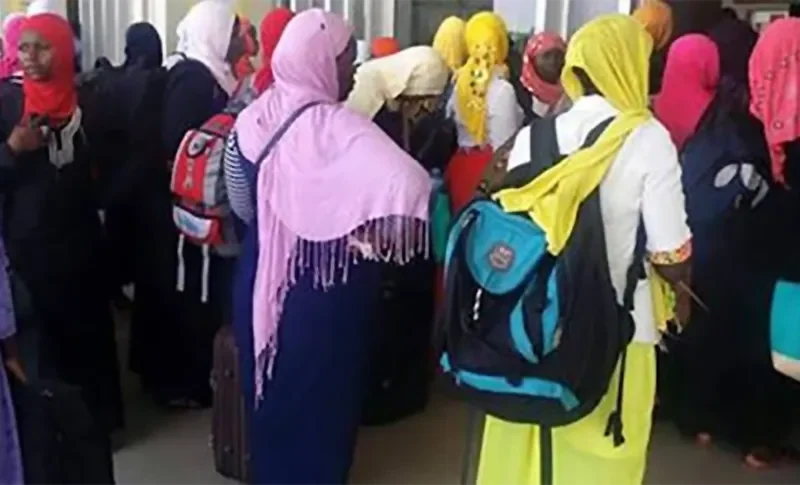
FOR close to a quarter of a century, a well-worn route has carried young Ugandan women out of Kampala’s dense suburbs and into the households of the Gulf. Most land as domestic workers in Oman, Kuwait, the United Arab Emirates and Saudi Arabia, drawn by recruitment agencies and posters promising a wage no local job can match.
New academic research tracking a group of these women between 2018 and 2022, published in The Conversation, has found a labour pipeline defined by brutal contradiction: accounts of confinement, humiliation and sexual violence sit alongside women’s own descriptions of “becoming somebody” through the same migration that broke others.
The scale is significant. International Labour Organisation figures show roughly 270,000 Ugandans migrated to the Middle East between 2016 and 2023 alone, the overwhelming majority into the care sector. Uganda’s own labour ministry has put outflows at close to 2,000 citizens a month, with Saudi Arabia the dominant destination.
Underpinning the risk is the “kafala” sponsorship system, which ties a domestic worker’s legal status directly to her employer. Under it, women cannot change jobs or leave the country without permission — a structure rights groups have repeatedly linked to passport confiscation, unpaid wages, excessive hours, beatings and rape. Researchers and advocates say the pattern amounts to conditions of modern slavery.
Yet the researchers, social scientists studying shifting gender relations in Uganda, argue that treating the women purely as victims misses half the story. Interviewees who survived exploitation also returned with savings no Ugandan wage could have produced — enough, for some, to build a home, educate children or become the acknowledged head of a household in a country where one in three homes is already run by a woman, according to the 2022 demographic survey.
That calculation, the study suggests, is what recruitment agencies exploit and what successive Ugandan interventions have failed to break. Kampala banned women from working as maids in Saudi Arabia and Jordan in 2016 after a wave of abuse reports, only to relax the restriction a year later under new bilateral labour agreements. Legislation on labour externalisation, first passed in 2010 and renewed in 2023, has done little to close the gap between paper protections and what happens once a woman is inside a foreign household with no independent means of leaving.
Uganda’s embassies across the Gulf remain understaffed relative to the numbers they are meant to protect, officials have acknowledged, leaving survivor support to fall largely to non-governmental shelters rather than the state.
The researchers’ conclusion is a challenge to both government and campaigners: protecting migrant domestic workers cannot mean stopping the migration itself, because for many of the women interviewed, the alternative — a life without the income, status or independence the Gulf made possible — was its own kind of confinement.