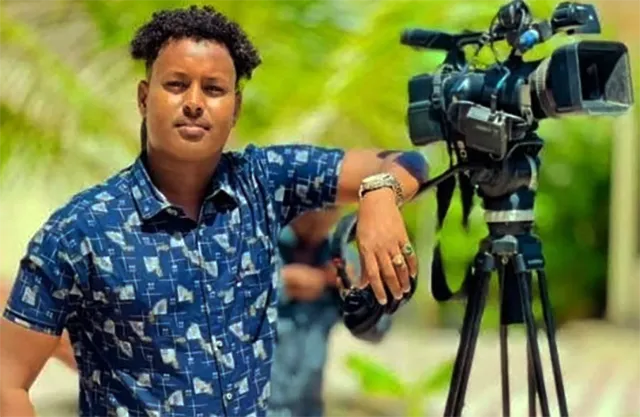
ON a night in early March, freelance journalist Abshir Khalif Shide Omar was returning from an Iftar gathering with colleagues in Kismayo, having just finished editing a programme about politicians scheduled for broadcast that same evening. He never made it home. A police officer shot him dead following a brief altercation in the commercial capital of the autonomous Jubbaland region, some 528 kilometres south of Mogadishu — making him the first journalist killed in Somalia in 2026.
His death is not an aberration. It is the continuation of a documented pattern. The Somali Journalists Syndicate (SJS), releasing its annual State of Press Freedom Report on 10 March 2026, has laid out in granular detail how Somalia and Somaliland have become among the most hostile environments for journalists on the African continent — a crisis of impunity, institutional violence, and increasingly sophisticated methods of suppression that go far beyond the battlefield.
A YEAR OF SYSTEMATIC VIOLENCE
The figures in the SJS report are stark. In 2025 alone, two journalists were killed in Mogadishu. Mohamed Abukar Dabaashe died in an Al-Shabaab suicide bombing in March. Abdifatah Abdi Osman, a television technician known as Arab, was shot dead by a lone gunman in May while on his way to work. Twenty-two journalists sustained beatings and physical assaults by state security forces during the course of their duties. Fourteen of the victims were reporters attacked in Mogadishu, including two women.
In Somaliland, security forces attacked five journalists, one of whom was shot with live ammunition before being beaten. Nine media stations were banned or denied access during the year: five in Southwest State, two in Mogadishu targeted directly by Somali security forces, one local television station closed in Somaliland over its coverage of tensions between Hargeisa and Mogadishu, and the Hadwanaag news website was suspended for a second time after a court had previously lifted a long-standing ban.
“When a journalist is killed in these circumstances, it raises serious concerns about the safety of media workers and the accountability of law enforcement agents.”
NUSOJ Secretary General Omar Faruk Osman
ARBITRARY DETENTION AS A TOOL OF CONTROL
The most pervasive form of repression documented by SJS is not violence but detention — the routine use of arrest and arbitrary imprisonment to silence reporters before their work reaches the public. In 2025, 148 journalists were arrested or arbitrarily detained. Mogadishu led with 118 recorded media violations, including arbitrary detentions, carried out primarily by the National Intelligence and Security Agency (NISA) and the police. Five of these incidents constituted abductions.
In Somaliland, 36 journalists were detained or arrested, concentrated in regions including Erigabo, Sanaag, and Awdal, where heightened inter-clan conflicts created conditions ripe for abuse. Nine violations each were recorded in Southwest and Galmudug states; Puntland committed seven; the Northeastern region detained three reporters; Hirshabelle arrested two; and Jubaland — now the scene of Omar’s killing — detained one journalist.
Critically, nearly 90 percent of those arrested or detained were released without charge — often after one or several days in custody. The pattern reveals detention used not as a judicial tool but as harassment and intimidation: sufficient disruption to interrupt publication cycles, damage source relationships, and induce self-censorship, all without producing a formal legal record.
LEGAL HARASSMENT AND THE SLAPP WEAPON
Beyond arrest, 2025 also saw the growing weaponisation of the legal system against the press. SJS documented nine incidents of legal harassment and Strategic Litigation Against Public Participation (SLAPP) lawsuits — instruments designed not to prevail in court but to financially drain and psychologically exhaust journalists and media organisations into silence. SJS itself was among the targets of such legal action. One case in Puntland State specifically targeted a woman journalist.
The IFJ, responding to the killing of Abshir Khalif Shide Omar, condemned what it characterised as disdain for journalists and media workers. IFJ General Secretary Anthony Bellanger demanded a full investigation and called the shooting both unacceptable and unwarranted. The Jubbaland Police spokesperson, Captain Shukri Farah Du’ale, stated that the officer responsible had been detained and would be taken to court — a commitment that press freedom advocates will be watching closely, given Somalia’s broader record of impunity in journalist killings.
“Such killings cannot go unpunished. We demand a full investigation into Abshir’s killing.”
IFJ General Secretary Anthony Bellanger
WOMEN JOURNALISTS: A CRISIS WITHIN THE CRISIS
The SJS report devotes significant attention to the gendered dimension of the press freedom crisis — and the picture it presents is troubling. Women journalists in Somalia are targeted with a distinct and compounding set of threats: online harassment, intimidation, disinformation campaigns, and now artificial intelligence-facilitated abuse, including voice cloning, manipulated imagery, and fake online content used to shame or professionally destroy female reporters.
Women make up only approximately 20 percent of professional journalists in Somalia. Many receive lower pay than their male counterparts for equivalent work. Structural barriers exclude them from editorial decision-making roles within male-dominated newsroom management structures. Sexual harassment linked to job security and career advancement has been documented. During 2025, with political tensions heightening ahead of the 2026 elections and forced evictions displacing communities across Mogadishu, several women journalists covering these stories were arrested — driving many to avoid posting opinions on social media or accepting reporting assignments that might provoke retaliation.
In Puntland, a woman journalist faced legal threats following street interviews that reportedly angered local authorities in Garowe. Such incidents, the SJS report notes, have generated growing fear and pervasive self-censorship among women in the Somali media. More than 10 percent of all media violations recorded in 2025 affected women journalists.
AN AFRICAN CRISIS THAT DEMANDS AN AFRICAN RESPONSE
Somalia and Somaliland’s press freedom crisis does not exist in continental isolation. Across Africa, the pattern of state actors weaponising detention, legal harassment, and violence against journalists is replicated with concerning regularity — from Nigeria’s Borno State, where reporters covering the Boko Haram and ISWAP insurgency operate under constant threat, to the Democratic Republic of Congo, where conflict-zone journalism carries mortal risk, to the Sahel, where military governments have expelled international correspondents and nationalised information environments.
What distinguishes Somalia’s crisis in 2025 is its breadth and its data trail. The SJS has produced one of the most methodologically rigorous documentation exercises of journalist targeting on the continent — a resource that should serve both as an indictment of the authorities responsible and a call to action for regional bodies including the African Union, the Intergovernmental Authority on Development (IGAD), and the East African Community, none of which has yet mounted a coherent continental response to the systematic destruction of independent media.
As Abshir Khalif Shide Omar’s colleagues prepared to broadcast his final programme, he was killed — his story incomplete, his voice silenced, his death one number in a ledger that grows with each passing month. The SJS annual report is a document of institutional failure: Somalia’s, but also Africa’s. Until accountability matches documentation, the ledger will continue to grow.