THEY LEFT on a chartered flight out of Oliver Reginald Tambo International Airport in Johannesburg in the early hours of this morning — 300 Ghanaian men and women, their belongings reduced to what they could carry, their enterprises abandoned, their South African chapters slammed shut by fear. By the time the aircraft touched down at Kotoka International Airport in Accra, they were no longer migrants chasing opportunity in Africa’s most industrialised economy. They were evacuees. And that word — with all its freight of emergency, danger, and state failure — is the word that will define this moment in continental memory.
The evacuation, approved by Ghanaian President John Dramani Mahama and coordinated by his Foreign Affairs Minister Samuel Okudzeto Ablakwa, is the most dramatic single act in a rapidly escalating diplomatic crisis between Accra and Pretoria. It is also something more: a mirror held up to the soul of post-apartheid South Africa, reflecting an image that the country’s founders — Mandela, Tambo, Sisulu, and the generations who survived because Africans elsewhere sheltered them — would struggle to recognise.
We did not walk alone into freedom. We were carried by a tide of solidarity from the nations of Africa.
President Cyril Ramaphosa, Freedom Day, 27 April 2026
South Africa’s own president spoke those words exactly one month ago today. They were not rhetorical excess. They were historical truth. Ghana’s Kwame Nkrumah was among the first African leaders to open his doors to the ANC in exile. Accra hosted cadres, funded movements, and offered moral authority when Pretoria was a synonym for state terrorism. That history is not ancient. Many of the Ghanaians now landing at Kotoka were born while that solidarity was still a living political fact.
Yet here they are. Coming home not in triumph but in trauma.
THE ANATOMY OF A CRISIS
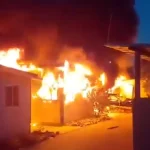
The trigger for this week’s evacuation was a surge of anti-immigrant protests that swept through Gauteng, KwaZulu-Natal, and the Eastern Cape, driven by a movement calling itself ‘March and March’, which issued an ultimatum demanding that all foreign nationals leave South Africa before the end of June. The demonstrations — which South African authorities have insisted were lawful expressions of free speech — produced something that felt, to those at their receiving end, indistinguishable from a pogrom of terror.
A widely circulated video of a Ghanaian man being physically assaulted while a crowd demanded proof of his immigration papers became the flashpoint. Ghana’s High Commissioner to South Africa, Benjamin Quashie, confirmed that by the time screening and verification exercises were conducted in Pretoria last Sunday, 826 Ghanaians had registered with the High Commission seeking to go home. More than 16,000 Ghanaians live in South Africa — the vast majority legally, as Quashie pointedly noted — and even a fraction seeking evacuation represents a crisis of confidence in South Africa as a safe destination for African lives.
The Ghanaian Government’s response has been swift, structured and deliberately symbolic. The Ministry of Foreign Affairs has announced a multi-layered reintegration package for returnees: a welcome-home financial grant, transport to their home districts, a reintegration allowance, free psychosocial support, and registration in a national database for employment and entrepreneurship opportunities. It is an acknowledgement that these citizens did not fail — they were failed.
826 Ghanaians registered for evacuation. More than 16,000 Ghanaians live in South Africa — the vast majority legally.
PRETORIA’S DENIAL AND ITS CONSEQUENCES
South Africa’s official response to this crisis has followed a now-familiar template. The government has condemned violence, assured affected embassies of its commitment to protecting foreign nationals, and consistently rejected the framing of events as xenophobia — insisting instead that the protests reflect legitimate constitutional expression by citizens frustrated by illegal immigration. South Africa’s International Relations Minister Ronald Lamola has personally initiated calls to counterpart ministers across the continent to manage the diplomatic fallout.
The position is untenable, and the continent increasingly knows it. There is a profound difference between protesting immigration policy and physically assaulting a man in the street while demanding to see his papers. There is a difference between calling for law enforcement on undocumented migrants and organising marches that terrorise entire communities of people — many of them, as in the Ghanaian case, entirely documented and legal. Pretoria’s semantic gymnastics around the word ‘xenophobia’ does not change the lived experience of those who fled.
The repatriation of Emmanuel Asamoah — a Ghanaian businessman who returned on May 5 after what his government called xenophobic harassment, and who subsequently received a GH¢200,000 donation from businessman Ibrahim Mahama alongside a pledge to rebuild his livelihood — was an early signal that Accra would not absorb this quietly. The establishment of Ghana’s formal evacuation apparatus confirmed it.
Ghana has gone further still. Accra has formally petitioned the African Union Commission to place xenophobic attacks in South Africa on the agenda of the Eighth AU Mid-Year Coordination Meeting, scheduled for Cairo on 24–27 June 2026. The diplomatic letter from the Ghanaian Government described the recurring violence against African migrants as a matter of urgent continental concern that undermines African solidarity — particularly given, the letter noted with pointed historical awareness, the continent’s material support for South Africa during the anti-apartheid struggle.
A CONTINENTAL WOUND
Ghana is not alone in its alarm. Nigeria has confirmed that over 130 of its citizens formally requested emergency evacuation. Kenya, Malawi, Lesotho, and Zimbabwe have issued urgent safety advisories urging their nationals to remain indoors. Other African nations have urged extreme caution. What began as a domestic South African political moment — the volatile intersection of 32 percent unemployment, surging youth frustration, and opportunistic political mobilisation — has metastasised into a continental diplomatic emergency.
The deeper tragedy is structural and historical. South Africa’s xenophobic violence did not begin in 2026. The country has experienced recurring waves of anti-immigrant brutality since 2008 — a year when dozens of people were killed and tens of thousands displaced in pogroms that shocked the world. The 2015 violence. The 2019 attacks prompted Nigeria to recall its ambassador and sparked retaliatory attacks on South African businesses across West Africa. The pattern is not a series of isolated incidents. It is a chronic condition, periodically exacerbated by political demagogy, and never decisively addressed.
Each time, South Africa’s government condemns and promises. Each time, the international community expresses concern and moves on. Each time, the next wave comes. What is different in 2026 is the organised, coordinated nature of the ultimatum being issued to foreign nationals — and the speed with which African governments, no longer willing to absorb the diplomatic insult quietly, have responded with concrete protective action.
What began as a domestic political moment has metastasised into a continental diplomatic emergency.
THE HUMAN COST BEHIND THE NUMBERS
It is easy, in the language of diplomacy and policy, to lose sight of what 300 human beings on a chartered flight actually represent. These are people who built lives. Who opened shops, laid trade connections, raised children in South African schools, paid rent and taxes, and contributed to an economy that desperately needs productive participants. They are people who are landing today in Accra carrying trauma that no reintegration allowance will fully address — the specific psychological wound of being driven from a country by hatred.
Psychosocial support, as Ghana’s government has promised, is not a bureaucratic nicety. The psychological literature on forced displacement and hate-driven persecution is clear: the damage is long-term, and it is compounded when the perpetrating society refuses to name what happened. When South Africa insists these were merely ‘protests’, it compounds the injury of those who experienced them as persecution. Naming matters. Truth matters. The refusal to call xenophobia by its name is itself a form of epistemic violence against the survivors.
There are also the businesses. The livelihoods. The savings accounts were cleaned out or abandoned. Emmanuel Asamoah, whose assault became the catalyst for this crisis, lost not just his safety but his commercial life. He is one. Behind the 300 evacuating today are hundreds more in South Africa, calculating their choices — weighing years of investment against the reality that the state cannot or will not protect them from organised hatred.
WHAT SOUTH AFRICA OWES, AND WHAT IT MUST CONFRONT
President Ramaphosa’s Freedom Day words deserve to be read again — not as condemnation but as a challenge South Africa has issued to itself. ‘South Africa should never trample into the dust the African fellowship that made our freedom possible.’ That is not a foreign critic speaking. That is South Africa’s own head of state, grappling with a national failure that his government has thus far proven unable to arrest.
The political economy of South Africa’s xenophobia is real and cannot be dismissed with moral exhortation alone. Thirty-two percent unemployment is not an abstraction. Youth unemployment in excess of 60 percent in some provinces is not a rhetorical device. The pressure on housing, on public services, on the informal economy — these are genuine grievances that generate genuine anger. But the direction of that anger — toward African migrants rather than toward the structural failures of a post-apartheid state that has not delivered on its promises to its own people — is a political choice, and a politically dangerous one.
When demagogues channel legitimate economic anxiety into ethnic and national hatred, they do not solve unemployment. They destroy trade networks. They drive away skills and enterprise. They fracture the regional economic ecosystems on which South Africa’s own long-term prosperity depends. The West African traders, the Zimbabwean engineers, the Congolese entrepreneurs — the human capital being driven out of South Africa is not the cause of its problems. It is, in significant part, a resource it is burning.
And it is paying a diplomatic price that will compound. The AU agenda item Ghana has requested is not merely symbolic. It places South Africa in the uncomfortable position of having its domestic failures aired in a continental forum it helped build. It creates precedent. It changes the terms of engagement.
ACCRA’S WELCOME, AND AFRICA’S RECKONING
At Kotoka International Airport today, immigration officers, health officials and social welfare practitioners received the evacuees. Ghana’s Foreign Ministry had made sure of that. There would be buses to take people to their home regions. There would be psychological counsellors. There would be a database waiting to connect shattered entrepreneurs with new opportunities.
It is, in its careful preparation and human dignity, everything that South Africa’s handling of foreign nationals in distress has not been. And that contrast — between a small West African state moving heaven and earth to restore the dignity of its people, and Africa’s most powerful economy failing to protect its continental neighbours from hatred on its streets — is the story of this week in African history.
The 300 Ghanaians who land in Accra today are not statistics. They are the living evidence of a continental crisis that South Africa must now confront honestly — not in the language of constitutional rights to protest, but in the language of moral responsibility to the continent that carried it to freedom.
KEY FACTS AT A GLANCE
▸ 300 Ghanaians evacuated today on a chartered flight from OR Tambo to Kotoka International Airport, Accra
▸ 826 Ghanaians registered for evacuation with Ghana’s High Commission in Pretoria
▸ 16,000+ Ghanaians are estimated to live in South Africa, the majority legally
▸ 130+ Nigerian citizens have also formally requested emergency evacuation
▸ Kenya, Malawi, Lesotho and Zimbabwe have issued urgent safety advisories to their nationals in South Africa
▸ Ghana has formally petitioned the AU to place xenophobic attacks in South Africa on the agenda of the June 2026 Mid-Year Coordination Meeting in Cairo
▸ 32% South Africa’s official unemployment rate; youth unemployment exceeds 60% in some provinces