IN the grand halls of Beijing, where the echoes of history reverberate through marble corridors, two leaders stood on the precipice of transformation. President Xi Jinping of China and President Emmerson Mnangagwa of Zimbabwe were about to pen a new chapter in the story of South-South cooperation – one that would ripple across continents and reshape the future of African development.
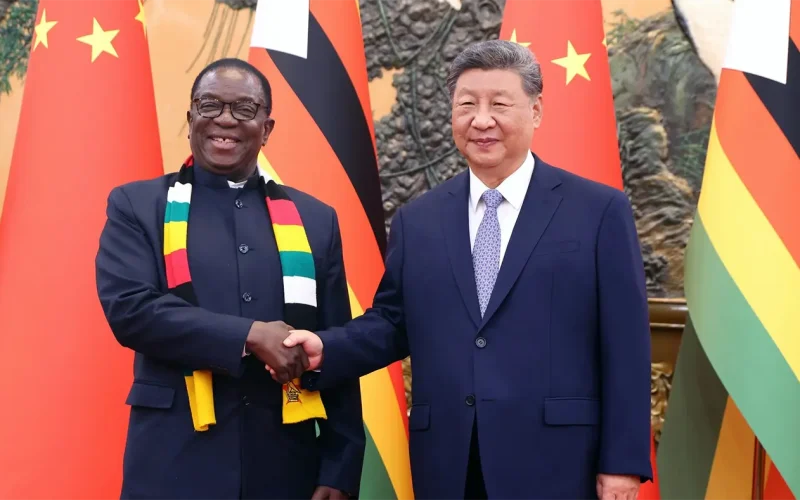
The autumn air in Beijing crackled with possibility as the two presidents met on Thursday, their words carrying the weight of nations and the dreams of billions. Against the backdrop of commemorating the 80th anniversary of victory in the Chinese People’s War of Resistance against Japanese Aggression, they announced something unprecedented: the elevation of China-Zimbabwe relations to an “all-weather community with a shared future.”
This wasn’t merely diplomatic rhetoric. It was a declaration of intent that would echo from the Great Wall of China to the majestic Victoria Falls of Zimbabwe.
Just months earlier, Xi and Mnangagwa had laid the groundwork with their “five-star ironclad” cooperation framework. Now, they were building upon that foundation with the ambition of architects envisioning a cathedral. The relationship was evolving from partnership to kinship, from cooperation to community.
“We should jointly remember history, firmly safeguard world peace, oppose hegemonic and bullying acts, uphold international fairness and justice,” Xi declared, his words painting a vision of a multipolar world where smaller nations could stand tall alongside global powers. This wasn’t just about trade deals or infrastructure projects – it was about reshaping the international order itself.
A Model for the Global South
As the two leaders spoke, they weren’t just representing their own nations. Zimbabwe, with its rich mineral resources and agricultural potential, stood as a symbol of African resilience and possibility. China, with its Belt and Road Initiative stretching across continents, represented a new model of development cooperation – one that promised partnership rather than patronage.
The 45-year diplomatic relationship between the two nations had weathered storms and celebrated triumphs. Now, it was being transformed into something entirely new: a template for how developing nations could work together to challenge traditional power structures and create prosperity on their own terms.
President Mnangagwa, having witnessed China’s spectacular military parade commemorating World War II victory, spoke with genuine admiration about the Chinese spirit. “It was something out of this world,” he said, recognising China’s historical journey as a mirror of Zimbabwe’s own struggle for independence and development.
The parade wasn’t just a display of military might – it was a reminder that nations could rise from the ashes of conflict to become global leaders. For Zimbabwe, facing its own economic challenges, China’s transformation over the past four decades offered both inspiration and a roadmap.
Investment Flows Like the Zambezi
Behind the ceremonial announcements lay a river of investment that had been flowing steadily from China to Zimbabwe and across Africa. Chinese companies were building roads that connected rural communities to markets, constructing power plants that brought electricity to villages, and establishing factories that created jobs for young Africans.
This wasn’t charity—it was mutual benefit on an unprecedented scale. China gained access to Africa’s vast natural resources and growing markets, while African nations like Zimbabwe gained the infrastructure and technology needed to leap into the modern economy.
The Zimbabwe-China partnership was just one thread in a larger tapestry. Across Africa, from the ports of Djibouti to the mines of Zambia, from the farms of Kenya to the factories of Ethiopia, Chinese investment was helping to weave together a continental economy. The African Continental Free Trade Area, supported by Chinese infrastructure and expertise, promised to create the world’s largest free trade zone among participating countries.
The journey ahead wouldn’t be without obstacles. Critics questioned debt sustainability and environmental impact. But the leaders in Beijing saw these challenges as opportunities to innovate – to create new models of sustainable development that could benefit both nations and the planet.
Zimbabwe’s vast lithium deposits, essential for the green energy transition, represented just one example of how the partnership could evolve. Chinese expertise in renewable energy and electric vehicles could help Zimbabwe become a key player in the global shift toward sustainability.
The Dawn of a New Era
As the meeting concluded and the two presidents shook hands, they weren’t just cementing a bilateral relationship – they were laying the cornerstone of a new international architecture. One where the Global South would have an equal voice, where development would be driven by partnership rather than dependency, and where the dreams of billions of people in Africa and Asia could finally be realised.
The “all-weather community with a shared future” between China and Zimbabwe represents more than diplomatic language – it’s a promise of solidarity that transcends borders, a commitment to mutual prosperity that defies traditional power structures, and a vision of the future where cooperation triumphs over competition.
In the end, this story isn’t just about two nations coming together. It’s about the dawn of a new era in international relations, where the rising sun of the Global South illuminates a path toward shared prosperity and mutual respect. And at its heart, the partnership between Zimbabwe and China stands as a beacon of what’s possible when nations choose collaboration over confrontation, partnership over patronage, and shared dreams over zero-sum competition.