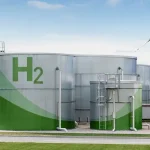
THE signing of the declaration of intent by the parties involved in a hydrogen “corridor” linking Algeria and Tunisia to Europe confirms the big bet that Europe is placing on Africa’s green hydrogen potential and the continent’s vital role in the global energy transition to renewables.
Representatives from Germany, Algeria, Italy, Austria, and Tunisia were in Rome last week for the signing of the declaration, which greenlights the development of the Southern Hydrogen Corridor (SoutH2), a 3300 km hydrogen pipeline from North Africa to Europe.
According to Philip Nimmermann, Germany’s representative who signed on behalf of the Federal Ministry for Economic Affairs and Climate Protection (BMWK), the SoutH2 project is “one of the largest and most important renewable energy projects of our time.”
“We can use North Africa’s immense potential for renewable energies, advance the hydrogen ramp-up in Germany, and support the EU’s climate goals,” he explained in a statement by the BMWK.
SoutH2 envisages the transportation of four million metric tons of hydrogen per year by pipeline from projects in Algeria and Tunisia to Italy and on to markets in Austria and Germany. The corridor is expected to be operational as early as 2030, according to the project’s website.
The EU aims to lead in green hydrogen with a target of 10 million tons of domestic production and 10 million tons of imports by 2030, backed by key investors like the European Investment Bank.
According to Hydrogen Insight, meeting the EU’s green hydrogen targets will require over US$130 billion in investments, much of which could flow to Africa, a growing hub for projects with the necessary capacity. Europe’s rising demand has already driven European countries to invest in Africa’s abundant green resources to meet their mounting needs.
Germany, for instance, is leading all European African countries in green hydrogen projects in Africa. According to Energy for Growth, a global energy think tank, the EU is responsible for nearly 80% of all green hydrogen energy commitments active on the continent today.
With SoutH2 expected to deliver 163 TWh of hydrogen annually (4.89 million metric tons) to European markets, with 55 TWh delivered to Germany alone, Germany leads in the financing of green hydrogen projects.
In addition to SoutH2, other hydrogen projects across Africa are also attracting significant German interest. A high-level German delegation attended Namibia’s hydrogen summit in September last year, underscoring growing collaboration.
Germany is also invested in Tunisia’s H2 Notes project, Angola’s H2-Greenforce, and Mauritania’s Conjuncta deal for 8 million tonnes of green hydrogen annually, with up to 10 gigawatts of electrolyser capacity.
Despite the West’s continued interest, experts cast problems in the actualisation of the projects on course in Africa, with the lion’s share of the proposed projects in the concept phase.
According to Energy for Growth, most active deals on the continent and globally are publicly financed. Deals in Africa that are publicly financed to date amount to more than US$8 billion. However, according to the think tank, about 92% of these deals lack supportive detail and thus cannot be justified.
In fact, a new report by the Energy Industries Council, EIC, on January 23, 2025, shows there are now more than 40 green hydrogen projects in Africa scheduled to take a final investment decision (FID) by 2030 spread across nine countries: Algeria, Djibouti, Egypt, Mauritania, Morocco, Namibia, South Africa, Tunisia, and Zimbabwe.
However, the energy supply-chain trade association highlights the fact that these projects are still facing “serious challenges” to realisation.
According to Neil Golding, EIC’s director of market intelligence, “While the longer-term outlook looks positive for the hydrogen sector, no commercial-scale project has yet reached a final investment decision.”
“Offtake agreements need to be signed and demand created for the projects to be commercially viable. At the same time, we see the need for regulatory frameworks to be established and the development of robust infrastructure.”
However, there are projects that are in advanced stages that cast light on the market viability of green hydrogen from Africa for export.
In July 2024, at the Egypt-EU Investment Conference, the German government signed a green hydrogen offtake deal with the Egyptian government, marking the first renewable hydrogen market in Africa. The deal involved Scatec ASA’s Egypt Green Hydrogen Project, which signed a 20-year offtake agreement with Fertiglobe.
Egypt’s National Green Hydrogen Strategy aims to hold 8% of the global hydrogen market and produce 10 million tons of green hydrogen annually by 2050, with a significant portion destined for export.
The Oshivela plant in Namibia also signed an offtake agreement with German metals processing firm Benteler for 200,000 metric tons a year of hydrogen-reduced iron. The plant is due to start operations of its first phase, which will produce 15,000 metric tons per year, in early 2025.
Namibia’s Hyphen Hydrogen project has also in the past announced securing over 1 million mt/year in green ammonia offtake deals, including 250,000 mt/year with South Korea’s Approtium, 500,000 mt/year with an undisclosed chemical giant, and 300,000 mt/year with RWE Supply and Trading. The renewable-powered plant is set to launch in 2027.
At the Coega Special Economic Zone in South Africa, Hive Energy’s US$5.8 billion project in March 2024, unveiled Itochu Corporation, as the Japanese partner who will offtake green hydrogen to be generated from the facility.
A 2022 report by the European Investment Bank, the Solar Alliance, and the AU highlights the immense economic potential of exporting green hydrogen. According to the report, Africa could make US$1.1 trillion by 2035 from the sale and use of green hydrogen.